Direct Neutrino Mass Measurements 5 th International Symposium on - - PowerPoint PPT Presentation

direct neutrino mass measurements
SMART_READER_LITE
LIVE PREVIEW

Direct Neutrino Mass Measurements 5 th International Symposium on - - PowerPoint PPT Presentation

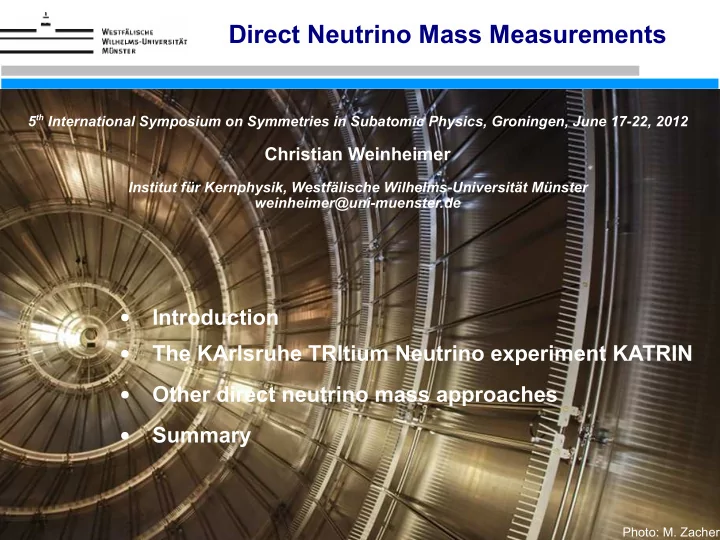
Direct Neutrino Mass Measurements 5 th International Symposium on Symmetries in Subatomic Physics, Groningen, June 17-22, 2012 Christian Weinheimer Institut fr Kernphysik, Westflische Wilhelms-Universitt Mnster weinheimer@uni-muenster.de


slide-1
SLIDE 1

SSP 2012, Groningen, June 21, 2012 1 Christian Weinheimer

  • Introduction
  • The KArlsruhe TRItium Neutrino experiment KATRIN
  • Other direct neutrino mass approaches
  • Summary

Direct Neutrino Mass Measurements

5th International Symposium on Symmetries in Subatomic Physics, Groningen, June 17-22, 2012

Christian Weinheimer

Institut für Kernphysik, Westfälische Wilhelms-Universität Münster weinheimer@uni-muenster.de

Photo: M. Zacher

slide-2
SLIDE 2

SSP 2012, Groningen, June 21, 2012 2 Christian Weinheimer

νe νµ ντ

ν1 ν2 ν3

Results of recent oscillation experiments: Θ23, Θ12, Θ13, Δm2

23, Δm2 12

0.001 0.01 0.1 1

Ω Δm2

23

Δm2

12

hierarchical masses

e.g. seesaw mechanism type 1 explains smallness of masses, but not mixing

degenerated masses

cosmological relevant e.g. seesaw mechanism type 2

Hot Dark Matter: neutrinos Their contribution depends on mν

Relics from the hot plasma after the big bang (like CMB): 336 ν / cm3

slide-3
SLIDE 3

SSP 2012, Groningen, June 21, 2012 3 Christian Weinheimer

1) Cosmology very sensitive, but model dependent compares power at different scales current sensitivity: Σm(νi)  0.5 eV e.g. S. Hannestad, Prog. Part. Nucl. Phys. 65 (2010) 185 2) Search for 0νββ Sensitive to Majorana neutrinos Evidence for mee(ν) 0.3 eV ? GERDA is running, EXO delivered 1st limit ! mββ(ν) = | Σ |Uei

2| eiα(i) m(νi)|

3) Direct neutrino mass determination: No further assumptions needed. no model dependence use E2 = p2c2 + m2c4  m2(ν) is observable mostly most sensitive methode: endpoint spectrum of β-decay m2(νe) = Σ |Uei

2| m2(νi)

Three complementary ways to the absolute neutrino mass scale

slide-4
SLIDE 4

SSP 2012, Groningen, June 21, 2012 4 Christian Weinheimer

averaged neutrino mass

Need: low endpoint energy  Tritium 3H, (187Re) very high energy resolution & very high luminosity &  MAC-E-Filter very low background (or bolometer for 187Re)

Direct determination of m(νe) from β decay

β decay: (A,Z) (A,Z+1)+ + e- + νe

β electron energy spectrum: dN/dE = K F(E,Z) p Etot (E0-Ee) Σ |Uei|2 (E0-Ee)2 – m(νi)2

(modified by electronic final states, recoil corrections, radiative corrections) Complementary to 0νββ and cosmology Complementary to 0νββ and cosmology Review: E.W. Otten & C. Weinheimer

  • Rep. Prog. Phys., 71 (2008) 086201

Review: E.W. Otten & C. Weinheimer

  • Rep. Prog. Phys., 71 (2008) 086201
slide-5
SLIDE 5

SSP 2012, Groningen, June 21, 2012 5 Christian Weinheimer

Tritium experiments: source  spectrometer MAC-E-Filter

Magnetic Adiabatic Collimation + Electrostatic Filter (A. Picard et al., Nucl. Instr. Meth. 63 (1992) 345)

  • Two supercond. solenoids

compose magnetic guiding field

  • adiabatic transformation:

µ = E/B = const.  parallel e- beam

  • Energy analysis by
  • electrostat. retarding field

ΔE = EBmin/Bmax = 0.93 eV (KATRIN) sharp integrating transmission function without tails 

slide-6
SLIDE 6

SSP 2012, Groningen, June 21, 2012 6 Christian Weinheimer

The Mainz Neutrino Mass Experiment Phase 2: 1997-2001

After all critical systematics measured by own experiment (atomic physics, surface and solid state physics: inelastic scattering, self-charging, neighbour excitation):

m2(ν) = -0.6 ± 2.2 ± 2.1 eV2  m(ν) < 2.3 eV (95% C.L.)

  • C. Kraus et al., Eur. Phys. J. C 40 (2005) 447

slide-7
SLIDE 7

SSP 2012, Groningen, June 21, 2012 7 Christian Weinheimer

The Troitsk Neutrino Mass Experiment

windowless gaseous T2 source, similar to LANL MAC-E-Filter, similar to Mainz Energy resolution: ΔE = 3.5eV 3 electrode system in 1.5m diameter UHV vessel (p<10-9 mbar) Luminosity: L = 0.6cm2

(L = ΔΩ/2π * Asource)

Vladimir Mikhailovich Lobashev 1934-2011

Re-analysis of Troitsk data

(better source thickness, better run selection) Aseev et al, Phys. Rev. D 84, 112003 (2011) mβ < 2.2 eV, 95% CL

slide-8
SLIDE 8

SSP 2012, Groningen, June 21, 2012 8 Christian Weinheimer

70 m windowless gaseous molecular tritium source tritium retention system pre spectro- meter main spectrometer detector

The KATRIN experiment at KIT

  • very high energy resolution

(ΔE  1eV, i.e. σ = 0.3 eV) source  spectrometer concept

  • strong, opaque source

dN/dt ~ Asource

  • magnetic flux conservation (Liouville)

scaling law: Aspectrometer / Asource = Bsource / Bspectrometer = E / ΔE = 20000 / 1

KATRIN Design Report

Scientific Report FZKA 7090)

Aim: m(νe) sensitivity of 200 meV (currently 2 eV)

10m

slide-9
SLIDE 9

SSP 2012, Groningen, June 21, 2012 9 Christian Weinheimer

WGTS: tub in long superconducting solenoids  9cm, length: 10m, T = 30 K Tritium recirculation (and purification) pinj = 0.003 mbar, qinj = 4.7Ci/s allows to measure with near to maximum count rate using ρd = 5  1017/cm2 with small systematics check column density by e-gun, T2 purity by laser Raman

T2

Molecular Windowless Gaseous Tritium Source WGTS

slide-10
SLIDE 10

SSP 2012, Groningen, June 21, 2012 10 Christian Weinheimer

  • S. Grohmann,

Cryogenics 49,

  • No. 8 (2009) 413
  • S. Grohmann,

Cryogenics 49,

  • No. 8 (2009) 413

Very successful cool-down and stability tests of the WGTS demonstrator

p r e l i m i n a r y

beam tube Ø=90mm

arrival of WGTS demonstrator at KIT: April 2010

cooling concept of WGTS: pressurized 2-phase Ne Currently: tests of sc magnets, constructing of WGTS

  • ut of demonstrator
slide-11
SLIDE 11

SSP 2012, Groningen, June 21, 2012 11 Christian Weinheimer

Transport and differential & cryo pumping sections

Molecular windowless gaseous tritium source

< 2.5 10-14 mbar l/s T2-injection 1.8 mbar l/s (STP) = 1.7*1011 Bq/s = 40 g/d

Differential pumping

 10-7 mbar l/s

 adiabatic electron guiding & T2 reduction factor of ~1014 Cryogenic pumping

with Argon snow at LHe temperatures (successfully tested with the TRAP experiment) FT-ICR Penning traps to measure ions from WGTS FT-ICR Penning traps to measure ions from WGTS

slide-12
SLIDE 12

SSP 2012, Groningen, June 21, 2012 12 Christian Weinheimer

gas inlet ≈ 3×10¹⁷ molecules/s

  • utgoing

gas flow ≈ 3×10¹² molecules/s

First gas flow reduction measurements with Ar

Commissioning of DPS2-F

FT-ICR Penning traps:

  • M. Ubieto-Diaz et al.,
  • Int. J. Mass. Spectrom.

288 (2009) 1-5 FT-ICR Penning traps:

  • M. Ubieto-Diaz et al.,
  • Int. J. Mass. Spectrom.

288 (2009) 1-5 Ion test source:

  • S. Lukic et al.,
  • Rev. Scient. Instr.

82 (2011) 013303 Ion test source:

  • S. Lukic et al.,
  • Rev. Scient. Instr.

82 (2011) 013303

  • S. Lukic et al.,

Vacuum 86 (2012) 1126

Currently: Problem of a broken diode from the safety system

  • f a superconducting coil
slide-13
SLIDE 13

SSP 2012, Groningen, June 21, 2012 13 Christian Weinheimer

  • 40 -30 -20 -10 0 +10

distance from analysing plane [m] B-field [T]

1:20000

Electromagnetic design: magnetic fields

ΔE = E  Bmin / Bmax = E 1 / 20000 = 0.93 eV

aircoils: axial field shaping + earth field compensation

slide-14
SLIDE 14

SSP 2012, Groningen, June 21, 2012 14 Christian Weinheimer PINCH MAGNET DETECTOR MAGNET DETECTOR SUPPORT STRUCTURE VACUUM, CALIBRATION SYSTEM ELECTRONICS

electrons   

The detector

Requirements

  • detection of β-electrons (mHz to kHz)
  • high efficiency (> 90%)
  • low background (< 1 mHz)

(passive and active shielding)

  • good energy resolution (< 1 keV)

Properties

  • 90 mm Ø Si PIN diode
  • thin entry window (50nm)
  • detector magnet 3 - 6 T
  • post acceleration (30kV)

(to lower background in signal region)

  • segmented wafer (145 pixels)

→ record azimuthal and radial profile of the flux tube → investigate systematic effects → compensate field inhomogeneities

slide-15
SLIDE 15

SSP 2012, Groningen, June 21, 2012 15 Christian Weinheimer

KATRIN detector is being commissioned at KIT

slide-16
SLIDE 16

SSP 2012, Groningen, June 21, 2012 16 Christian Weinheimer

Main Spectrometer – Transport to Karlsruhe Institute of Technology

Leopoldshafen, 25.11.06

8800 km

slide-17
SLIDE 17

SSP 2012, Groningen, June 21, 2012 17 Christian Weinheimer

Secondary electrons from wall/electrode by cosmic rays, environmental radioactivity, ... New: wire electrode on slightly more negative potential Mainz V (2004)

KATRIN has a 100-times larger surface, but requests same bg → something new

       e- U-ΔU U µ γ Mainz 2001-2004

slide-18
SLIDE 18

SSP 2012, Groningen, June 21, 2012 18 Christian Weinheimer

Design, construction and mounting of the 690m2 2-layer wire electrode system

Foto: Peter Lessmann

Requirements:

  • 200 µm precision
  • out-bakeable 350 oC
  • 10-11 mbar compatiible
  • 1 kV difference voltage
  • non magnetic
  • ...
slide-19
SLIDE 19

SSP 2012, Groningen, June 21, 2012 19 Christian Weinheimer

All 248 modules are installed, January 31, 2012

Two-layer wire electrode modules installation inside main spectrometer

slide-20
SLIDE 20

SSP 2012, Groningen, June 21, 2012 20 Christian Weinheimer

Background from stored electrons: methods to avoid or to eliminate them

Stored electron by magnetic mirrors

  • F. Fränkle et al., Astropart. Phys. 35 (2011) 128

Radon suppression by LN2 cooled baffle radial E x B drift due to electric dipole pulse Nulling magnetic field by magn. pulse Mechanical eliminating stored particles:

  • M. Beck et al, Eur. Phys. J. A44 (2010) 499
slide-21
SLIDE 21

SSP 2012, Groningen, June 21, 2012 21 Christian Weinheimer

Radon elimination by LN2-cooled baffles in the main spectrometer

pre spectrometer baffle prototype with NEC pump

Main spectrometer vessel is closed Commissioning of main spectrometer with detector and e-gun ist starting in fall 2012 Main spectrometer vessel is closed Commissioning of main spectrometer with detector and e-gun ist starting in fall 2012

slide-22
SLIDE 22

SSP 2012, Groningen, June 21, 2012 22 Christian Weinheimer

As smaller m(ν) as smaller the region of interest below endpoint E0 → quantum mechanical thresholds help a lot ! A few contributions with Δmν

2

 0.007 eV2 each:

Systematic uncertainties

  • 1. inelastic scatterings of β´s inside WGTS
  • dedicated e-gun measurements, unfolding of response fct.
  • 2. fluctuations of WGTS column density (required < 0.1%)
  • rear detector, Laser-Raman spectroscopy, T=30K stabilisation,

e-gun measurements

  • 3. WGTS charging due to remaining ions (MC: ϕ < 20mV)
  • monocrystaline rear plate short-cuts potential differences
  • 4. final state distribution
  • reliable quantum chem. calculations
  • 5. transmission function
  • detailed simulations, angular-selective e-gun measurements
  • 6. HV stability of retarding potential on ~3ppm level required
  • precision HV divider (with PTB), monitor spectrometer beamline

tritium source spectrometer

slide-23
SLIDE 23

SSP 2012, Groningen, June 21, 2012 23 Christian Weinheimer

KATRIN Mainz

□ m = 0.5 eV ○ m = 0.35 eV

  • m = 0 eV

KATRIN´s sensitivity

Example of KATRIN simulation & fit (last 25eV below endpoint, reference):

sensitivity: mν < 0.2eV (90%CL) discovery potential: mν = 0.3eV (3σ) mν = 0.35eV (5σ)

Expectation for 3 full data taking years: σsyst ~ σstat Sensitivity is still statistically limited, because with more statistics would go closer to the endpoint, where most systematics nearly vanish Sensitivity still has to proven, but there might be even some more improvements

slide-24
SLIDE 24

SSP 2012, Groningen, June 21, 2012 24 Christian Weinheimer

KATRIN Mainz

□ m = 0.5 eV ○ m = 0.35 eV

  • m = 0 eV

KATRIN´s sensitivity

Example of KATRIN simulation & fit (last 25eV below endpoint, reference):

sensitivity: mν < 0.2eV (90%CL) discovery potential: mν = 0.3eV (3σ) mν = 0.35eV (5σ)

Expectation for 3 full data taking years: σsyst ~ σstat Sensitivity is still statistically limited, because with more statistics would go closer to the endpoint, where most systematics nearly vanish Sensitivity still has to proven, but there might be even some more improvements KATRIN will improve the sensitivity by 1 order of magnitude will check the whole cosmological relevant mass range will detect degenerate neutrinos (if they are degen.) KATRIN can also searching sterile neutrinos by looking for a kink in the decay spectrum: dN/dE = K F(E,Z) p Etot (E0-Ee) Σ |Uei|2 (E0-Ee)2 – m(νi)2 eV scale (reactor anomaly):

  • J. A. Formaggio, J. Barret, PLB 706 (2011) 68
  • A. Sejersen Riis, S. Hannestad, JCAP02 (2011) 011
  • A. Esmaili, O.L.G. Peres, arXiv:1203.2632

keV scale (dark matter): under study

nactive + nsterile i=1

slide-25
SLIDE 25

SSP 2012, Groningen, June 21, 2012 25 Christian Weinheimer

Measures all energy except that

  • f the neutrino

detectors: 10 (AgReO4) rate each: 0.13 1/s energy res.: ΔE = 28 eV pile-up frac.: 1.7 10-4

Mν 15.6 eV (90% c.l.) Mν

2 = -141  211 stat  90 sys eV2

(M. Sisti et al., NIMA520 (2004) 125)

MANU (Genova)

  • Re metalic crystal (1.5 mg)
  • BEFS observed (F.Gatti et al., Nature 397 (1999) 137)
  • sensitivity:

m(ν) < 26 eV (F.Gatti, Nucl. Phys. B91 (2001) 293)

Cryogenic bolometers with 187Re MIBETA (Milano/Como)

slide-26
SLIDE 26

SSP 2012, Groningen, June 21, 2012 26 Christian Weinheimer

MARE neutrino mass project:

187Re beta decay with cryogenic bolometers

Advantages:

  • measures all released energy

except that of the neutrino

  • no final atomic/molecular states
  • no energy losses
  • no back-scattering

Challenges:

  • measures the full spectrum (pile-up)
  • need large arrays to get statistics
  • understanding spectrum
  • still energy losses or trapping possible
slide-27
SLIDE 27

SSP 2012, Groningen, June 21, 2012 27 Christian Weinheimer

First 163Ho spectrum with MMC P.C.-O. Ranitzsch et al., J Low Temp Phys 167 (2012) 1004

3 ECHO neutrino mass project: 163Ho electron capture with metallic magnetic calorimeters

courtesy L. Gastaldo

163Ho + e- → 163Dy* + νe → 163Dy + γ/e- + νe

slide-28
SLIDE 28

SSP 2012, Groningen, June 21, 2012 28 Christian Weinheimer

β electron radiates coherent cyclotron radiation

B field

T2 gas

Project 8: Measure coherent cyclotron radiation of tritium β electrons

  • B. Monreal and J. Formaggio, PRD 80:051301, 2009

General idea:

  • Source = KATRIN tritium source technology :

uniform B field low pressure T2 gas

  • Antenna array (interferometry) for cyclotron radiation detection

since cyclotron radiation can leave the source and carries the information of the β electron energy courtesy J. Formaggio

A lot of R&D necessary and has just started

  • Is it really possible ?
  • What are the systematic uncertainties ?
slide-29
SLIDE 29

SSP 2012, Groningen, June 21, 2012 29 Christian Weinheimer

Summary & Outlook

KATRIN collaboration of 2009 Neutrinos do oscillate → non-zero neutrino mass which is very important for nuclear & particle physics (which model beyond the Standard Model ?) for cosmology & astrophysics (evolution of the universe) 3 complementary approaches to the neutrino mass: cosmology, 0νββ, direct (no further assumptions) KATRIN is the next generation direct neutrino mass experiment with 0.2 eV sensitivity

2012-2013: commissioning of spectrometer & detector 2011-2015: commissioning of tritium source & elimination lines 2015 (?): regular data taking for 5-6 years (3 full-beam-years)

MARE, ECHO: cryo-bolometers may achieve similar sensitivity after a lot of successful R&D Quite different attempts: Project 8, ...

J.F. Wilkerson, Neutrino 2012

KATRIN