
SLIDE 1
Neutrino Latin America Workshop - Fermilab April 27th, 2016 Ornella Palamara Fermilab & Yale University*
*on leave of absence from INFN, Laboratori Nazionali del Gran Sasso, Italy
1
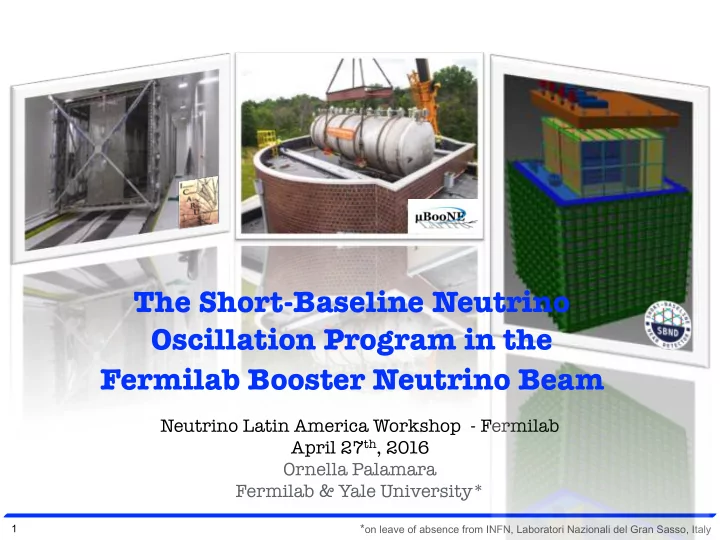
The Short-Baseline Neutrino Oscillation Program in the Fermilab - - PowerPoint PPT Presentation
The Short-Baseline Neutrino Oscillation Program in the Fermilab Booster Neutrino Beam Neutrino Latin America Workshop - Fermilab April 27 th , 2016 Ornella Palamara Fermilab & Yale University* * on leave of absence from INFN, Laboratori
Neutrino Latin America Workshop - Fermilab April 27th, 2016 Ornella Palamara Fermilab & Yale University*
*on leave of absence from INFN, Laboratori Nazionali del Gran Sasso, Italy
1
Neutrino - Latin America Workshop | April 27 2016
๏ The future U.S. accelerator neutrino program is based on the Liquid
Argon Time Projection Chamber (LAr TPC) technology.
๏ LArTPC offers the ability to measure interactions of neutrinos and other
particles in real time with sub-millimeter position resolution, allowing for
๏ track reconstruction ๏ particle identification and ๏ electron/gamma separation
far beyond that offered by any other neutrino detection method.
2
Neutrino - Latin America Workshop | April 27 2016
3
R & D Physics
Yale TPC and Bo (2008-2009) Proof of Concept ArgoNeuT (2009 - 2010) ν-Ar Cross Sections MicroBooNE (2015 - 2018) MiniBooNE Low Energy Excess SBN (SBND, MicroBooNE, ICARUS-T600) (2018 - 2021) Searches for Sterile Neutrino Oscillations DUNE (2023+) CP Violation LUKE (2008) Material Teststand LAPD (2011) LAr Purity LArIAT (2015) LArTPC Calibration 35Ton (2013) Cryostat Purity CAPTAIN LArTPC Calibration
First&T300&in&Cleanroom&at&CERN&
SBND ICARUS-T600
SBN program, this talk
A rich R&D and physics program
Neutrino - Latin America Workshop | April 27 2016
4
Physics motivations for the FNAL Short Baseline Neutrino program (SBN)
Booster Neutrino Beam -
B
t e r B e a m
Neutrino - Latin America Workshop | April 27 2016
5
~ 2.7σ
In recent years, two classes of experimental “neutrino anomalies” have been reported from measurement at short-baseline: (I) An apparent 𝜉e disappearance signal in the low energy anti- neutrinos from nuclear reactors (“reactor anomaly”) and from radioactive neutrino sources in the Gallium experiments (“Gallium anomaly”)
Neutrino - Latin America Workshop | April 27 2016
6
LSND MiniBooNE
(II) Evidence for an electron-like excess from neutrinos from particle accelerators (the “LSND and Mini-BooNE anomalies”)
Neutrino - Latin America Workshop | April 27 2016
7
LSND
Baseline 30 m E= [20 – 50] MeV
L/E ≈ 1 m/MeV
167 ¡tons ¡liquid ¡scintillator
Oscillation signal?
Detected an excess in the appearance of 𝜉e, corresponding to a 3.8 𝜏 evidence for 𝜉𝜈 → 𝜉e
_
This signal cannot be accommodated with the 3 SM neutrinos!
Low energy 𝜉𝜈 beam from a decay-at-rest pion beam
_ _ _
Neutrino - Latin America Workshop | April 27 2016
8
MiniBooNE
540 m from the target E=[0 - 2] GeV
L/E ≈ 1 m/MeV
800 ¡tons ¡mineral ¡oil
Low-energy excess
LSND excess expected at HE
expected, but a clear excess in 𝜉𝜈→𝜉e (3.4 𝜏) and 𝜉𝜈→𝜉e (2.8 𝜏) appearance is observed in a lower energy range
_ _
PRL 110 (2013) 161801
Neutrino - Latin America Workshop | April 27 2016
9
MiniBooNE
540 m from the target E=[0 - 2] GeV
L/E ≈ 1 m/MeV
800 ¡tons ¡mineral ¡oil
MiniBooNE (Cherenkov detector) cannot distinguish electron from single gamma and cannot determine the composition of the excess
– Electrons or photons?
PRL 110 (2013) 161801
Neutrino - Latin America Workshop | April 27 2016
10
None of the SBL neutrino anomalies can be described by oscillations between the three Standard Model neutrinos
The standard active neutrino mass splittings are way down here at 10-3 and 10-5 eV2
10-3 10-5
Atmospheric Solar LSND and MiniBooNE allowed regions
Atmospheric Solar LSND
Neutrino - Latin America Workshop | April 27 2016
11
None of the SBL neutrino anomalies can be described by oscillations between the three Standard Model neutrinos and …
Could be pointing at additional physics beyond the Standard Model in the neutrino sector: additional neutrino states with larger mass-squared differences driving neutrino oscillation at small distances
Any additional neutrino doesn’t participate in weak interactions ⇒ “sterile neutrino”*
* Sterile neutrinos were introduced by Pontecorvo in 1968 as neutrinos with no standard model interaction
3 flavor states, 3 “active” (weakly interacting) neutrinos!
Neutrino - Latin America Workshop | April 27 2016
๏ The accelerator neutrino anomalies at short-baseline hint at oscillation with very
small amplitude
๏ Resolving small oscillation effects requires good control of systematic
uncertainties
12
Kopp et at. Best
FNAL SBN: Multi-detector approach in a well characterized beam
Neutrino - Latin America Workshop | April 27 2016
13
Neutrino Latin America Workshop - Fermilab April 27th, 2016 Ornella Palamara Fermilab & Yale University*
*on leave of absence from INFN, Laboratori Nazionali del Gran Sasso, Italy
Booster'('8'GeV'protons'
Fermilab’s+low(energy+neutrino+beam:++ +<Eν>+≈+700+MeV+
14
Fermilab’s+low2energy+neutrino+beam:++ +⟨Eν⟩+≈+700+MeV+
Neutrino Latin America Workshop - Fermilab April 27th, 2016 Ornella Palamara Fermilab & Yale University*
*on leave of absence from INFN, Laboratori Nazionali del Gran Sasso, Italy
Booster'('8'GeV'protons'
Fermilab’s+low(energy+neutrino+beam:++ +<Eν>+≈+700+MeV+
15
Fermilab’s+low2energy+neutrino+beam:++ +⟨Eν⟩+≈+700+MeV+
and 𝜉e appearance
(well characterized)
Small electron neutrino contamination: <0.5%
Neutrino - Latin America Workshop | April 27 2016
16
B
t e r B e a m
ICARUS-T600
470 m, 86 t
MICROBOONE
Detector commissioning Summer 2015 Neutrino run started on Oct. 15
SBN program - Phase 1 - The MicroBooNE detector is taking neutrino data
MiniBooNE data (on the same beam)
(from unaccounted background).
Neutrino - Latin America Workshop | April 27 2016
B
t e r B e a m 110 m, 112 t
SBND
600 m, 470 t
ICARUS-T600
470 m, 86 t SBN program - Phase 2 - By 2018, the MicroBooNE detector will be joined by two additional LAr-TPC detectors at different baselines
forming a LAr TPC trio (to sample the neutrino spectrum as a function distance) for the SBN neutrino oscillation program
arXiv:1503.01520, January 2014
MicroBooNE
Neutrino - Latin America Workshop | April 27 2016
18
B
t e r B e a m 110 m, 112 ton
The Short-Baseline Near Detector (SBND), which will sit close to the source, plays a unique role in the chain of detectors, measuring the purity of the muon neutrino beam (it will characterize the beam before
dominant systematic uncertainties)
SBND
Length of Neutrino Flight [m] 200 400 600 800
Oscillation Probability [%]
0.2 0.4 0.6 0.8 1
2
eV = 1.2
2 41
m ∆ ) = 0.003 θ (2
2
sin Neutrino Energy: 700 MeV
SBND MicroBooNE ICARUS
Neutrino - Latin America Workshop | April 27 2016
19
B
t e r B e a m 600 m, 470 t
ICARUS-T600
๏ The ICARUS T600 neutrino detector —the world’s largest liquid-argon neutrino experiment — operated at Gran Sasso National Laboratory in Italy for four years
Fermilab. ๏ Given its large mass and far location ICARUS-T600 will provide high sensitivity to oscillated neutrinos allowing for a precision search.
Neutrino - Latin America Workshop | April 27 2016
20
(I) BNB emits muon neutrinos (𝜉𝜈) (II) on the way, these might be morphing into another, undetectable form (sterile neutrinos, 𝜉X)… and eventually change again to electron neutrinos (𝜉e)…
𝜉𝜈 𝜉e? 𝜉𝜈 𝜉X?
Appearance Disappearance
Having multiple detectors allows simultaneous searches for oscillations in appearance and disappearance channels, a very important constraint for interpreting the experimental observations.
110 m 470 m 600 m
Neutrino - Latin America Workshop | April 27 2016
SBND
21
A large mass far detectors and a near detector of the same technology is the key to large reductions of both statistical and systematic uncertainties (reduced to % level ) in SBN oscillation searches, allowing to address region of interest at 5σ 𝜉𝜈→𝜉e Appearance sensitivity
} Giunti et al. } Kopp et al.
~3 years of run
SBND
Neutrino - Latin America Workshop | April 27 2016
22
𝜉𝜈→𝜉e Appearance sensitivity
SBND
SBN will cover the LSND 99% C.L. allowed region with ≥ 5σ significance (conclusive experiment w.r.t. LSND anomaly)
} Giunti et al. } Kopp et al.
Neutrino - Latin America Workshop | April 27 2016
23
SBND
SBN can extend the search for muon neutrino disappearance an order of magnitude beyond the combined analysis of SciBooNE and MiniBooNE
𝜉𝜈→𝜉x Disappearance sensitivity
µ µ θ 2
2
sin
3 −
10
2 −
10
1 −
10 1
]
2
[eV
2
m ∆
1 −
10 1 10
2
10
POT)
2010 × POT) and T600 (6.6
2110 × MicroBooNE (1.3 POT)
2010 × LAr1-ND (6.6
INTERNAL
mode, CC Events ν Stat, Flux, and Cross Section Uncerts. Reconstructed Energy Efficiency µ ν 80% Shape and Rate 90% CL CL σ 3 CL σ 5 MiniBooNE + SciBooNE 90% CL
SBND
Neutrino - Latin America Workshop | April 27 2016
24
๏ A correct interpretation of the outcome of 𝜉 oscillation experiments requires precise understanding of 𝜉 interaction cross sections ๏ SBN detectors will provide huge data sets of 𝜉-Ar interactions from the BNB
๏ Large samples in MicroBooNE are coming! ๏ SBND will record ~1.5 million 𝜉μ CC and ~12,000 𝜉e CC interactions per year ๏ ~100k NuMI off-axis events in T600 per year
Neutrino - Latin America Workshop | April 27 2016
25
The only existing GeV neutrino-Ar scattering data are ~6000 events from ArgoNeuT (NuMI beam, 3 GeV peak energy)
๏ A correct interpretation of the outcome of 𝜉 oscillation experiments requires precise understanding of 𝜉 interaction cross sections ๏ SBN detectors will provide huge data sets of 𝜉-Ar interactions from the BNB
๏ Large samples in MicroBooNE are coming! ๏ SBND will record ~1.5 million 𝜉μ CC and ~12,000 𝜉e CC interactions per year ๏ ~100k NuMI off-axis events in T600 per year
Neutrino - Latin America Workshop | April 27 2016
26
December'20th,'2013'
TPC Active volume: 86 t of LAr
MicroBooNE is taking neutrino data since Oct. 2015
Neutrino - Latin America Workshop | April 27 2016
27
SBND design is in final stages and starting construction
TPC Active volume: 112 t of LAr
Neutrino - Latin America Workshop | April 27 2016
28
On)the)road)to)CERN) In)Cleanroom)@)CERN) Dec)2014) New)building)complete)late)2016)
Early&2017&
Nov$2014$ Fermilab)
Jan$2015$
TPC Active volume: 475 t of LAr
Neutrino - Latin America Workshop | April 27 2016
29
55 institutions, 8 countries Five U.S. national laboratories plus CERN
Neutrino - Latin America Workshop | April 27 2016
Puerto Rico
30
University of Campinas Federal University of ABC Federal University of Alfenas [13 collaborators - SBND experiment] University of Puerto Rico [3 collaborators - SBND experiment]
Brasil 3
Latin America institutions
Puerto Rico
Neutrino - Latin America Workshop | April 27 2016
31
Latin America institutions
Greater participation by Latin American groups is welcome!
Neutrino - Latin America Workshop | April 27 2016
32
40 Kton LAr TPC
Physics goals:
(CP violation)
S U R F ( L e a d , S D )
๏ SBN provides an excellent opportunity for the continued development of the liquid argon TPC technology toward the DUNE long-baseline program
๏ SBN data also presents important physics
program ๏ Measurements of neutrino-argon interactions ๏ Execution of precision oscillation searches will drive the development of sophisticated reconstruction and data analysis techniques using TPC data
Neutrino - Latin America Workshop | April 27 2016
33
The three SBN detectors will all use state-of-the-art liquid-argon time projection technology to track neutrino interactions. The international SBN research program at Fermilab will probe one enduring mystery: Are there only three types of ghostly neutrinos, or is a fourth type waiting to be discovered? In the coming years we will know if the neutrinos have still more surprises for us!