Network Layer network layer services virtual circuit and datagram - - PDF document

network layer
SMART_READER_LITE
LIVE PREVIEW

Network Layer network layer services virtual circuit and datagram - - PDF document

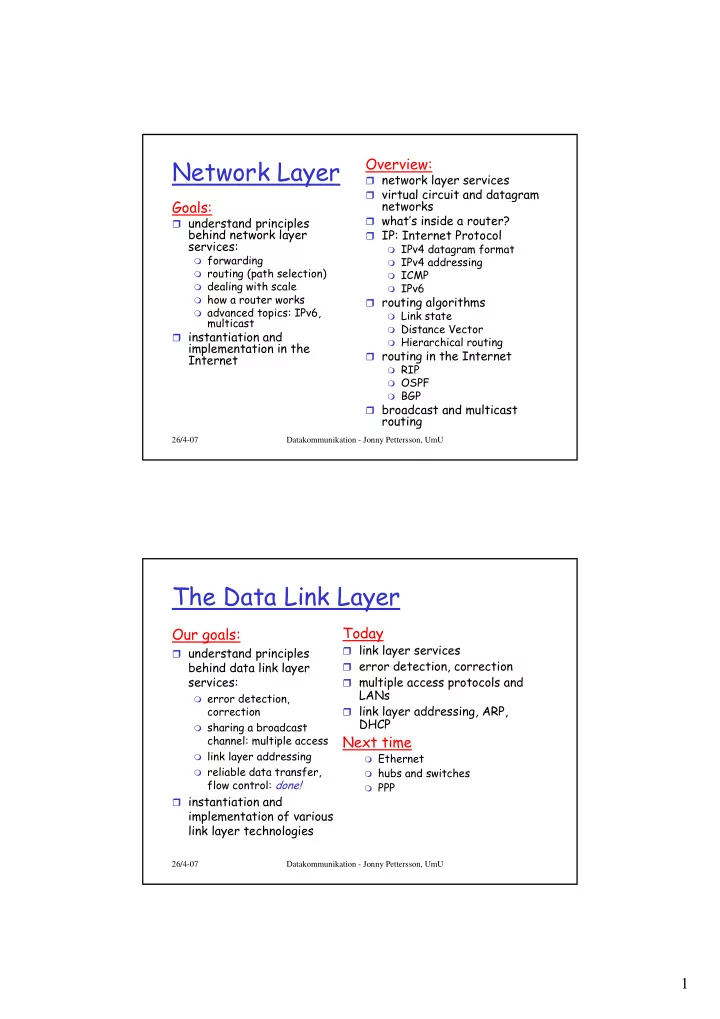
Overview: Network Layer network layer services virtual circuit and datagram Goals: networks whats inside a router? understand principles behind network layer IP: Internet Protocol services: IPv4 datagram format


slide-1
SLIDE 1

1

26/4-07 Datakommunikation - Jonny Pettersson, UmU

Network Layer

Goals:

understand principles

behind network layer services:

forwarding routing (path selection) dealing with scale how a router works advanced topics: IPv6,

multicast instantiation and

implementation in the Internet

Overview:

network layer services virtual circuit and datagram

networks

what’s inside a router? IP: Internet Protocol

IPv4 datagram format IPv4 addressing ICMP IPv6

routing algorithms

Link state Distance Vector Hierarchical routing

routing in the Internet

RIP OSPF BGP

broadcast and multicast

routing

26/4-07 Datakommunikation - Jonny Pettersson, UmU

The Data Link Layer

Our goals:

understand principles

behind data link layer services:

error detection,

correction

sharing a broadcast

channel: multiple access

link layer addressing reliable data transfer,

flow control: done! instantiation and

implementation of various link layer technologies

Today

link layer services error detection, correction multiple access protocols and

LANs

link layer addressing, ARP,

DHCP

Next time

Ethernet hubs and switches PPP

slide-2
SLIDE 2

2

26/4-07 Datakommunikation - Jonny Pettersson, UmU

Link Layer: setting the context

26/4-07 Datakommunikation - Jonny Pettersson, UmU

Link Layer: setting the context

two physically connected devices:

host-router, router-router, host-host

unit of data: frame

application transport network link physical network link physical

M M M M Ht Ht Hn Ht Hn Hl M Ht Hn Hl frame

  • phys. link

data link protocol adapter card

slide-3
SLIDE 3

3

26/4-07 Datakommunikation - Jonny Pettersson, UmU

Link Layer Services

Framing, link access:

encapsulate datagram into frame, adding header, trailer channel access if shared medium, ‘physical addresses’ used in frame headers to identify

source, dest

  • different from IP address!

Reliable delivery between two physically connected

devices:

we learned how to do this already (chapter 3)! seldom used on low bit error link (fiber, some twisted

pair)

wireless links: high error rates

  • Q: why both link-level and end-end reliability?

26/4-07 Datakommunikation - Jonny Pettersson, UmU

Link Layer Services (more)

Flow Control:

pacing between adjacent sending and receiving nodes

Error Detection:

errors caused by signal attenuation, noise. receiver detects presence of errors:

  • signals sender for retransmission or drops frame

Error Correction:

receiver identifies and corrects bit error(s) without

resorting to retransmission Half-duplex and full-duplex

with half duplex, nodes at both ends of link can transmit,

but not at same time

slide-4
SLIDE 4

4

26/4-07 Datakommunikation - Jonny Pettersson, UmU

Adaptors Communicating

link layer implemented in

“adaptor” (aka NIC)

Ethernet card, PCMCIA

card, 802.11 card

typically includes: RAM, DSP

(Digital Signal Processing) chips, host bus interface, and link interface adapter is semi-autonomous link & physical layers sending side:

encapsulates datagram in a

frame

adds error checking bits, rdt,

flow control, etc. receiving side

looks for errors, rdt, flow

control, etc

extracts datagram, passes to

rcving node sending node frame rcving node datagram frame adapter adapter link layer protocol

26/4-07 Datakommunikation - Jonny Pettersson, UmU

Error Detection

EDC= Error Detection and Correction bits (redundancy) D = Data protected by error checking, may include header fields

  • Error detection not 100% reliable!
  • protocol may miss some errors, but rarely
  • larger EDC field yields better detection and correction
slide-5
SLIDE 5

5

26/4-07 Datakommunikation - Jonny Pettersson, UmU

Parity Checking

Single Bit Parity:

Detect single bit errors

Two Dimensional Bit Parity:

Detect and correct single bit errors

26/4-07 Datakommunikation - Jonny Pettersson, UmU

Checksumming: Cyclic Redundancy Check

view data bits, D, as a binary number choose r+1 bit pattern (generator), G goal: choose r CRC bits, R, such that

  • <D,R> exactly divisible by G (modulo 2)

receiver knows G, divides <D,R> by G. If non-zero remainder:

error detected! can detect all burst errors less than r+1 bits and any odd

number of bit errors

a burst of length greater than r+1 bits is detected with

probability 1-0.5r

widely used in practice (ATM, HDCL)

slide-6
SLIDE 6

6

26/4-07 Datakommunikation - Jonny Pettersson, UmU

Multiple Access protocols

single shared communication channel two or more simultaneous transmissions by nodes:

interference

  • nly one node can send successfully at a time

multiple access protocol:

distributed algorithm that determines how nodes share

channel, i.e., determine when node can transmit

communication about channel sharing must use channel itself! what to look for in multiple access protocols:

  • synchronous or asynchronous
  • information needed about other nodes
  • robustness (e.g., to channel errors)
  • performance

26/4-07 Datakommunikation - Jonny Pettersson, UmU

Ideal Mulitple Access Protocol

Broadcast channel of rate R bps

  • 1. When one node wants to transmit, it can send at

rate R

  • 2. When M nodes want to transmit, each can send at

average rate R/M

  • 3. Fully decentralized:

no special node to coordinate transmissions no synchronization of clocks, slots

  • 4. Simple
slide-7
SLIDE 7

7

26/4-07 Datakommunikation - Jonny Pettersson, UmU

MAC Protocols: a taxonomy

(MAC – Media Access Control)

Three broad classes:

Channel Partitioning

divide channel into smaller “pieces” (time slots,

frequency, code)

allocate piece to node for exclusive use

Random Access

channel not divided, allow collisions “recover” from collisions

“Taking turns”

tightly coordinate shared access to avoid collisions

Goal: efficient, fair, simple, decentralized

26/4-07 Datakommunikation - Jonny Pettersson, UmU

Channel Partitioning MAC protocols: TDMA

TDMA: time division multiple access

access to channel in "rounds" each station gets fixed length slot (length = pkt

trans time) in each round

unused slots go idle example: 6-station LAN, 1,3,4 have pkt, slots 2,5,6

idle

slide-8
SLIDE 8

8

26/4-07 Datakommunikation - Jonny Pettersson, UmU

Channel Partitioning MAC protocols: FDMA

FDMA: frequency division multiple access

channel spectrum divided into frequency bands each station assigned fixed frequency band unused transmission time in frequency bands go idle example: 6-station LAN, 1,3,4 have pkt, frequency

bands 2,5,6 idle

frequency bands time

26/4-07 Datakommunikation - Jonny Pettersson, UmU

Channel Partitioning (CDMA)

CDMA (Code Division Multiple Access)

unique “code” assigned to each user; ie, code set

partitioning

used mostly in wireless broadcast channels

(cellular, satellite,etc)

all users share same frequency, but each user has

  • wn “chipping” sequence (ie, code) to encode data

allows multiple users to “coexist” and transmit

simultaneously with minimal interference (if codes are “orthogonal”)

more later…

slide-9
SLIDE 9

9

26/4-07 Datakommunikation - Jonny Pettersson, UmU

Random Access protocols

When node has packet to send

transmit at full channel data rate R no a priori coordination among nodes

two or more transmitting nodes -> “collision”, random access MAC protocol specifies:

how to detect collisions how to recover from collisions (e.g., via delayed

retransmissions) Examples of random access MAC protocols:

slotted ALOHA ALOHA CSMA and CSMA/CD 26/4-07 Datakommunikation - Jonny Pettersson, UmU

Slotted ALOHA

Assumptions

all frames same size time is divided into

equal size slots = time to transmit 1 frame

nodes start to transmit

frames only at beginning of slots

nodes are synchronized if 2 or more nodes

transmit in slot, all nodes detect collision Operation

when node obtains fresh

frame, it transmits in next slot

no collision, node can send

new frame in next slot

if collision, node

retransmits frame in each subsequent slot with prob. p until success

slide-10
SLIDE 10

10

26/4-07 Datakommunikation - Jonny Pettersson, UmU

Slotted ALOHA

Pros

single active node can

continuously transmit at full rate of channel

highly decentralized:

  • nly slots in nodes

need to be in sync

simple

Cons

collisions, wasting slots idle slots nodes may be able to

detect collision in less than time to transmit packet

clock synchronization

26/4-07 Datakommunikation - Jonny Pettersson, UmU

Slotted Aloha efficiency

Suppose N nodes with

many frames to send, each transmits in slot with probability p

prob that node 1 has

success in a slot

= p(1-p)N-1 prob that any node has

a success = Np(1-p)N-1

For max efficiency

with N nodes, find p* that maximizes Np(1-p)N-1

For many nodes, take

limit of Np*(1-p*)N-1 as N goes to infinity, gives 1/e = .37 Efficiency is the long-run fraction of successful slots when there are many nodes, each with many frames to send At best: channel used for useful transmissions 37%

  • f time!
slide-11
SLIDE 11

11

26/4-07 Datakommunikation - Jonny Pettersson, UmU

Pure (unslotted) ALOHA

unslotted Aloha: simpler, no synchronization when frame first arrives

transmit immediately

collision probability increases:

frame sent at t0 collides with other frames sent in [t0-1,t0+1] 26/4-07 Datakommunikation - Jonny Pettersson, UmU

Pure Aloha efficiency

P(success by given node) = P(node transmits) . P(no other node transmits in [p0-1,p0] . P(no other node transmits in [p0,p0+1] = p . (1-p)(N-1) . (1-p)(N-1) P(success by any of N nodes) = N p . (1-p)(N-1) . (1-p)(N-1)

… choosing optimum p as N -> infty ... = 1/(2e) = .18

S = throughput = “goodput” (success rate) G = offered load = Np

0.5 1.0 1.5 2.0 0.1 0.2 0.3 0.4

Pure Aloha Slotted Aloha

protocol constrains effective channel throughput!

slide-12
SLIDE 12

12

26/4-07 Datakommunikation - Jonny Pettersson, UmU

CSMA (Carrier Sense Multiple Access)

CSMA: listen before transmit: If channel sensed idle: transmit entire frame

If channel sensed busy, defer transmission Human analogy: don’t interrupt others!

26/4-07 Datakommunikation - Jonny Pettersson, UmU

CSMA collisions

collisions can still occur:

propagation delay means two nodes may not hear each other’s transmission

collision:

entire packet transmission time wasted

spatial layout of nodes

note:

role of distance & propagation delay in determining collision probability

slide-13
SLIDE 13

13

26/4-07 Datakommunikation - Jonny Pettersson, UmU

CSMA/CD (Collision Detection)

CSMA/CD: carrier sensing, deferral as in CSMA

collisions detected within short time colliding transmissions aborted, reducing channel

wastage collision detection:

easy in wired LANs: measure signal strengths,

compare transmitted, received signals

difficult in wireless LANs: receiver shut off while

transmitting human analogy: the polite conversationalist

26/4-07 Datakommunikation - Jonny Pettersson, UmU

CSMA/CD collision detection

slide-14
SLIDE 14

14

26/4-07 Datakommunikation - Jonny Pettersson, UmU

“Taking Turns” MAC protocols

channel partitioning MAC protocols:

share channel efficiently and fairly at high load inefficient at low load: delay in channel access,

1/N bandwidth allocated even if only 1 active node! Random access MAC protocols

efficient at low load: single node can fully

utilize channel

high load: collision overhead

“taking turns” protocols look for best of both worlds!

26/4-07 Datakommunikation - Jonny Pettersson, UmU

“Taking Turns” MAC protocols

Polling:

master node “invites” slave

nodes to transmit in turn

concerns:

polling overhead latency single point of failure

(master)

Token passing:

control token passed from

  • ne node to next

sequentially.

token message concerns:

token overhead latency single point of failure (token)

slide-15
SLIDE 15

15

26/4-07 Datakommunikation - Jonny Pettersson, UmU

Summary of MAC protocols

What do you do with a shared media?

Channel Partitioning, by time, frequency or code

  • Time Division, Frequency Division, Code Division

Random partitioning (dynamic),

  • ALOHA, S-ALOHA, CSMA, CSMA/CD
  • carrier sensing: easy in some technologies (wire), hard

in others (wireless)

  • CSMA/CD used in Ethernet
  • CSMA/CA used in 802.11

Taking Turns

  • polling from a central site, token passing

26/4-07 Datakommunikation - Jonny Pettersson, UmU

MAC Addresses and ARP

32-bit IP address:

network-layer address used to get datagram to destination IP subnet

MAC (or LAN or physical or Ethernet)

address:

used to get datagram from one interface to

another physically-connected interface (same network)

48 bit MAC address (for most LANs)

burned in the adapter ROM

slide-16
SLIDE 16

16

26/4-07 Datakommunikation - Jonny Pettersson, UmU

MAC Addresses

Each adapter on LAN has unique MAC address

Broadcast address = FF-FF-FF-FF-FF-FF = adapter

1A-2F-BB-76-09-AD 58-23-D7-FA-20-B0 0C-C4-11-6F-E3-98 71-65-F7-2B-08-53

LAN (wired or wireless)

26/4-07 Datakommunikation - Jonny Pettersson, UmU

LAN Address (more)

MAC address allocation administered by IEEE manufacturer buys portion of MAC address space

(to assure uniqueness)

analogy:

(a) MAC address: like Social Security Number (b) IP address: like postal address

MAC flat address ➜ portability

can move LAN card from one LAN to another

IP hierarchical address NOT portable

depends on IP subnet to which node is attached

slide-17
SLIDE 17

17

26/4-07 Datakommunikation - Jonny Pettersson, UmU

Recall earlier routing discussion

223.1.1.1 223.1.1.2 223.1.1.3 223.1.1.4 223.1.2.9 223.1.2.2 223.1.2.1 223.1.3.2 223.1.3.1 223.1.3.27

A B E

Starting at A, given IP datagram addressed to B:

look up net. address of B, find B

  • n same net. as A

link layer send datagram to B

inside link-layer frame

B’s MAC addr A’s MAC addr A’s IP addr B’s IP addr IP payload datagram frame frame source, dest address datagram source, dest address

26/4-07 Datakommunikation - Jonny Pettersson, UmU

IP-adress - Fysisk adress

Maskiner kan bara kommunicera via fysiska

adresser

Adaptrar måste översätta IP-adressen till

fysisk adress

Om IP-adress och fysisk adress får

bestämmas vid installation kan översättningen ske med en funktion

Direct Mapping Resolution

Bättre med en dynamisk lösning

Dynamic Binding Resolution

slide-18
SLIDE 18

18

26/4-07 Datakommunikation - Jonny Pettersson, UmU

Dynamic Binding Resolution

TCP/IP använder sig av ett lågnivåprotokoll

ARP (Address Resolution Protocol)

ARP-mekanismen är både effektiv och lätt

att underhålla

Del av det fysiska nätverket och inte en

del av Internetprotokollen

26/4-07 Datakommunikation - Jonny Pettersson, UmU

ARP - Address Resolution Protocol

Mål:

Varje adapter i ett nätverk ska kunna bygga upp

en tabell med IP-adress - länk-nivå-adress mappningar ARP-cache/tabell

En post tas bort efter ca 20 minuter

Använder sig av broadcast

slide-19
SLIDE 19

19

26/4-07 Datakommunikation - Jonny Pettersson, UmU

Hur går det till?

En maskin upptäcker att mottagaren är på samma

nätverk

Kollar i ARP-cachen/tabellen

Om inte där

  • Broadcast ARP-Query (inkl mottagarens IP-adress) till FF-

FF-FF-FF-FF-FF

  • Alla tar emot, den berörda svarar med unicast
  • Båda parter uppdaterar sina cacher/tabeller

ARP-Query innehåller även sändarens IP- och länk-

nivå-adress

Alla kan uppdatera sin cache/tabell om sändaren redan

finns i tabellen ARP är “plug and play”

26/4-07 Datakommunikation - Jonny Pettersson, UmU

ARP paket

TargetHardwareAddr (bytes 2– 5) TargetProtocolAddr (bytes 0– 3) SourceProtocolAddr (bytes 2 – 3) Hardware type = 1 ProtocolType = 0x0800 SourceHardwareAddr (bytes 4 – 5) TargetHardwareAddr (bytes 0– 1) SourceProtocolAddr (bytes 0 – 1) HLen = 48 PLen = 32 Operation SourceHardwareAddr (bytes 0– 3) 8 16 31

slide-20
SLIDE 20

20

26/4-07 Datakommunikation - Jonny Pettersson, UmU

Exempel ARP-cache

peppar ~>/usr/sbin/arp -a Net to Media Table: IPv4 Device IP Address Mask Flags Phys Addr

  • ----- -------------------- --------------- ----- ---------------

hme0 NTP.MCAST.NET 255.255.255.255 01:00:5e:00:01:01 hme0 morrhoppa 255.255.255.255 00:0d:56:93:e8:eb hme0 hexagon 255.255.255.255 00:11:43:9c:1d:c7 hme0 fyrkant 255.255.255.255 00:11:43:9c:1a:dd hme0 kub 255.255.255.255 00:11:43:9c:12:3e hme0 peppar 255.255.255.255 SP 08:00:20:b6:57:47 ... hme0 panda 255.255.255.255 08:00:20:cf:f6:b0 hme0 bark 255.255.255.255 08:00:20:fb:15:64 hme0 blad 255.255.255.255 08:00:20:fb:31:86 hme0 BASE-ADDRESS.MCAST.NET 240.0.0.0 SM 01:00:5e:00:00:00 26/4-07 Datakommunikation - Jonny Pettersson, UmU

Exempel ARP-cache

nudel ~>/usr/sbin/arp -a scrat.cs.umu.se (130.239.40.18) at 00:06:5B:F1:47:BA [ether] on eth0 mit.gw.umu.se (130.239.40.1) at 00:08:20:DC:53:80 [ether] on eth0 muu.cs.umu.se (130.239.40.16) at 00:03:BA:10:0A:03 [ether] on eth0 puff.cs.umu.se (130.239.40.12) at 00:03:BA:3F:81:37 [ether] on eth0 knopp.cs.umu.se (130.239.40.189) at 08:00:20:FB:1E:BC [ether] on eth0 piff.cs.umu.se (130.239.40.11) at 00:03:BA:40:27:4F [ether] on eth0 salt.cs.umu.se (130.239.40.15) at 00:06:5B:FC:EB:3C [ether] on eth0 leopard.cs.umu.se (130.239.40.177) at 08:00:20:D1:89:F4 [ether] on eth0 peppar.cs.umu.se (130.239.40.13) at 08:00:20:B6:57:47 [ether] on eth0

slide-21
SLIDE 21

21

26/4-07 Datakommunikation - Jonny Pettersson, UmU

Routing to another LAN

walkthrough: send datagram from A to B via R assume A know’s B IP address

Two ARP tables in router R, one for each IP

network (LAN) A R B

A creates datagram with source A, destination B A uses ARP to get R’s MAC address for 111.111.111.110 A creates link-layer frame with R's MAC address as dest,

frame contains A-to-B IP datagram

A’s adapter sends frame R’s adapter receives frame R removes IP datagram from Ethernet frame, sees its

destined to B

R uses ARP to get B’s MAC address R creates frame containing A-to-B IP datagram sends to B

A R B

slide-22
SLIDE 22

22

26/4-07 Datakommunikation - Jonny Pettersson, UmU

DHCP

A new node needs an IP-address:

hard-coded by system admin in a file DHCP: Dynamic Host Configuration Protocol: dynamically get address: “plug-and-play”

host broadcasts “DHCP discover” msg DHCP server responds with “DHCP offer” msg host requests IP address: “DHCP request” msg DHCP server sends address: “DHCP ack” msg can use relay agent

An example on scaling of network

administration

26/4-07 Datakommunikation - Jonny Pettersson, UmU

DHCP

slide-23
SLIDE 23

23

26/4-07 Datakommunikation - Jonny Pettersson, UmU

The Data Link Layer

Our goals:

understand principles

behind data link layer services:

error detection,

correction

sharing a broadcast

channel: multiple access

link layer addressing reliable data transfer,

flow control: done! instantiation and

implementation of various link layer technologies

Today

link layer services error detection, correction multiple access protocols and

LANs

link layer addressing, ARP,

DHCP

Next time

Ethernet hubs and switches PPP