SLIDE 12 The Beta Model
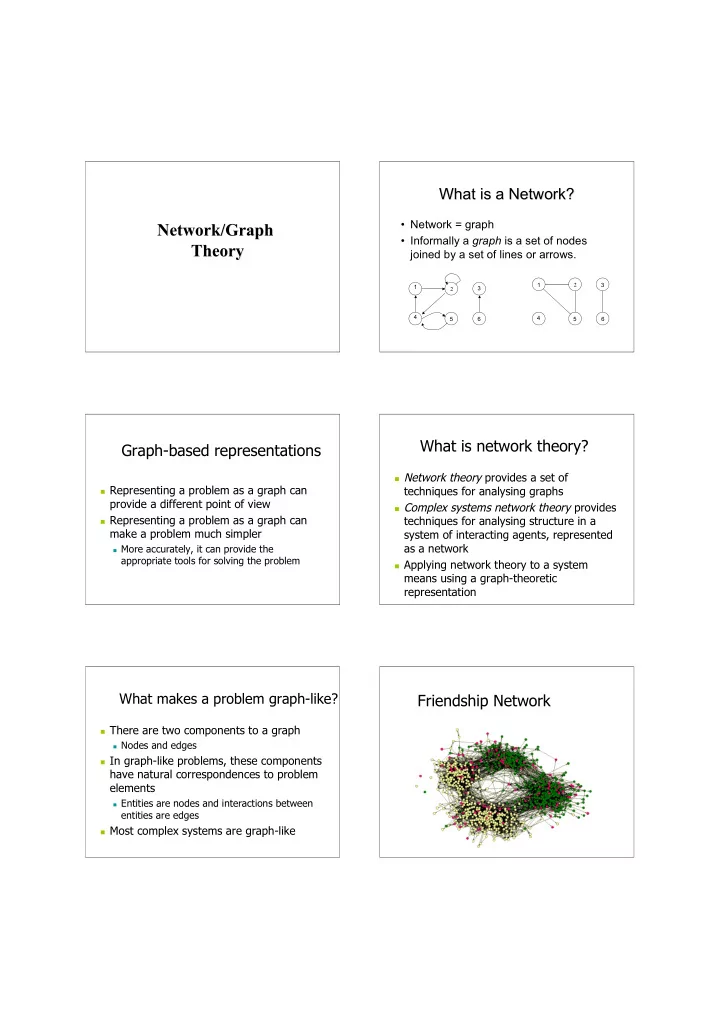
Watts and Strogatz (1998) β = 0 β = 0.125 β = 1 People know
random. Not clustered, but “small world” People know their neighbors, and a few distant people. Clustered and “small world” People know their neighbors. Clustered, but not a “small world”
The Beta Model
First five random links reduce the average path length of the network by half, regardless of N! Both α and β models reproduce short-path results of random graphs, but also allow for clustering. Small-world phenomena occur at threshold between order and chaos. Watts and Strogatz (1998)
Nobuyuki Hanaki Jonathan Donner Kentaro Toyama Clustering coefficient / Normalized path length
Clustering coefficient (C) and average path length (L) plotted against β
Power Laws
Albert and Barabasi (1999) Degree distribution of a random graph, N = 10,000 p = 0.0015 k = 15. (Curve is a Poisson curve, for comparison.) What’s the degree (number of edges) distribution over a graph, for real-world graphs? Random-graph model results in Poisson distribution. But, many real-world networks exhibit a power-law distribution.
Power Laws
Albert and Barabasi (1999) Typical shape of a power-law distribution. What’s the degree (number of edges) distribution over a graph, for real-world graphs? Random-graph model results in Poisson distribution. But, many real-world networks exhibit a power-law distribution.
Power Laws
Albert and Barabasi (1999) Power-law distributions are straight lines in log-log space. How should random graphs be generated to create a power-law distribution of node degrees? Hint: Pareto’s* Law: Wealth distribution follows a power law.
Power laws in real networks: (a) WWW hyperlinks (b) co-starring in movies (c) co-authorship of physicists (d) co-authorship of neuroscientists
* Same Velfredo Pareto, who defined Pareto optimality in game theory.
Power Laws
“The rich get richer!” Power-law distribution of node distribution arises if – Number of nodes grow; – Edges are added in proportion to the number of edges a node already has. Additional variable fitness coefficient allows for some nodes to grow faster than others. Albert and Barabasi (1999)
Jennifer Chayes Anandan Kentaro Toyama
“Map of the Internet” poster