Neoadjuvant Chemotherapy Neoadjuvant Chemotherapy NSABP 18 NSABP - - PowerPoint PPT Presentation

neoadjuvant chemotherapy
SMART_READER_LITE
LIVE PREVIEW

Neoadjuvant Chemotherapy Neoadjuvant Chemotherapy NSABP 18 NSABP - - PowerPoint PPT Presentation

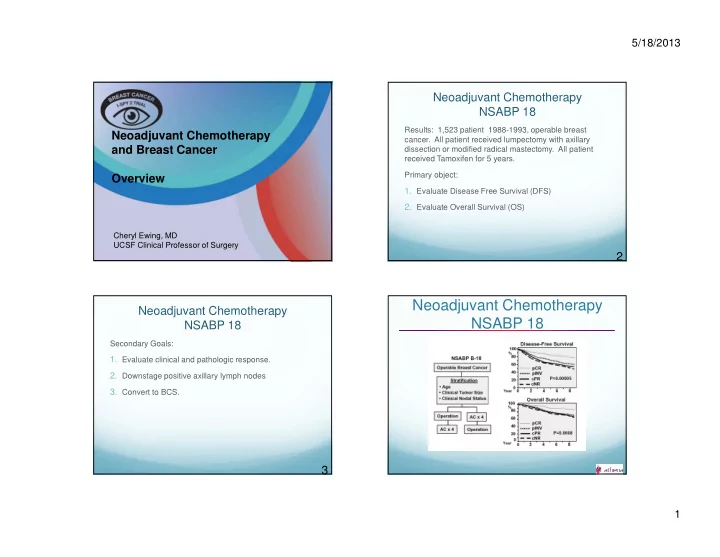
5/18/2013 Neoadjuvant Chemotherapy NSABP 18 Results: 1,523 patient 1988-1993, operable breast Neoadjuvant Chemotherapy cancer. All patient received lumpectomy with axillary and Breast Cancer dissection or modified radical mastectomy. All


slide-1
SLIDE 1

5/18/2013 1

Neoadjuvant Chemotherapy and Breast Cancer Overview

Cheryl Ewing, MD UCSF Clinical Professor of Surgery Results: 1,523 patient 1988-1993, operable breast

  • cancer. All patient received lumpectomy with axillary

dissection or modified radical mastectomy. All patient received Tamoxifen for 5 years. Primary object:

  • 1. Evaluate Disease Free Survival (DFS)
  • 2. Evaluate Overall Survival (OS)

Neoadjuvant Chemotherapy NSABP 18 2

Secondary Goals:

  • 1. Evaluate clinical and pathologic response.
  • 2. Downstage positive axillary lymph nodes
  • 3. Convert to BCS.

Neoadjuvant Chemotherapy NSABP 18 3

Neoadjuvant Chemotherapy NSABP 18

slide-2
SLIDE 2

5/18/2013 2

DFS p value OS p value pCR 75% 0.00005 85% 0.00008 pINV 58% 73%

Neoadjuvant Chemotherapy NSABP 18

Results are independent of age, nodal status, or tumor size. Pathologic response is predictive of survival

Results:

1.

No difference in DFS or OS when comparing neoadjuvant to adjuvant chemotherapy.

2.

For the neoadjuvant group 36% of patients had a cCR and 43% cPR for a total of 79% were downstaged. Only 3% had progression of disease.

3.

Patient who had a pCR had a better DFS and OS compared to

  • pPR. Response is predictor of prognosis, independent of

receptor status, grade, and other biomarkers

4.

16% of patient downstaged the positive axillary lymph nodes.

5.

Patients receiving neoadjuvant chemotherapy is more likely to have BCS. 67% vs.60% (p=0.002)

Neoadjuvant Chemotherapy NSABP 18 6

Evaluate Docetaxol in the neoadjuvant setting after 4 cycles of Adriamycin and Cytoxan

Opened in 1995, closed in 2000. Accrued 2,411 patients.

Neoadjuvant Chemotherapy NSABP 27 7

Primary goal:

  • 1. Evaluate the worth of giving Docetaxol (Taxol) in the

preoperative setting after 4 cycles of AC, compared to AC alone.

  • 2. Evaluate DFS and OS

Neoadjuvant Chemotherapy NSABP 27 8

slide-3
SLIDE 3

5/18/2013 3

Secondary goal:

  • 1. Preoperative Docetaxol after 4 cycles of AC improve

pCR, axillary nodal status, increase BCS

  • 2. For patient who receive preoperative AC alone, did

postoperatve Docetaxol improve DFS and OS for patient with residual invasive cancer (pINV).

Neoadjuvant Chemotherapy NSABP 27 9

Neoadjuvant Chemotherapy NSABP 27 NSABP 27

11

cCR P value Overall cCR+cPR P value pCR P value AC>T 65.4% 0.001 91.1% 0.001 25.6% <0.001 AC 40.4% 85.7% 13.7% BCS p value Node Neg p value AC 61.45 0.7 50.7% >0.01 AC>T 63.1% 75.8%

Neoadjuvant Chemotherapy NSABP 27

BCS is in contrast to NSAPB 18 DSF and OS data not published Prediction for survival with biomarkers not published

slide-4
SLIDE 4

5/18/2013 4

Take home points from NASBP 18 and 27

The response to chemotherapy is predictive of DFS and OS. The response to chemotherapy can be used an immediate

endpoint in testing new chemotherapy or target agents.

Evaluate biomarkers for predicting prognosis, ER, PR,

grade, Ki-67, Her-2, P53, and others.

Serial monitoring of biomarkers may provide insight into the

nature and function of these markers. Example the Ki-67 or hormonal receptor status may change with neoadjuvant chemotherapy.

Neoadjuvant Chemotherapy 1 3

Advances in Surgical Techniques

Can Be Used After Neoadjuvant Therapy

Breast Conservation and Sentinel Node Dissection

Complete response Partial response Progressive disease

Evaluation of tumor response by MRI

Pre- treatment Post- treatment

Pre-chemotherapy Post-chemotherapy

MRI allows more accurate measure

  • f size pre/post therapy

LD=47 mm LD=16 mm (AC, 4 cycles)

slide-5
SLIDE 5

5/18/2013 5

Classification of Morphologic Pattern

1 2 3 4 5

1: Uni-centric mass with well-defined margin 2: Multi-lobulated mass with well-defined margin 3: Area enhancement with irregular margins - with nodularity 4: Area enhancement with irregular margins - without nodularity 5: Septal spread; streaming

Early Change in Tumor Volume Predictive

  • f Final Volume Response

Improved evaluation of mechanism of action with evaluation

  • f treated cancer cells.

Provide information for regarding need for additional

chemotherapy (e.g.., anthracyclines) or postmastectomy radiation.

Evaluate predictors of response, Oncotype DX, Mammaprint

and breast MRI.

Downstage patients to allow BCS and lesser axillary

surgery.

Objective tumor response for high risk patients.

Neoadjuvant Chemotherapy

Consider Neoadjuvant chemotherapy for all breast cancer that are high risk for LRR and metastatic disease.

Neoadjuvant Chemotherapy

  • 1. Breast cancers larger than 2.5 CM.
  • 2. Triple negative breast cancers larger than 5mm
  • 3. Her-2 positive breast cancers larger than 5mm
  • 4. Core needle or FNA positive axillary lymph nodes.
  • 5. Any T3 or T4 breast cancer
  • 6. All inflammatory breast cancers.

Neoadjuvant Chemotherapy

slide-6
SLIDE 6

5/18/2013 6

Questions for future and ongoing clinical trials

  • 1. Efficacy of neoadjuvant hormonal therapy in pre and

postmenopausal women. Currently multiple trials are open using Tamoxifen, Letrozole, and Anastrozole.

  • 2. NSABP recently opened NSABP-N-SAS-BC06
  • 3. Alliance and CALGB recently open a DCIS trial and

hormonal therapy.

  • 4. Is surgery indicated for women who have a cCR on breast
  • MRI. Is radiation sufficient treatment?

Neoadjuvant Hormonal Therapy

Happy Trails

22

Happy Trails Marin County

RONIN AND TEYLA SAYS THANK YOU FOR YOUR TIME