Natural Resources Subcommittee 2:00-2:15 Welcome and Intros - - PowerPoint PPT Presentation

natural resources subcommittee
SMART_READER_LITE
LIVE PREVIEW

Natural Resources Subcommittee 2:00-2:15 Welcome and Intros - - PowerPoint PPT Presentation

Natural Resources Subcommittee 2:00-2:15 Welcome and Intros 2:15-2:30 TRB Resource Conservation and Recovery Summer Meeting and Haz Mat Working Group 2:30-3:00 EPA Stormwater Audits 3:00-3:15 NCHRP Research 3:15-3:30 Upcoming Research


slide-1
SLIDE 1

Natural Resources Subcommittee

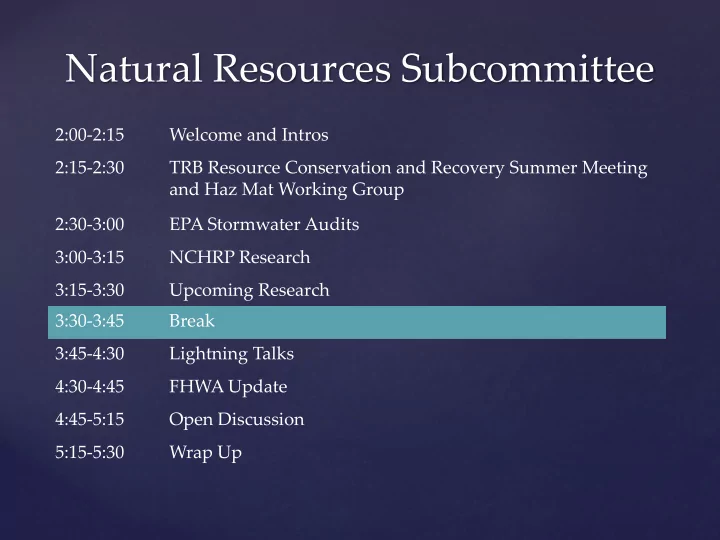
2:00-2:15 Welcome and Intros 2:15-2:30 TRB Resource Conservation and Recovery Summer Meeting and Haz Mat Working Group 2:30-3:00 EPA Stormwater Audits 3:00-3:15 NCHRP Research 3:15-3:30 Upcoming Research 3:30-3:45 Break 3:45-4:30 Lightning Talks 4:30-4:45 FHWA Update 4:45-5:15 Open Discussion 5:15-5:30 Wrap Up

slide-2
SLIDE 2
  • Proposals due August 1
  • Led by Nevada DOT; 9 agencies total
  • Literature review, interviews and field tests
  • Develop improvements related to wildlife movement and

livestock

  • Manual for Cost Effective Wildlife Mitigation
  • Procedures and data needed to integrate in planning
  • Manual to Integrate Wildlife Mitigation in Transportation

Planning

Pooled Fund Project TPF-5(358) : Wildlife Vehicle Collision Reduction and Habitat Connectivity

slide-3
SLIDE 3

NR TERI Topics

1090 Combining Compost and Phosphorus Sorption Media into a Homogenized "Mix" for Stormwater Treatment 1092 Compliance Measures for Managing Chloride-Based Deicers 1094 Documenting and implementing UAS data for roadside vegetation management 1098 Quiet bridges: Design, Construction, and Modification 1099 Lightly Contaminated Transportation Material Reuse Options and Specifications 1100 Evaluation of circuit theory to predict optimal locations for wildlife crossing structures to maintain ecological processes and population level connectivity 1101 Use of innovative technology to deter bat-bridge use 1103 Understanding Appropriate Approach Slopes to Wildlife Highway Overpasses 1105 Understanding the Efficacy of Median Barrier Scuppers on Wildlife Passage 1106 Effective On-Bridge Treatment of Stormwater 1109 Methodology for Analyzing Noise and Vibration Impacts on Different Terrestrial Species

slide-4
SLIDE 4

NR TERI Survey of DOTs

  • Used Survey Monkey
  • Sent to all on the NR Subcommittee email list
  • Received survey responses from 35 individuals

representing 23 state DOTs

  • Votes from DOTs with multiple voters were

averaged

slide-5
SLIDE 5

NR TERI Survey Results

  • 1. 1101 – Use of innovative technology to deter bat-bridge use

(4.8)

  • 2. 1099 – Lightly Contaminated Transportation Material

Reuse Options and Specifications (5.3)

  • 3. 1106 – Effective On-Bridge Treatment of Stormwater (5.6)
  • 4. 1100 – Evaluation of circuit theory to predict optimal

locations for wildlife crossing structures to maintain ecological processes and population level connectivity (5.7)

  • 5. 1090 – Combining Compost and Phosphorus Sorption

Media into a Homogenized "Mix" for Stormwater Treatment (6.0)

slide-6
SLIDE 6

NCHRP Overview

  • NCHRP 25-25 Ended
  • 25-25 one of four “suballocations” from “main”NCHRP
  • Performed small-scope, short-duration research for SCOE
  • Tasks selected by SCOE; 113 tasks completed since FY 2003
  • 21 tasks on cultural resources topics (19%)
  • Moving Forward
  • All research proposals submitted through regular NCHRP processes
  • Submission by AASHTO’s Standing Committee on Environment and

Sustainability (CES), State DOT, or FHWA

  • Projects selected by AASHTO’s Special Committee on Research and

Innovation (R&I)

  • R&I members have little to no environmental expertise
  • Research panels selected by NCHRP
slide-7
SLIDE 7

Considerations

  • Is the problem national in scope?
  • Will the research results substantially contribute to project

delivery?

  • Will the results save money and/or time?
  • Will the research outcome be implementable and/or

measurable?

  • Will the research results help resolve compelling

problems with legal/regulatory compliance, or resolve ambiguities with the regulatory community?

  • Can the importance of the problem and research solution

be explained to a non-environmental audience?

  • Will the research topic appear duplicative, in title or substance?