Nave Bayes in a Nutshell Bayes rule: Assuming conditional - - PDF document

na ve bayes in a nutshell
SMART_READER_LITE
LIVE PREVIEW

Nave Bayes in a Nutshell Bayes rule: Assuming conditional - - PDF document

Machine Learning 10-701 Tom M. Mitchell Machine Learning Department Carnegie Mellon University January 25, 2011 Today: Readings: Nave Bayes Required: discrete-valued X i s Mitchell: Nave Bayes and Document


slide-1
SLIDE 1

1

Machine Learning 10-701

Tom M. Mitchell Machine Learning Department Carnegie Mellon University January 25, 2011

Today:

  • Naïve Bayes
  • discrete-valued Xi’s
  • Document classification
  • Gaussian Naïve Bayes
  • real-valued Xi’s
  • Brain image classification
  • Form of decision surfaces

Readings:

Required:

  • Mitchell: “Naïve Bayes and

Logistic Regression” (available on class website) Optional

  • Bishop 1.2.4
  • Bishop 4.2

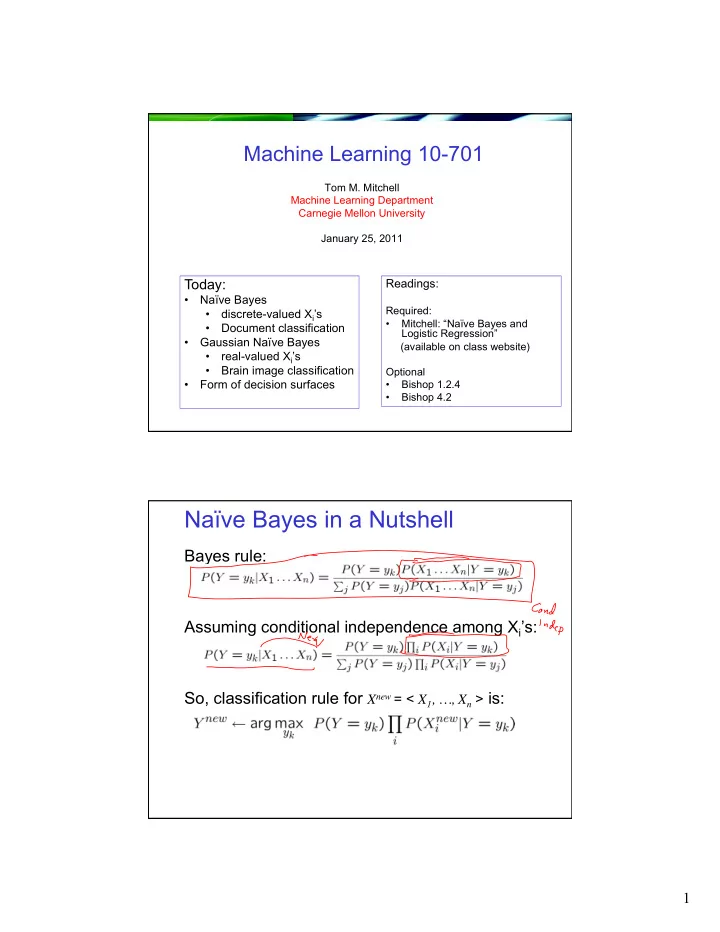
Naïve Bayes in a Nutshell

Bayes rule: Assuming conditional independence among Xi’s: So, classification rule for Xnew = < X1, …, Xn > is:

slide-2
SLIDE 2

2

Another way to view Naïve Bayes (Boolean Y): Decision rule: is this quantity greater or less than 1?

P(S | D,G,M)

slide-3
SLIDE 3

3

Naïve Bayes: classifying text documents

  • Classify which emails are spam?
  • Classify which emails promise an attachment?

How shall we represent text documents for Naïve Bayes?

Learning to classify documents: P(Y|X)

  • Y discrete valued.

– e.g., Spam or not

  • X = <X1, X2, … Xn> = document
  • Xi is a random variable describing…
slide-4
SLIDE 4

4

Learning to classify documents: P(Y|X)

  • Y discrete valued.

– e.g., Spam or not

  • X = <X1, X2, … Xn> = document
  • Xi is a random variable describing…

Answer 1: Xi is boolean, 1 if word i is in document, else 0 e.g., Xpleased = 1 Issues?

Learning to classify documents: P(Y|X)

  • Y discrete valued.

– e.g., Spam or not

  • X = <X1, X2, … Xn> = document
  • Xi is a random variable describing…

Answer 2:

  • Xi represents the ith word position in document
  • X1 = “I”, X2 = “am”, X3 = “pleased”
  • and, let’s assume the Xi are iid (indep, identically distributed)
slide-5
SLIDE 5

5

Learning to classify document: P(Y|X) the “Bag of Words” model

  • Y discrete valued. e.g., Spam or not
  • X = <X1, X2, … Xn> = document
  • Xi are iid random variables. Each represents the word at its

position i in the document

  • Generating a document according to this distribution =

rolling a 50,000 sided die, once for each word position in the document

  • The observed counts for each word follow a ??? distribution

Multinomial Distribution

slide-6
SLIDE 6

6

Multinomial Bag of Words

aardvark 0 about 2 all 2 Africa 1 apple anxious ... gas 1 ...

  • il

1 … Zaire

MAP estimates for bag of words

Map estimate for multinomial

What β’s should we choose?

slide-7
SLIDE 7

7

Naïve Bayes Algorithm – discrete Xi

  • Train Naïve Bayes (examples)

for each value yk estimate for each value xij of each attribute Xi estimate

  • Classify (Xnew)

prob that word xij appears in position i, given Y=yk * Additional assumption: word probabilities are position independent

slide-8
SLIDE 8

8

For code and data, see

www.cs.cmu.edu/~tom/mlbook.html

click on “Software and Data”

What if we have continuous Xi ?

Eg., image classification: Xi is real-valued ith pixel

slide-9
SLIDE 9

9

What if we have continuous Xi ?

Eg., image classification: Xi is real-valued ith pixel Naïve Bayes requires P(Xi | Y=yk), but Xi is real (continuous) Common approach: assume P(Xi | Y=yk) follows a Normal (Gaussian) distribution

Gaussian Distribution

(also called “Normal”) p(x) is a probability density function, whose integral (not sum) is 1

slide-10
SLIDE 10

10

What if we have continuous Xi ?

Gaussian Naïve Bayes (GNB): assume Sometimes assume variance

  • is independent of Y (i.e., σi),
  • or independent of Xi (i.e., σk)
  • or both (i.e., σ)
  • Train Naïve Bayes (examples)

for each value yk estimate* for each attribute Xi estimate

  • class conditional mean , variance
  • Classify (Xnew)

Gaussian Naïve Bayes Algorithm – continuous Xi

(but still discrete Y) * probabilities must sum to 1, so need estimate only n-1 parameters...

slide-11
SLIDE 11

11

Estimating Parameters: Y discrete, Xi continuous Maximum likelihood estimates:

jth training example

δ()=1 if (Yj=yk)

else 0 ith feature kth class

How many parameters must we estimate for Gaussian Naïve Bayes if Y has k possible values, X=<X1, … Xn>?

slide-12
SLIDE 12

12

What is form of decision surface for Gaussian Naïve Bayes classifier?

eg., if we assume attributes have same variance, indep of Y ( )

GNB Example: Classify a person’s cognitive state, based on brain image

  • reading a sentence or viewing a picture?
  • reading the word describing a “Tool” or “Building”?
  • answering the question, or getting confused?
slide-13
SLIDE 13

13

Y is the mental state (reading “house” or “bottle”) Xi are the voxel activities, this is a plot of the µ’s defining P(Xi | Y=“bottle”)

fMRI activation

high below average average

Mean activations over all training examples for Y=“bottle”

Classification task: is person viewing a “tool” or “building”?

statistically significant p<0.05

Classification accuracy

slide-14
SLIDE 14

14

Where is information encoded in the brain?

Accuracies of cubical 27-voxel classifiers centered at each significant voxel [0.7-0.8]

Naïve Bayes: What you should know

  • Designing classifiers based on Bayes rule
  • Conditional independence

– What it is – Why it’s important

  • Naïve Bayes assumption and its consequences

– Which (and how many) parameters must be estimated under different generative models (different forms for P(X|Y) )

  • and why this matters
  • How to train Naïve Bayes classifiers

– MLE and MAP estimates – with discrete and/or continuous inputs Xi

slide-15
SLIDE 15

15

Questions to think about:

  • Can you use Naïve Bayes for a combination of

discrete and real-valued Xi?

  • How can we easily model just 2 of n attributes as

dependent?

  • What does the decision surface of a Naïve Bayes

classifier look like?

  • How would you select a subset of Xi’s?