
SLIDE 1
Facilities & Campus Planning Committee Climate Action Plan 2.0
October 30, 2014
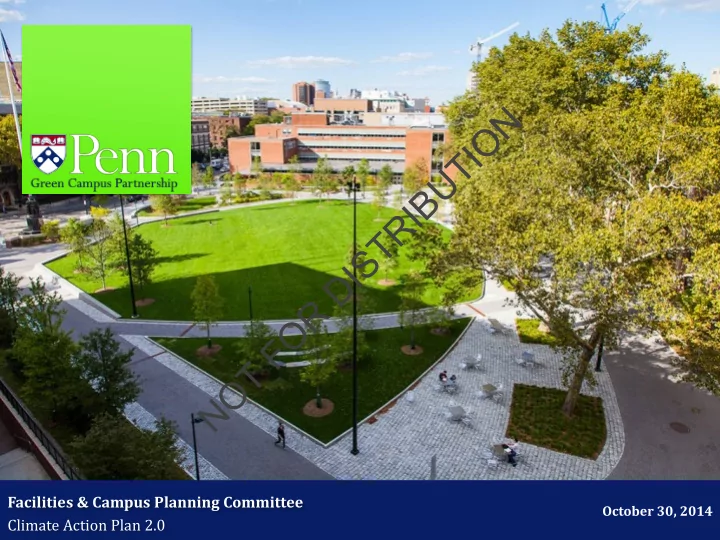
N O I T U B I R T S I D R O F T O N Facilities - - PowerPoint PPT Presentation
N O I T U B I R T S I D R O F T O N Facilities & Campus Planning Committee October 30, 2014 Climate Action Plan 2.0 PENNS CONTINUING COMMITMENT N O I T U B I R T S I D STARS Penn signs Climate Action
Facilities & Campus Planning Committee Climate Action Plan 2.0
October 30, 2014
STARS sustainability survey completed Climate Action Plan 2.0 launched Climate Action Plan launched
Climate Action Plan Implementation
Penn signs Presidents Climate Commitment
ESAC writes Penn’s Climate Action Plan
1
Implement Climate Action Plan 2.0 ESAC writes CAP2.0
2
Expand sustainability programs for Penn’s undergraduate and graduate students:
summer faculty research assistantships Provide outreach and support to faculty for sustainability research & teaching:
Create a Penn Sustainability Symposium / Speaker Series Promote Penn’s sustainability leadership by engaging with key government, corporate, professional, & nonprofit stakeholders
Climate Action Plan Phase 1 (2009-2014) Goals
Sustainability & Environmental Management minor (Achieved)
Teaching and Learning to hold sustainability workshops for faculty (Achieved)
Research in Action courses (Achieved)
engagement opportunities for students (Achieved)
Project a sustainability related subject (Achieved)
3
Carbon Reduction in Buildings: 7% by 2019 18% by 2042 Energy Reduction in Buildings: 10% by 2019 27% by 2042
(All reductions are based on an FY14 baseline, normalized for weather and campus growth)
The top 20% of buildings with the highest energy use (~45 buildings) will be recommissioned on a five-year basis The remaining 80% of buildings (~ 135) will be recommissioned on a ten-year basis Update the Penn Engineering Guidelines to ensure all capital projects meet next generation codes Develop a model energy plan for all buildings Investigate alternative strategies and costs to achieve the 2042 carbon neutrality goal, including additional REC purchases
Climate Action Plan Phase 1 (2009-2014) Goals
emissions by FY14 (Achieved - 18%)
consumption (Achieved- 6.6% decrease normalized to weather and campus growth; absolute consumption increased 5.1%)
each year (Recommissioned 54 buildings in total)
(Achieved – Century Bond program will upgrade 8 building HVAC systems and 45 lighting systems)
performance standards (Achieved)
4
LEED Silver minimum for capital projects; focus on energy performance, water conservation, and indoor environmental quality Apply Penn’s Green Guidelines for Renovations Implement Ecological Landscape Stewardship Plan
Green Sustainable SITES pilot
biodiversity
Continue implementation of the Penn Stormwater Master Plan:
Climate Action Plan Phase 1 (2009-2014) Goals
Certification for new buildings (Achieved - Six
buildings)
for campus renovations (Achieved)
for building maintenance and operations (Achieved)
Statement to incorporate a sustainability agenda (Achieved)
5
Extend the Climate Action Plan beyond the core campus:
will complete a carbon inventory, starting with the Hospital of the University of Pennsylvania
promote its sustainability initiatives & completed a carbon inventory
and resource conservation ethic to implement strategic sustainability initiatives, in addition to completing a carbon inventory
Institutionalize high-performance sustainability goals for Penn’s leased space and real estate projects.
6
Implement the 2013 Solid Waste Management Plan, prioritizing the following goals:
for managing landfill waste, recycling, e-waste, food & landscape refuse, and construction/demolition debris
Set an aggressive goal to increase Penn’s overall waste diversion by 2019:
and reduce single-use products sold & used on campus
Climate Action Plan Phase 1 (2009-2014) Goals
rate of paper, cardboard, and commingled recyclables from 20% to 40% (Achieved - 24%)
waste minimization and recycling policy (Under development through the Solid Waste Working Group)
mechanism for communication and feedback from Penn constituents (Achieved)
waste minimization and recycling awareness campaign (Achieved)
and Recycling Coordinator position
7
Delivering Green Purchasing Solutions
Identify green purchasing opportunities and require suppliers to report on green initiatives quarterly
Recognizing Green Purchasing Champions
Develop a recognition program to reward green purchasing
Modernizing Contracts
Partner with the Office of General Council to integrate sustainability language into Contracts and Request for Proposals
Learning and Sharing with Industry Leaders
Actively participate in the Sustainable Purchasing Leadership Council to identify best practices
Integrating Performance Tracking
Integrate sustainability goals into Purchasing performance plans and report green impact twice annually
8
The Bicycle Committee will meet quarterly to focus on the following improvements:
pertinent information for bikers on campus
repair stations
facilities for commuters Continue to encourage alternative commuting to reduce the number of single-occupancy vehicles coming to campus
Climate Action Plan Phase 1 (2009-2014) Goals
population will use alternative transit by FY14. (Achieved – over 50%)
transportation through better services and
public transportation and decrease of single-
(Achieved)
Penn Transit’s fleet. (Achieved)
9
Expand Sustainability Coordinators to all Schools & Centers Sustain vibrant Eco-Reps programs in College Houses, Greek chapters, Hillel, and Athletics to foster a student culture of sustainability Enhance collaboration with the Office of Student Affairs Maintain a dynamic Faculty/Staff Eco-Rep program Support expanded Faculty Sustainability Discussion Forums Increase the number of Green Office Certifications
by 2019
Promote Penn Green Fund grants for behavior change and operational improvements
Climate Action Plan Phase 1 (2009-2014) Goals
Penn’s sustainability efforts (Achieved)
Student Eco-Reps peer leadership programs (Achieved – 160 participants)
leadership to speak on Penn’s Climate Action Plan (Achieved)
maintain a robust website (Achieved)
sustainability six times annually (Achieved)
campaigns throughout the school year (Achieved)
10
Metric FY07 FY14 Progress
Learn Sustainability: Sustainability focused Undergrad & Grad programs 1 4 Conserve Energy: Total Utilities Consumption 2,435,611,286 kBTU (Absolute Data ) 32.46 BTU/degree day/sq ft
(Normalized Data)
2,558,952,628 kBTU
(Absolute Data – 5.1% increase )
30.32 BTU/degree day/sq ft
(Normalized Data – 6.6% decrease)
Design Green: Certified LEED on- campus buildings and renovations 6 Reduce Emissions: Commuters that use public transit, bike, or walk 40% 50+% Minimizing Waste: Recycling Rate 17%
(paper, cardboard, & comingled)
27%
(paper, cardboard, & comingled)
31%
(above plus food waste)
Outreach & Engagement Eco-Reps 160 Green Fund projects 49
11