
SLIDE 1
G2P Payments in COVID-19 context:
Key areas of action and experiences from country emergency actions
Welcome to the webinar
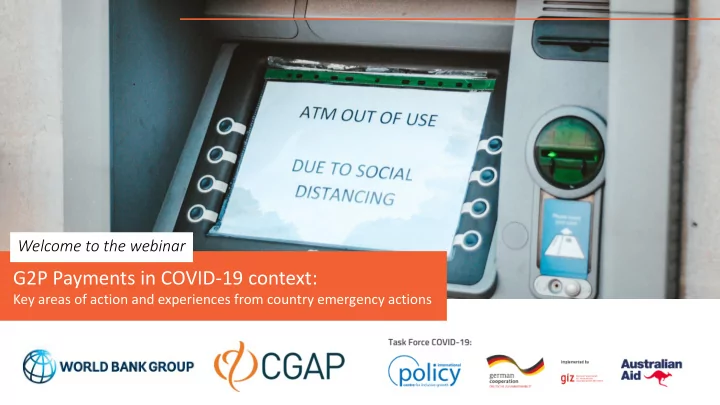
G2P Payments in COVID-19 context: Key areas of action and - - PowerPoint PPT Presentation
Welcome to the webinar G2P Payments in COVID-19 context: Key areas of action and experiences from country emergency actions Social protection responses to #COVID19 This joint effort is inspired by colleagues and organisations working to dis
G2P Payments in COVID-19 context:
Key areas of action and experiences from country emergency actions
Welcome to the webinar
This joint effort is inspired by colleagues and
issemin inate and dis iscu cuss th the e mos
t rec ecent con
ial protection res esponses es to
19. The initiative has three major components:
1. A weekly special edition of a dedicated ne newsle letter, featuring a compilation of relevant information from all
COVID-19; 2. Weekly web ebinars to foster discussions and exchanges; 3. An Onl Onlin ine Co Communit ity to systematise the information gathered on the topic and foster discussion.
Photo by Zhang Kenny on Unsplash
#SPcovid19 #COVID19 #SPresponses
DFID-UK / Flickr / CC BY 2.0
Thursday, 16 April, at 8:00 am EDT/GMT-4
Les esson sons s learned rned and d Oppor pportun tunities es: :
Link nking ng social al protecti tion n systems s to to humani manitari rian an ca cash h in a p pande demic Tuesday, 21 April, at 3 pm CEST/GMT+2
Impa mpacts cts of the e COVID VID-19 19 crisi sis s on n empl mploym ymen ent: t:
(potential al) solut utions ns for inf nform rmal al/ self-empl ployed d workers
socialprotection.org presents:
Panell ellis ists: Douglas Randall, Financial Sector Specialist, World Bank Veronica Trujillo, Financial Inclusion Expert, World Bank Fiorella Risso, Financial Inclusion Analyst, World Bank Guillermo Galicia, Consultant, World Bank Silvia Baur-Yazbeck, Financial Sector Analyst, CGAP Mod
Luz Stella Rodriguez, Social Protection Specialist, World Bank
Panellist
Douglas Randall
World Bank
Douglas Randall is a financial sector specialist in the World Bank’s Finance, Competitive & Innovation Global Practice. In his current role, Douglas works with financial sector authorities in Latin American and the Caribbean to improve financial sector development and financial inclusion through policy advice, lending operations, diagnostic assessments and capacity-building. Douglas also contributes to the global knowledge agenda for financial inclusion; recent publications include a global survey and report on regulatory approaches to alternative finance, a toolkit on national financial inclusion strategies, a discussion note on suptech, and a report on the fintech revolution in China.
G2P Payments in COVID-19 context: Key areas of action and experiences from country emergency actions
Panellist
Veronica Trujillo
World Bank
Verónica is a specialist in Digital Financial Services (DFS) and Financial Inclusion. She works as consultant for the World Bank analyzing policies and regulations to favor DFS development around the world. Her analysis includes financial system infrastructure, DFS specific products (e-money, alternative finance, crowdfunding, among others) and the use of technologies for compliance (RegTech/SupTech). Previously she worked as a consultant for the Multilateral Investment Fund (MIF, Inter- American Development Bank), leading or participating in many regional projects to support financial inclusion across Latin –America and Caribbean
Team publication and leads a project to build a regional database on financial institutions' sustainability and outreach indicators. Verónica is PhD by Salamanca University and holds a Master in International Relations and Diplomacy, and another in Law and Economics.
G2P Payments in COVID-19 context: Key areas of action and experiences from country emergency actions
Panellist
Fiorella Risso
World Bank Fiorella Risso is Professional Financial Inclusion Consultant at the World
related to financial inclusion, poverty and inequality of opportunities; as well as experience in management and evaluation of projects in Peru and abroad, as well as regulatory proposals around financial inclusion. PhD candidate in Economics, she holds a master's degree in International Economics and Development, and a degree in Applied Economics by the Paris Dauphine University.
G2P Payments in COVID-19 context: Key areas of action and experiences from country emergency actions
Panellist
Guillermo Galicia
World Bank
Guillermo is an Extended-Term Consultant at the Financial Inclusion, Infrastructure & Access Global Practice of the World Bank, based in Washington DC. Previously, he was a Consultant at the Inter-American Development Bank in Washington DC, where he developed research for digital payments and where he was seconded by the Central Bank
design and implementation of regulation for digital payments, retail payment systems, financial market infrastructures, fintech, prudential requirements and derivatives and capital markets. He has also conducted research at the Columbia Center on Sustainable Investment and headed product design functions at FINCA Impact Finance. He has an MPA from Columbia University and a Master of Finance from ITESM.
G2P Payments in COVID-19 context: Key areas of action and experiences from country emergency actions
Panellist
Silvia Baur-Yazbeck
CGAP Silvia Baur-Yazbeck is a development economist working on financial sector policy and consumer protection issues at CGAP. Her work focuses on the risks and opportunities emerging from the digitization of financial services and the growing interconnectedness of financial systems. Silvia has been leading CGAP work on government-to-person payment systems that are designed to empower recipients through customer choice and convenience.
G2P Payments in COVID-19 context: Key areas of action and experiences from country emergency actions
Moderator
Luz Rodriguez
World Bank
Luz Stella Rodriguez is a Social Protection Specialist in the World Bank Social Protection and Jobs Global Practice. In her current role, Luz works with Latin American governments to strength the design and delivery of social protection systems. In addition, Luz contributes to the global knowledge agenda to improve G2P payments from a human centered design
National Planning Department (DNP) and the President’s Office for Social Policy in Colombia, where she was actively involved in the design, implementation and evaluation of signature social protection programs. Luz also has worked with other international organizations, including the IDB, IOM and UNDP. Luz holds a MSc. in Planning from the University of Toronto and a M.A. in Political Economy from Essex University.
G2P Payments in COVID-19 context: Key areas of action and experiences from country emergency actions
#SPorgWebinar #SPcovid19 #COVID19 #SPresponses
type them in the chat bar
Also, interact with us on Twitter (@SP_Gateway): G2P Payments in COVID-19 context: Key areas of action and experiences from country emergency actions
and measures for emergency payments
The optimal design of the payment mechanism in the context of COVID-19 must take into account:
payment points, and make sure there are enough cash out points
use of financial services
Foto de Charlotte Green
and (ii) facilitate social distancing, sanitation, and security at access points
receiving account-based transfers; (ii) systemize health measures
account-based transfers; and (ii) strengthen digital payments ecosystem
Providers Access Points Payments Infra Account-based Over-the-counter Liquidity Targeting Enrollment Authentication Consumer Protection Health Communication
Immediate actions Short-term actions Medium-term actions ➢ Expand to include largest financial service providers (FSPs); ➢ Design incentives to incentivize scale-up and ensure liquidity; ➢ Begin to address
barriers to further inclusion of FSPs; ➢ Further expand set of FSPs to include all licensed FSPs (e.g., banks, cooperatives, mobile money providers) with significant branch/ATM/agent network; ➢ Implement emergency regulatory measures to enable additional providers (e.g. mobile network operators, social network or e- commerce platforms) to disburse into e- wallets; ➢ Expand consumer choice and enable provider switching;
Immediate actions Short-term actions Medium-term actions
➢ Classify financial access points as essential services to ensure they remain open to public; ➢ Leverage full range of financial access points ➢ Expand universe of agents to include other essential business (e.g. pharmacies) and government offices ➢ Distribute mPOS and mobile hotspots; ➢ Build data infrastructure to monitor access points ➢ Extend no-interest credit lines to agents to ensure liquidity; ➢ Leverage agent network managers to address liquidity issues; ➢ Ensure adequate licensing and supervision of agent network managers; ➢ Implement regulatory measures to expand permitted activities of agents;
Immediate actions Short-term actions Medium-term actions ➢ Require beneficiaries with existing accounts to register accounts with the government and shift to account-based transfers; ➢ Require FSPs to waive key fees (e.g., account re-activation fees, third-party ATM withdrawal fees); ➢ Waive clawback provisions; ➢ Enable and promote remote account
➢ Implement a contingency basic account, with transaction limits, no fees, and simplified due diligence. ➢ Leverage enrollment platform to enable remote account opening and authentication; ➢ Provide ‘virtual cards’ using one-time- passwords (OTPs) ➢ Assess implementing semi closed USSD mechanism for mobile payments, with access to cash outs in branches and ATMs with one-time-password (OTP) requests; ➢ Foster interoperability for G2P linked accounts between e-wallets and accounts with other FSPs;
Immediate actions Short-term actions ➢ Defer KYC/CDD on new basic account
enable agents to perform KYC/CDD; ➢ Defer KYC/CDD for new agents/merchants; ➢ Extend validity of expiring IDs; ➢ Use one-time-passwords (OTP) to validate identity for OTC transactions; ➢ Facilitate eKYC and online authentication ➢ Coordinate across authorities (e.g., telco authority, ID authority, social security authority) to validate beneficiary identify and link to mobile numbers ➢ Allow for alternative forms of identification for vulnerable groups (e.g. refugees); ➢ Inform beneficiaries of the importance of maintaining same mobile number;
Foto de Luis Davila
also share their phone number through hotline
verification)
available
Picture by: World Bank (2013)
Bono “Yo me quedo en casa”, implemented by the Ministry of Development and Social Inclusion and deliver to 2.7 million households in poverty and extreme poverty (PEN 380, around USD110) 2 payments will be disbursed.
Targeting System (SISFOH) and other administrative databases such as from de ministry of health.
(yomequedoencasa)
branch) to collect the bono.
branches showing their ID.
received the transfer on their accounts. Cash-out allow from existing ATM or from Banco de la Nacion agent banking.
Key opportunities
member beneficiary.
access points.
Key considerations
branches based on their localization.
Bono Independiente (780,000 families will receive PEN 380, approximately USD 110) implemented by the Ministry of Labor Main in pr process
the subsidy.
the transfer on the account.
receive, through SMS, a code and link to access Banco de la Nación mobile banking.
service that works as follows: ➢ Beneficiaries dial 551# from cellphone ➔ They will access an interface where they will input the code they received and select the withdrawal option ➔ They key the amount to withdraw and will receive an OTP valid for 10 minutes ➔ They can use the OTP at BN agents and BN ATMs.
Key considerations
Key challenges and opportunities
access points.
Picture by: Dominik Chavez (2016)
Main process
Labor databases.
financial system.
the type of connectivity on the device that beneficiaries have (4G, 3G, 2G).
➢ 4G and 3G: They are notified through an SMS and a link is provided to download app and open an account on a mobile wallet (OTP can be obtained to cash-out at ATMs and agents). ➢ 2G: They are notified through an SMS and must open an account using USSD technology (OTP also available).
Ingreso Solidario, implemented by the National Planning Department (DNP) and the Financial Regulatory Unit (URF). A first payment of COP 160, 000 (Approximately USD 40) and a second of COP 80,000 (USD 20) to 3 million families (who had not received social payments before).
Source: Alternativa Caribe. April 7, 2020
Key considerations:
by the government
specific banks based
the infrastructure of each bank to spread
payment points and avoid agglomerations.
Ahorro Simplificado, CATS) which can be opened remotely using Simplified Customer Due Dilligence
Opportunities:
Fuente: https://www.trendsmap.com/twitter/tweet/1247577855518793733
Picture by: Dominik Chavez (2016) Picture by: World Bank (2014)
Main process
data for almost one million households that applied to the Takaful Cash Transfer program and, more recently, to the Bread Subsidy Compensation program.
automatically using the National Unified Registry (NUR), which includes data from multiple government entities.
wallet provider to receive the support.
National Aid Fund (NAF) will deliver to 200,000 families an estimated 136 JOD -192 USD - per month for households with 4 or more members, and JOD 34 – USD 48 - times the number of members for households with 3 members or less. This emergency program is expected to continue for six months. Key considerations:
(CBJ) relaxed its current regulations to the six licensed Payment Service Provers (PSPs) by providing an
wallet
process with basic and simplified KYC requirement, and instructed them to provide full interoperability through the central JoMoPay
the 7th license to a new PSP expediting the normal process.
interchange fee structure the wallet transactions and increased the allowable limits to 5000 JD per wallet.
Wide reaching distribution networks Customer choice Public private cooperation Supported cash-out
$ Effective communication and recourse channels Use of mobile technology Robust customer authentication Connected public systems and registries
Examples: India’s Aadhaar Payments Bridge System, Thailand’s PromptPay Requirement: unique digital ID system, interoperability between public registries Result: Easier enrollment, customer choice
From “National Payments Corporation of India and the Remaking of Payments in India” on cgap.org
Recipients
PROVIDER Y PROVIDER X PROVIDER Z
PROGRAM PROGRAM PROGRAM
Multiple programs and payers plug into shared infrastructure Numerous and widely accessible access points Shared infrastructure, including payment schemes, ID system, ID-account directory/mapper Variety of suitable payment instruments Multiple account issuers and payment providers Learn more about “The Future of G2P Payments” on cgap.org
G2P Payments in COVID-19 context: Key areas of action and experiences from country emergency actions
DFID-UK / Flickr / CC BY 2.0
Thursday, 16 April, at 8:00 am EDT/GMT-4
Le Lessons le lear arned an and Opportunitie ies:
Lin Linkin ing SP systems to
itarian cash in in a pandemic
Make sure to answer our webinar survey, available after the session! G2P Payments in COVID-19 context: Key areas of action and experiences from country emergency actions