My background I graduated 2000 with a BA in Physics and a minor in - - PowerPoint PPT Presentation

my background
SMART_READER_LITE
LIVE PREVIEW

My background I graduated 2000 with a BA in Physics and a minor in - - PowerPoint PPT Presentation

My background I graduated 2000 with a BA in Physics and a minor in Astrophysics. I worked with Dr. Scott Robertson in the Plasma Physics lab from 1997 to 2000. Very hands on work on small research projects Machine shop work to


slide-1
SLIDE 1

Space Science Teacher’s Summit 6/7/2011

LASP Open Information Triplett page 1

My background

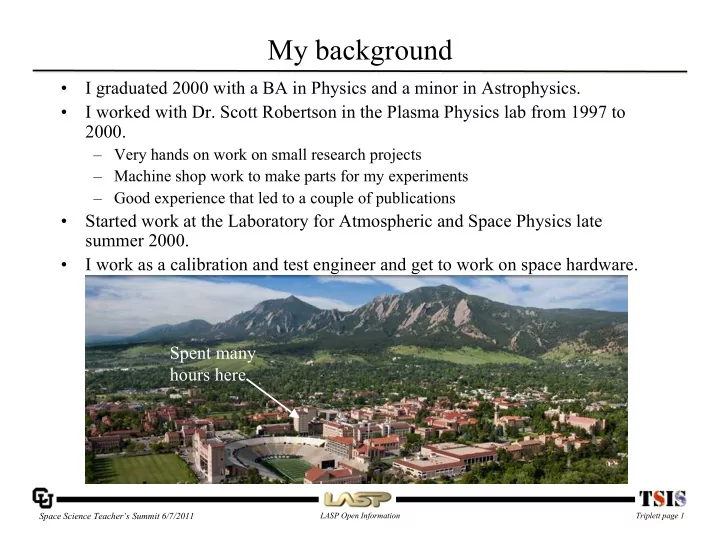
  • I graduated 2000 with a BA in Physics and a minor in Astrophysics.
  • I worked with Dr. Scott Robertson in the Plasma Physics lab from 1997 to

2000.

– Very hands on work on small research projects – Machine shop work to make parts for my experiments – Good experience that led to a couple of publications

  • Started work at the Laboratory for Atmospheric and Space Physics late

summer 2000.

  • I work as a calibration and test engineer and get to work on space hardware.

Spent many hours here

slide-2
SLIDE 2

Space Science Teacher’s Summit 6/7/2011

LASP Open Information Triplett page 2

LASP

  • LASP has been doing space research for over 60 years.
  • LASP studies many things about space including the Sun and Earths

atmosphere.

  • There are currently 302 professionals and 137 students working at LASP on

183 projects.

  • I work in the Cal and Test group (21 professionals and 2 students) on the Total

and Spectral solar Irradiance Sensor (TSIS) program slated to launch mid 2014.

  • http://lasp.colorado.edu/home/
slide-3
SLIDE 3

Space Science Teacher’s Summit 6/7/2011

LASP Open Information Triplett page 3

Why we study the Sun

  • The Sun is the largest driver of the

Earth’s climate.

  • The Sun changes constantly.

NASA SOHO image of a Solar Prominence that could release into a CME

Composite SOHO image of a CME

SOHO image of Sun at 3 wavelengths of UV light

Image from:http://www.internet-d.com/2009/03/18/a-prominent-solar-prominence-from-soho/ Image from: http://apod.nasa.gov/apod/ap980820.html Image from: http://solar-center.stanford.edu/sun-today.html

slide-4
SLIDE 4

Space Science Teacher’s Summit 6/7/2011

LASP Open Information Triplett page 4

Solar “weather”

  • Solar “weather” affects us all.
  • Solar events can damage satellites.
  • Sun spots go hand in hand with

solar activity.

  • High solar activity = Better Aurora

Sun spots as of June 3 2011 Aurora from the ground Aurora viewed from Space

Image from: http://www.spaceweather.com/ Image from: http://earthobservatory.nasa.gov/IOTD/view.php?id=6226 Image from: http://apod.nasa.gov/apod/ap070409.html

slide-5
SLIDE 5

Space Science Teacher’s Summit 6/7/2011

LASP Open Information Triplett page 5

What I am going to talk about

  • Start with the “small” part that I

work on and move to the “bigger” part that is the instrument.

  • How all of the pieces come together

to answer a science question.

  • Sorry I get wordy on slides.
slide-6
SLIDE 6

Space Science Teacher’s Summit 6/7/2011

LASP Open Information Triplett page 6

My current work

  • The work that I am doing now is a

repeat of the work I did fresh out of college.

  • I am building the second generation

Electrical Substitution Radiometer (ESR) for the Spectral Irradiance Monitor (SIM).

  • The ESR is the on-flight calibrated

detector for measuring solar output from 200nm (Ultra Violet) to 2.5 microns (Infrared).

  • The ESR measures solar

irradiance (power/ area) by measuring the heat of light and converting it to electrons that we detect in our electronics. SIM SIM ESR ESR Bolometer

slide-7
SLIDE 7

Space Science Teacher’s Summit 6/7/2011

LASP Open Information Triplett page 7

ESR details

  • I will pass around the ESR bolometer

for a better sense of scale.

  • The ESR is a good example of the

things that we need to consider for space instrumentation.

– Thermal environment – Optical alignment to collect light – Mechanically durable – Detector that meets program requirements

  • The ESR is a thermal detector.
  • We want it to work fast to minimize the

amount of exposure to the sun.

– The Sun’s radiation is very hard on equipment especially outside of the atmosphere.

  • The ESR works with one bolometer

looking at the Sun and one in the dark and then they are balanced.

Bolometer layout Bolometer operation

slide-8
SLIDE 8

Space Science Teacher’s Summit 6/7/2011

LASP Open Information Triplett page 8

Calibration

  • Once the detector is built it is time to

calibrate it.

  • Calibration verifies that the output of the

detector is understood.

  • We measure the output of our detector in

DN (Data Numbers).

  • What does it mean if I plug the detector into
  • ur instrument and look at a light source and

get 25,237 DN?

  • We use calibrated light sources that have

known outputs of power and are traceable to a National Institute of Standards and Technology (NIST) standard.

  • We also use a NIST traceable detector to

measure this light. – We can measure the power of the light with this detector.

  • Now we put our detector in the light and can

say that we know power/ DN.

  • There are many facilities in the world that

have specialized light sources to calibrate detectors.

Image from: http://icpem.org/2008/tours.html

NIST Boulder, CO NIST Gaithersburg, MD

Image from:http://events.oasis-open.org/home/forum/2009/venue

slide-9
SLIDE 9

Space Science Teacher’s Summit 6/7/2011

LASP Open Information Triplett page 9

Total Irradiance Monitor (TIM) data

  • Multiple instruments calibrated

various ways may give a different answer when looking at the same source like the Sun.

  • Who’s right?
  • Some work with ground based

instruments has happened.

slide-10
SLIDE 10

Space Science Teacher’s Summit 6/7/2011

LASP Open Information Triplett page 10

Spectrometer

  • A spectrometer is a device that

disperses light into the wavelengths that make it up.

  • A spectrometer first has an entrance

aperture for the light to go in.

  • Different spectrometers use different

ways of dispersing the light depending

  • n what wavelengths you wish to see.
  • Gratings disperse light using slits that

diffract the light.

  • Some spectrometers use prisms and

some use gratings (transmission and reflective).

– Low UV and X-ray spectrometers need to use a grating because the light will not go through the glass.

  • Different shapes of the prisms and

different rulings on the gratings give different wavelength resolution.

  • The dispersed light is then sent into the

detector to know the power of the wavelength of light.

Image from: http://deepimpact.umd.edu/science/spectroscopy.html Image from: http://www.daviddarling.info/encyclopedia/D/diffgrating.html

slide-11
SLIDE 11

Space Science Teacher’s Summit 6/7/2011

LASP Open Information Triplett page 11

How SIM works

  • Where does the ESR fit into a spectrometer?
  • Fery prism both disperses the light and focuses it at the focal plane.
slide-12
SLIDE 12

Space Science Teacher’s Summit 6/7/2011

LASP Open Information Triplett page 12

Spectrometers used by LASP for…

  • Understanding the Sun/ Earth interactions:
  • SORCE: SOlar Radiation and Climate Experiment

– Total solar irradiance (TSI)—the total amount of solar radiative energy reaching the Earth’s upper atmosphere in all spectra . – Spectral solar irradiance (SSI)—the amount of solar radiative energy reaching the Earth’s upper atmosphere in a specific range of the spectrum. – Understanding the Solar input into the Earths atmosphere.

  • Answering questions about other planets:
  • MASCS: Mercury Atmospheric and Surface

Composition Spectrometer LASP developed and built the MASCS instrument

  • nboard MESSENGER. MASCS is designed to detect

minerals on Mercury’s surface, and determine the abundance and components of its thin atmosphere. Data from MASCS will help answer the questions: What is Mercury’s surface made out of? How is Mercury’s atmosphere generated? Does Mercury have ice at its poles?

  • And many more instruments at many other planets.
slide-13
SLIDE 13

Space Science Teacher’s Summit 6/7/2011

LASP Open Information Triplett page 13

Engineering thought process

  • Scientist proposes to make a certain measurement

to answer a question.

  • Need to design an instrument to make the

measurement to the required accuracy and range.

– Work inside of LASP between engineers and the scientist

  • Need to make this design fit into the size and

weight requirements of the satellite that the instrument will go on.

– Work between LASP and the spacecraft vendor and NASA

  • The size and weight will help to determine the

materials used.

– MASCS needed to be very light and small and as such used a Magnesium case for light weight and high strength.

  • Design the electronics and data streaming to give

the information the scientist needs in the cadence that will help answer the question they are after.

– Work inside of LASP between OPS and the scientist

MASCS instrument