SLIDE 1 Muon Monitor Analysis Update
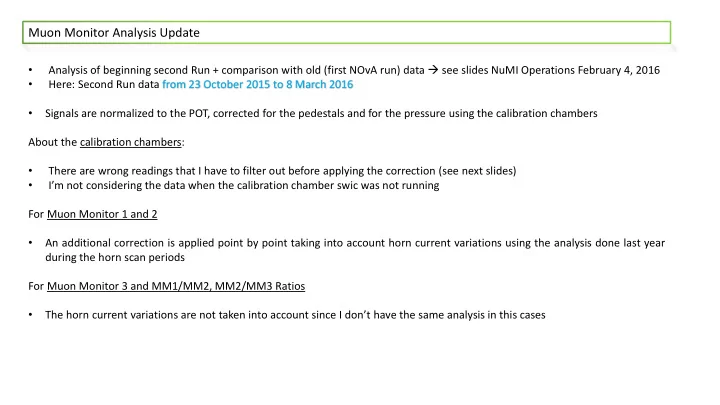
- Analysis of beginning second Run + comparison with old (first NOvA run) data see slides NuMI Operations February 4, 2016
- Here: Second Run data from 23 October 2015 to 8 March 2016
- Signals are normalized to the POT, corrected for the pedestals and for the pressure using the calibration chambers
About the calibration chambers:
- There are wrong readings that I have to filter out before applying the correction (see next slides)
- I’m not considering the data when the calibration chamber swic was not running
For Muon Monitor 1 and 2
- An additional correction is applied point by point taking into account horn current variations using the analysis done last year
during the horn scan periods For Muon Monitor 3 and MM1/MM2, MM2/MM3 Ratios
- The horn current variations are not taken into account since I don’t have the same analysis in this cases
SLIDE 2 Muon Monitors – Calibration Chambers
Wrong readings to be filtered
- There are wrong data clearly out of the
distribution
- There are periods when the calibration
chamber swic was not running don’t compute the corresponding MM signal in those cases
- Plus, we need to filter out wrong readings,
can’t really just cut them since they’re in the distribution of the good values
Here’s an example for Calibration Chamber104 (MM1) same considerations are valid for the other 2 Calib. Ch.
SLIDE 3
Muon Monitor 1 and Muon Monitor 2 – Correction for the Horn Current variations
Measured values during the Horn Scans in 2015
Use fit parameters to apply correction for horn current variations point by point
Last year I analyzed the MM data during the horn current scans so we can check what happens applying a correction for the current variation
The correction applied is m’ = mmeasured – mexpected + mnominal from fit
MM1 nominal value from Run1: 0.2699 MM2 nominal value from Run1: 1.244 13Oct2015 8Mar2016 13Oct2015 8Mar2016 13Oct2015 8Mar2016 Second Run – before horn current correction – POT norm, Ped&Press Corr.
MM1 MM2 Horn Current
SLIDE 4 Muon Monitor 1 – Correction for the Horn Current variations
- Before Horn Current Correction
- After correction
-2% variation since beginning of Run2 -1.7% in the first period (<17Jan) -0.3% in the second period (>17Jan)
23Oct2015 17Jan2016 8Mar2016
SLIDE 5 Muon Monitor 2 – Correction for the Horn Current variations MM2: -1% variation since beginning
-1.% in the first period (<17Jan) -0.2% in the second period (>17Jan)
- Before Horn Current Correction
- After correction
23Oct2015 17 Jan2016 8Mar2016
SLIDE 6
Muon Monitor 1&2 after Horn Current Correction Vs POT
13Oct2015 8Mar2016
SLIDE 7 Muon Monitor 3 and MM1/MM2, MM2/MM3 Ratios
23Oct2015 8Mar2016 23Oct2015 17Jan 2016 8Mar2016
MM3: +5% from Run start to 17 Jan +2% after 17 Jan MM1/MM2: -0.2% variation since beginning of Run2 ….The ratio is very stable as expected since MM1&MM2 have the same behaviour MM2/MM3:
- 7% from Run start to 17 Jan
- 2% after 17 Jan
..as expected because MM2 decreases while MM3 increases
23Oct2015 17Jan 2016 8Mar2016
SLIDE 8
Muon Monitor 3 and MM1/MM2, MM2/MM3 Ratios VS POT
SLIDE 9 Muon Monitors – Centroids
My definition:
- I defined the horizontal and vertical positions taking the distances
from one chamber center to the next chamber center
- The horizontal distance between two chambers is 25,4 cm, same for
vertical
- The central chamber corresponds to (0,0) position, negative
positions are on the left and on the bottom, positive positions on the right and on the top
SLIDE 10
Muon Monitors – Centroids
Gas change + beam restart (not stable)
MM1 &MM2 Horizontal Centroid <0.5cm variation since Run start MM1 &MM2 Vertical Centroids are known to follow the horn current
SLIDE 11
Muon Monitor 1 – Centroids, Horn Current and POT
MM1 Vertical Centroid has about 1 cm decrease since beginning of the run but last period looks stable (it follows the horn current) MM1 Horizontal Centroid is very stable. There’s a little jump in March at the beam restart but we should see with next data a stable behavior again
SLIDE 12
Muon Monitor 2 – Centroids, Horn Current and POT
MM2 Vertical Centroid has about 1 cm decrease since beginning of the run but last period looks stable (it follows the horn current) MM2 Horizontal Centroid has a variation at the order of a mm. Same little jump when the beam restarted
SLIDE 13 Muon Monitor Analysis Update - Conclusions
- Second Run data analysed: from 23 October 2015 to 8 March 2016
- Signals are normalized to the POT, corrected for the pedestals and for the pressure using the calibration chambers.
- For the first and second muon monitor a correction to take into account the horn current variation is also applied
Since the beginning of the run the signal decrease is about 1,2 % but after the 17th of January the signals become much more stable (<<1% variation)
- The third muon monitor increases since the Run start, it looks like it’s more stable after January 17 (..still it shows a
+2% increase)
- The MM1/MM2 ratio is as expected very stable and the MM2/MM3 ratio decreases since the MM3 signal increases
- The signals w.r.t. the POT look ok
- The vertical centroids follow the horn current as already seen in the past. It looks like they are more stable in the last part of
the run (the variations are anyway of the order of the cm)
- The horizontal centroids are very stable, at the mm level
Keep monitoring