
SLIDE 1
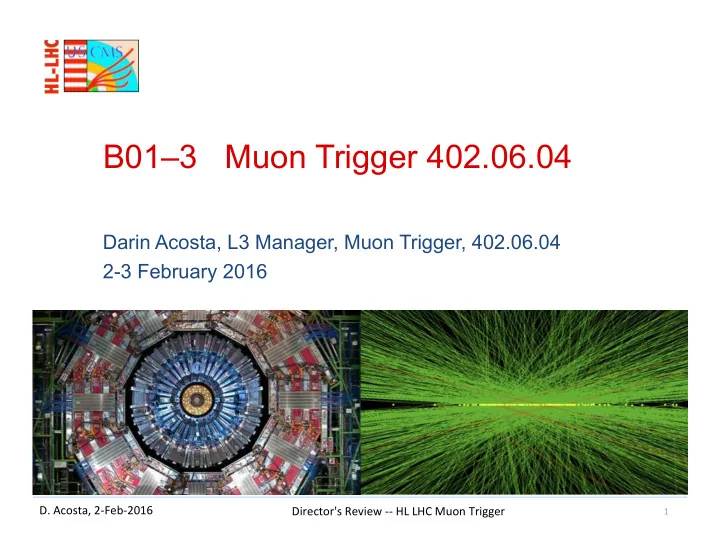
B01–3 Muon Trigger 402.06.04
Darin Acosta, L3 Manager, Muon Trigger, 402.06.04 2-3 February 2016
1 ¡
Director's ¡Review ¡-‑-‑ ¡HL ¡LHC ¡Muon ¡Trigger ¡
- D. ¡Acosta, ¡2-‑Feb-‑2016 ¡
B013 Muon Trigger 402.06.04 Darin Acosta, L3 Manager, Muon - - PowerPoint PPT Presentation
B013 Muon Trigger 402.06.04 Darin Acosta, L3 Manager, Muon Trigger, 402.06.04 2-3 February 2016 D. Acosta, 2-Feb-2016 Director's Review -- HL LHC Muon Trigger 1 Outline
1 ¡
Director's ¡Review ¡-‑-‑ ¡HL ¡LHC ¡Muon ¡Trigger ¡
2 ¡
Director's ¡Review ¡-‑-‑ ¡HL ¡LHC ¡Muon ¡Trigger ¡
3 ¡
Director's ¡Review ¡-‑-‑ ¡HL ¡LHC ¡Muon ¡Trigger ¡
§ Darin Acosta (U. Florida) – US CMS HL-LHC L3 Muon Trigger Project Manager
§ CMS Level-1 Trigger (co)Project Manager, 2012-16 § US CMS Phase 1 Upgrade L3 Muon Trigger Project Manager 2013 – present § US CMS CSC Track-Finder project, 1998- present
§ Ivan Furic (U. Florida)
§ CSC and EMU Track-Finder projects, 2008-present
§ Paul Padley (Rice U.)
§ US CMS EMU Project Manager 2006-2012 § US CMS EMU Port Card, Clock Card, and Sorter projects, 1998 – present
§ Alexei Safonov (Texas A&M)
§ US CMS EMU CSC Trigger Motherboard project
§ Darien Wood (Northeastern U.)
§ US CMS EMU electronics manager § CSC and EMU Track-Finder projects
§ Alex Madorsky (U. Florida) – Muon Track-Finder Trigger Lead Engineer
§ Nearly two decades of engineering on CMS Trigger, EMU, and Track-Finder – since 1999 § Delivered CSC Track-Finder Trigger for CMS § Delivered Phase-1 EMU Track-Finder upgrade electronics and firmware
§ Mike Matveev (Rice U.) – Muon Port Cards and Sorter Lead Engineer
§ Over a decade of engineering on CMS Trigger, EMU, Port Cards, Sorter – since 1999 § Delivered CSC Clock and Control Board and Muon Sorter for CMS § Delivered Phase-1 EMU Track-Finder upgrade electronics and firmware
4 ¡
Director's ¡Review ¡-‑-‑ ¡HL ¡LHC ¡Muon ¡Trigger ¡
5 ¡
Director's ¡Review ¡-‑-‑ ¡HL ¡LHC ¡Muon ¡Trigger ¡
Director's ¡Review ¡-‑-‑ ¡HL ¡LHC ¡Muon ¡Trigger ¡
6 ¡
U.S. ¡covers ¡fracTon ¡ (endcap ¡region) ¡
7 ¡
Director's ¡Review ¡-‑-‑ ¡HL ¡LHC ¡Muon ¡Trigger ¡
Current ¡trigger ¡ parTToning ¡in ¡η ¡
Director's ¡Review ¡-‑-‑ ¡HL ¡LHC ¡Muon ¡Trigger ¡
8 ¡
§ Efficiency, redundancy, improved PT measurement (see next slide)
§ Larger output bandwidth than current phase-1 system
§ Hardware, firmware, algorithms § Most changes and challenges are in the forward region, the traditional US responsibility
Director's ¡Review ¡-‑-‑ ¡HL ¡LHC ¡Muon ¡Trigger ¡
9 ¡
§ GEM in first 2 layers § Improved RPC in outer layers
Director's ¡Review ¡-‑-‑ ¡HL ¡LHC ¡Muon ¡Trigger ¡
10 ¡
Rate only in GE1/1 region
1.5 ¡Tbps ¡ ¡ ¡ ¡ ¡ ¡ ¡ ¡ ¡ ¡ ¡ ¡ ¡ ¡ ¡ ¡ ¡ ¡ ¡1 ¡Tbps ¡ ¡0.5 ¡Tbps ¡ ¡ ¡ ¡ ¡ ¡ ¡1 ¡Tbps ¡
Director's ¡Review ¡-‑-‑ ¡HL ¡LHC ¡Muon ¡Trigger ¡
11 ¡
Actual ¡ legacy ¡ Expected ¡ Phase ¡1 ¡
HL ¡LHC ¡ More ¡on ¡this ¡in ¡correlator ¡talk ¡
Director's ¡Review ¡-‑-‑ ¡HL ¡LHC ¡Muon ¡Trigger ¡
12 ¡
1.5 ¡Tbps ¡ ¡ ¡ ¡ ¡ ¡ ¡ ¡ ¡ ¡ ¡ ¡ ¡ ¡ ¡ ¡ ¡ ¡ ¡ ¡ ¡1 ¡Tbps ¡ ¡ ¡0.5 ¡Tbps ¡ ¡ ¡ ¡ ¡ ¡ ¡ ¡1 ¡Tbps ¡ ¡
CMS ¡TDR-‑013 ¡ 10° ¡chamber ¡
§ One 3.2 Gbps GBT link per 10° chamber going to off-detector electronics for trigger § 72 chambers à 0.25 Tbps for GE1/1
§ Assume same bandwidth per station for additional GEM and iRPC layers
§ Leads to at least a 50% increase in the input dataflow to the forward track-finding region § A larger number of hits sent to pattern recognition logic, and more tracking calculations to perform (e.g. angles) for optimal PT assignment
§ Less expensive optical parts and FPGAs lack bandwidth to process trigger data in planned number of cards and crates, resulting in a multiplication of the system in size by factors of 2-4, which costs significantly more in both M&S and labor.
13 ¡
Director's ¡Review ¡-‑-‑ ¡HL ¡LHC ¡Muon ¡Trigger ¡
§ 402.06.04.01 Muon Trigger Management
§ 402.06.03.01.01 Muon Trigger Milestones, Interfaces § 402.06.03.01.02 Muon Trigger Travel
§ 402.06.04.02 Muon Track-Finder Trigger
§ 402.06.03.02.01 Muon Track-Finder Trigger M&S (Detail Next Slide) § 402.06.03.02.02 Muon Track-Finder Trigger Engineering § 402.06.03.02.03 Muon Track-Finder Trigger Technical Work § 402.06.03.02.04 Muon Track-Finder Trigger FW § 402.06.03.02.05 Muon Track-Finder Trigger SW
§ 402.06.04.03 Muon Global Sorting Trigger
§ 402.06.03.03.01 Muon Global Sorting Trigger M&S (Detail Next Slide) § 402.06.03.03.02 Muon Global Sorting Trigger Engineering § 402.06.03.03.03 Muon Global Sorting Trigger Technical Work § 402.06.03.03.04 Muon Global Sorting Trigger FW § 402.06.03.03.05 Muon Global Sorting Trigger SW
§ 402.06.04.04 Muon Trigger Infrastructure
§ 402.06.03.04.01 Crates and Power Supplies M&S § 402.06.03.04.02 Cables, Fibers and Patch Panel M&S § 402.06.03.04.03 Test Facilities M&S § 402.06.03.04.04 Infrastructure Engineering § 402.06.03.04.05 Infrastructure Technical Work 14 ¡
Director's ¡Review ¡-‑-‑ ¡HL ¡LHC ¡Muon ¡Trigger ¡
15 ¡
Director's ¡Review ¡-‑-‑ ¡HL ¡LHC ¡Muon ¡Trigger ¡
Director's ¡Review ¡-‑-‑ ¡HL ¡LHC ¡Muon ¡Trigger ¡
16 ¡
Director's ¡Review ¡-‑-‑ ¡HL ¡LHC ¡Muon ¡Trigger ¡
17 ¡
Modules ¡also ¡used ¡by ¡CMS ¡for ¡the ¡ barrel/endcap ¡overlap ¡region ¡
Design ¡started ¡~2009 ¡
§ Coarse patterns and large PT LUT for track “fit” (uses multiple angles) § FPGA resources are 50% used
§ Will improve efficiency in endcap § Will increase the FPGA usage, leaving much less room for new inputs. § Expect inclusion later this year
§ Factor 2 for 20 GeV threshold and increasing for higher thresholds § Still to include TF algorithm improvements § But note that rate curve still flattens out at high PT (as expected for standalone resolution)
18 ¡
legacy ¡ phase-‑1 ¡
Director's ¡Review ¡-‑-‑ ¡HL ¡LHC ¡Muon ¡Trigger ¡
§ Similar size and scope (12 modules, 3 uTCA crates or larger ATCA one) § Increased I/O and logic/memory resources to meet HL LHC challenges
§ MPC Mezzanines (data source drivers) § uTCA Track Finder Cards [20 x $17.7k / card]
§ Crates, Infrastructure, Patch Panels § Test Stands [@CERN, Universities]
§ Escalation in part cost § Associative Memories (ASIC or larger FPGA) for fine patterns [$2.5k/MTF7 equivalent ~ 500k patterns] = $2.5k * 20 = $50k
19 ¡
Director's ¡Review ¡-‑-‑ ¡HL ¡LHC ¡Muon ¡Trigger ¡
20 ¡
Cost = AY $K (No Contingency)
Director's ¡Review ¡-‑-‑ ¡HL ¡LHC ¡Muon ¡Trigger ¡
*Includes Travel
21 ¡
CD4 CD1 CD2 CD3 CD0
Specification and Technology R&D Trigger TDR
Pre- production
Installation
LS 2 LS 3 Physics Physics
LHC Schedule
CDR PDR CD3A FDR
Prototyping and Demonstrators Production Readiness Review Production and Test Test & Commission
Director's ¡Review ¡-‑-‑ ¡HL ¡LHC ¡Muon ¡Trigger ¡
22 ¡
Director's ¡Review ¡-‑-‑ ¡HL ¡LHC ¡Muon ¡Trigger ¡
0 ¡ 0.5 ¡ 1 ¡ 1.5 ¡ 2 ¡ 2.5 ¡
FY16 ¡ FY17 ¡ FY18 ¡ FY19 ¡ FY20 ¡ FY21 ¡ FY22 ¡ FY23 ¡ FY24 ¡ FY25 ¡
23 ¡
Director's ¡Review ¡-‑-‑ ¡HL ¡LHC ¡Muon ¡Trigger ¡
§ Based on conceptual design documented in CMS HL-LHC Technical Proposal § Items based on existing Phase 1 Trigger upgrade with documented costs
§ Based on LOE required as determined from Phase 1 Trigger Upgrade
§ Based on expert judgment using documented experience of similar work required for the Phase 1 Trigger Upgrade § Development of activities defined at a conceptual level informed by the experience of the Phase 1 Trigger Upgrade § Technical requirements are moderately challenging, but straightforward extrapolation from the Phase 1 Trigger Upgrade
24 ¡
Director's ¡Review ¡-‑-‑ ¡HL ¡LHC ¡Muon ¡Trigger ¡
25 ¡
Director's ¡Review ¡-‑-‑ ¡HL ¡LHC ¡Muon ¡Trigger ¡
§ Hire new engineer, subcontract to consulting firm, use FNAL engineer
§ Hire extra expert effort to recover schedule and help personnel
§ Hire extra effort to speed up testing schedule
§ Acquire spending authority to use alternative vendors (while original funds are being unencumbered).
§ Built in capabilities of trigger electronics provide signals for their own inputs &
26 ¡
Director's ¡Review ¡-‑-‑ ¡HL ¡LHC ¡Muon ¡Trigger ¡
§ L3 Manager (D.A.) responsible for applying ISM to trigger upgrade.
§ Modules similar to others built before, of small size and no high voltage
§ Regularly evaluate achievement relative to performance requirements and appropriately validate or update performance requirements and expectations to ensure quality. § QA: Equipment inspections and verifications; Software code inspections, verifications, and validations; Design reviews; Baseline change reviews; Work planning; and Self-assessments. § All modules have hardware identifiers which are tracked in a database logging QA data through all phases of construction, installation, operation and repair.
§ Apply appropriate level of analysis, controls, and documentation commensurate with the potential to have an environmental, safety, health, radiological, or quality impact. § Four ESH&Q Risk levels are defined and documented in CMS-doc-11584.
27 ¡
Director's ¡Review ¡-‑-‑ ¡HL ¡LHC ¡Muon ¡Trigger ¡
§ After full testing at institute, shipped to CERN
§ All tests recorded (of all types) for individual boards in database § Tests use and validate software and firmware test release
§ Acceptance Testing in Electronics Integration Center (EIC) at CERN
§ Individual labs for CSC and Calorimeter Trigger § Boards retested to validate institute test results § Tests use software and firmware test release
§ Integration Testing in EIC
§ Row of racks with DAQ, Trigger, Central Clock, Crates of other subsystem electronics § Operation of a vertical slice with electronics to be tested installed. § Tests use and validate software and firmware commissioning release
§ Integration Testing at P5: Global Runs/Parallel Operation
§ Test with all CMS with cosmics when beam not running/with beam when running § Electronics installed in final locations with final cables § Full-scale tests with full CMS DAQ/Trigger/Clocking § Tests use software and firmware commissioning release
§ Handover to Operations at P5: Global Runs/Parallel Operation
§ After testing completes, continue with Global Runs/Parallel Operation § Validate software and firmware initial operational release
28 ¡
Director's ¡Review ¡-‑-‑ ¡HL ¡LHC ¡Muon ¡Trigger ¡
§ Coarse patterns are sufficient for high pile-up, or do we need finer
from AM Track Trigger
§ Look for high PT patterns (to reduce rate), but displaced § Increases logic resources required for patterns § More on next slide à
§ Also increases logic resources
Director's ¡Review ¡-‑-‑ ¡HL ¡LHC ¡Muon ¡Trigger ¡
29 ¡
Director's ¡Review ¡-‑-‑ ¡HL ¡LHC ¡Muon ¡Trigger ¡
30 ¡
Director's ¡Review ¡-‑-‑ ¡HL ¡LHC ¡Muon ¡Trigger ¡
31 ¡
32 ¡
Director's ¡Review ¡-‑-‑ ¡HL ¡LHC ¡Muon ¡Trigger ¡
FPGA but using same optics card
increased memory, or additional FPGA or pattern ASIC
33 ¡
Director's ¡Review ¡-‑-‑ ¡HL ¡LHC ¡Muon ¡Trigger ¡
34 ¡
Director's ¡Review ¡-‑-‑ ¡HL ¡LHC ¡Muon ¡Trigger ¡
35 ¡
Director's ¡Review ¡-‑-‑ ¡HL ¡LHC ¡Muon ¡Trigger ¡