10/21/08 cs242 Midterm: Wed. Oct. 22, 7-9pm, Gates B01 Closed - - PDF document

10 21 08
SMART_READER_LITE
LIVE PREVIEW

10/21/08 cs242 Midterm: Wed. Oct. 22, 7-9pm, Gates B01 Closed - - PDF document

10/21/08 cs242 Midterm: Wed. Oct. 22, 7-9pm, Gates B01 Closed book, but you may bring one, letter-sized page of notes, double sided. SCPD students: if you are local, please come to campus to take the exam. Kathleen


slide-1
SLIDE 1

10/21/08
 1


Kathleen Fisher

cs242 Reading: “Tackling the Awkward Squad,” Sections 1-2 “Real World Haskell,” Chapter 7: I/O Thanks to Simon Peyton Jones for many of these slides.

 Midterm: Wed. Oct. 22, 7-9pm, Gates B01

 Closed book, but you may bring one, letter-sized page of notes, double sided.  SCPD students: if you are local, please come to campus to take the exam.

 Homework assigned 10/15 will be ungraded,

 But we strongly urge you to do it!  Solutions will be passed out on 10/20

 Minor corrections to HW3 posted (#’ s 3 and 5).  Reminder: you can work on homework in pairs. Functional programming is beautiful:

 Concise and powerful abstractions

 higher-order functions, algebraic data types, parametric polymorphism, principled overloading, ...

 Close correspondence with mathematics

 Semantics of a code function is the math function  Equational reasoning: if x = y, then f x = f y  Independence of order-of-evaluation (Church-Rosser)

e1 * e2 e1’ * e2 e1 * e2’ result The compiler can choose the best

  • rder in which to do

evaluation, including skipping a term if it is not needed.

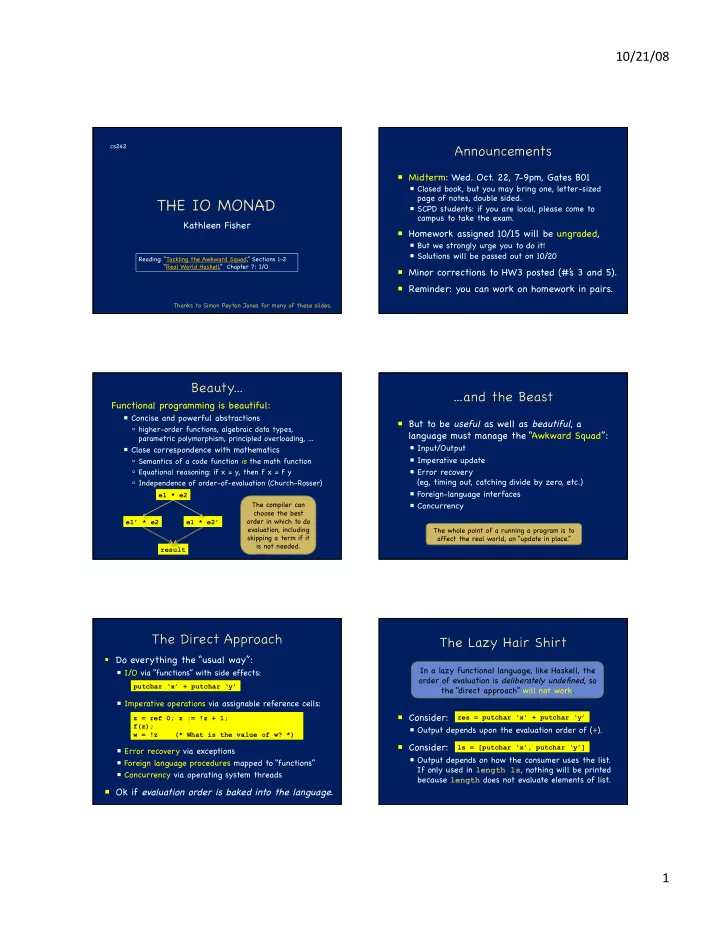
 But to be useful as well as beautiful, a language must manage the “Awkward Squad”:

 Input/Output  Imperative update  Error recovery (eg, timing out, catching divide by zero, etc.)  Foreign-language interfaces  Concurrency

The whole point of a running a program is to affect the real world, an “update in place. ”

  • Do everything the “usual way”:

 I/O via “functions” with side effects:  Imperative operations via assignable reference cells:  Error recovery via exceptions  Foreign language procedures mapped to “functions”  Concurrency via operating system threads

 Ok if evaluation order is baked into the language.

putchar ‘x’ + putchar ‘y’ z = ref 0; z := !z + 1; f(z); w = !z (* What is the value of w? *)

 Consider:

 Output depends upon the evaluation order of (+).

 Consider:

 Output depends on how the consumer uses the list. If only used in length ls, nothing will be printed because length does not evaluate elements of list. In a lazy functional language, like Haskell, the

  • rder of evaluation is deliberately undefined, so

the “direct approach” will not work.

res = putchar ‘x’ + putchar ‘y’ ls = [putchar ‘x’, putchar ‘y’]

slide-2
SLIDE 2

10/21/08
 2


 Laziness and side effects are incompatible.  Side effects are important!  For a long time, this tension was embarrassing to the lazy functional programming community.  In early 90’ s, a surprising solution (the monad) emerged from an unlikely source (category theory).  Haskell’ s IO monad provides a way of tackling the awkward squad: I/O, imperative state, exceptions, foreign functions, & concurrency.  The reading uses a web server as an example.  Lots of I/O, need for error recovery, need to call external libraries, need for concurrency

Web server

Client 1 Client 2 Client 3 Client 4

1500 lines of Haskell 700 connections/sec

Writing High-Performance Server Applications in Haskell by Simon Marlow

Monadic Input and Output

A functional program defines a pure function, with no side effects. The whole point of running a program is to have some side effect.

Tension

 Streams

 Program issues a stream of requests to OS, which responds with a stream of inputs.

 Continuations

 User supplies continuations to I/O routines to specify how to process results.

 World-Passing

 The “World” is passed around and updated, like a normal data structure.  Not a serious contender because designers didn’ t know how to guarantee single-threaded access to the world.

 Stream and Continuation models were discovered to be inter-definable.  Haskell 1.0 Report adopted Stream model.  Move side effects outside of functional program  If Haskell main :: String -> String  But what if you need to read more than one file? Or delete files? Or communicate over a socket? ...

Haskell main program standard input location (file or stdin) standard

  • utput

location (file or stdin) Wrapper Program, written in some other language

slide-3
SLIDE 3

10/21/08
 3


 Enrich argument and return type of main to include all input and output events.  Wrapper program interprets requests and adds responses to input.

main :: [Response] -> [Request] data Request = ReadFile Filename | WriteFile FileName String | … data Response = RequestFailed | ReadOK String | WriteOk | Success | …

 Move side effects outside of functional program  If Haskell main :: [Response] -> [Request]  Laziness allows program to generate requests prior to processing any responses.

Haskell program [Response] [Request]

 Haskell 1.0 program asks user for filename, echoes name, reads file, and prints to standard out.  The ~ denotes a lazy pattern, which is evaluated

  • nly when the corresponding identifier is needed.

main :: [Response] -> [Request] main ~(Success : ~((Str userInput) : ~(Success : ~(r4 : _)))) = [ AppendChan stdout "enter filename\n", ReadChan stdin, AppendChan stdout name, ReadFile name, AppendChan stdout (case r4 of Str contents -> contents Failure ioerr -> "can’t open file") ] where (name : _) = lines userInput

 Hard to extend: new I/O operations require adding new constructors to Request and Response types and modifying the wrapper.  No close connection between a Request and corresponding Response, so easy to get “out-

  • f-step,” which can lead to deadlock.

 The style is not composable: no easy way to combine two “main” programs.  ... and other problems!!!

A value of type (IO t) is an “action. ” When performed, it may do some input/output before delivering a result of type t. A value of type (IO t) is an “action. ” When performed, it may do some input/output before delivering a result of type t.

type IO t = World -> (t, World)

IO t

World out World in result :: t

slide-4
SLIDE 4

10/21/08
 4


 “Actions” are sometimes called “computations. ”  An action is a first-class value.  Evaluating an action has no effect; performing the action has the effect.

A value of type (IO t) is an “action. ” When performed, it may do some input/output before delivering a result of type t.

type IO t = World -> (t, World)

putChar

()

getChar

Char Char getChar :: IO Char putChar :: Char -> IO () main :: IO () main = putChar ‘x’ Main program is an action

  • f type IO ()

putChar

()

getChar

Char

To read a character and then write it back out, we need to connect two actions.

>>= >>=

 We have connected two actions to make a new, bigger action. putChar

() Char

getChar

(>>=) :: IO a -> (a -> IO b) -> IO b echo :: IO () echo = getChar >>= putChar

>>= >>=

 Operator is called bind because it binds the result of the left-hand action in the action on the right.  Performing compound action a >>= \x->b:

 performs action a, to yield value r  applies function \x->b to r  performs the resulting action b{x <- r}  returns the resulting value v

b

v

a

x r

 The parentheses are optional because lambda abstractions extend “as far to the right as possible. ”  The putChar function returns unit, so there is no interesting value to pass on.

echoDup :: IO () echoDup = getChar >>= (\c -> putChar c >>= (\() -> putChar c ))

slide-5
SLIDE 5

10/21/08
 5
 >> >>

 The “then” combinator (>>) does sequencing when there is no value to pass:

(>>) :: IO a -> IO b -> IO b m >> n = m >>= (\_ -> n) echoDup :: IO () echoDup = getChar >>= \c -> putChar c >> putChar c echoTwice :: IO () echoTwice = echo >> echo

 We want to return (c1,c2).

 But, (c1,c2) :: (Char, Char)  And we need to return something of type IO(Char, Char)

 We need to have some way to convert values

  • f “plain” type into the I/O Monad.

getTwoChars :: IO (Char,Char) getTwoChars = getChar >>= \c1 -> getChar >>= \c2 -> ????

return

 The action (return v) does no IO and immediately returns v:

return :: a -> IO a

return

getTwoChars :: IO (Char,Char) getTwoChars = getChar >>= \c1 -> getChar >>= \c2 -> return (c1,c2)

 The “do” notation adds syntactic sugar to make monadic code easier to read.  Do syntax designed to look imperative.

  • - Do Notation

getTwoCharsDo :: IO(Char,Char) getTwoCharsDo = do { c1 <- getChar ; c2 <- getChar ; return (c1,c2) }

  • - Plain Syntax

getTwoChars :: IO (Char,Char) getTwoChars = getChar >>= \c1 -> getChar >>= \c2 -> return (c1,c2)

 The “do” notation only adds syntactic sugar:

do { x<-e; es } = e >>= \x -> do { es } do { e; es } = e >> do { es } do { e } = e do {l do {let t ds ds; ; es es} = l } = let t ds ds in do { in do {es es} }

The scope of variables bound in a generator is the rest of the “do” expression. The last item in a “do” expression must be an expression.

 The following are equivalent:

do { x1 <- p1; ...; xn <- pn; q } do x1 <- p1 ... xn <- pn q do x1 <- p1; ...; xn <- pn; q

If the semicolons are

  • mitted, then the

generators must line up. The indentation replaces the punctuation.

slide-6
SLIDE 6

10/21/08
 6


 The getLine function reads a line of input:

getLine :: IO [Char] getLine = do { c <- getChar ; if c == '\n' then return [] else do { cs <- getLine; return (c:cs) }} Note the “regular” code mixed with the monadic

  • perations and the nested “do” expression.

 Each action in the IO monad is a possible stage in an assembly line.  For an action with type IO a, the type

 tags the action as suitable for the IO assembly line via the IO type constructor.  indicates that the kind of thing being passed to the next stage in the assembly line has type a.

 The bind operator “snaps” two stages s1 and s2 together to build a compound stage.  The return operator converts a pure value into a stage in the assembly line.  The assembly line does nothing until it is turned on.  The only safe way to “run” an IO assembly is to execute the program, either using ghci or running an executable.

1 2

 Running the program turns on the IO assembly line.  The assembly line gets “the world” as its input and delivers a result and a modified world.  The types guarantee that the world flows in a single thread through the assembly line.

Result ghci or compiled program

 Values of type (IO t) are first class, so we can define our own control structures.  Example use:

forever :: IO () -> IO () forever a = a >> forever a repeatN :: Int -> IO () -> IO () repeatN 0 a = return () repeatN n a = a >> repeatN (n-1) a Main> repeatN 5 (putChar 'h')

 Values of type (IO t) are first class, so we can define our own control structures.  Example use:

for :: [a] -> (a -> IO b) -> IO () for [] fa = return () for (x:xs) fa = fa x >> for xs fa Main> for [1..10] (\x -> putStr (show x))

 Example use:

sequence :: [IO a] -> IO [a] sequence [] = return [] sequence (a:as) = do { r <- a; rs <- sequence as; return (r:rs) } Main> sequence [getChar, getChar, getChar] A list of IO actions. An IO action returning a list.

slide-7
SLIDE 7

10/21/08
 7


Slogan: First-class actions let programmers write application- specific control structures.

 The IO Monad provides a large collection of

  • perations for interacting with the “World.

”  For example, it provides a direct analogy to the Standard C library functions for files:

  • penFile :: String -> IOMode -> IO Handle

hPutStr :: Handle -> String -> IO () hGetLine :: Handle -> IO String hClose :: Handle -> IO ()

 The IO operations let us write programs that do I/O in a strictly sequential, imperative fashion.  Idea: We can leverage the sequential nature of the IO monad to do other imperative things!  A value of type IORef a is a reference to a mutable cell holding a value of type a.

data IORef a -- Abstract type newIORef :: a -> IO (IORef a) readIORef :: IORef a -> IO a writeIORef :: IORef a -> a -> IO () But this is terrible! Contrast with: sum [1..n]. Claims to need side effects, but doesn’ t really.

import Data.IORef -- import reference functions

  • - Compute the sum of the first n integers

count :: Int -> IO Int count n = do { r <- newIORef 0; loop r 1 } where loop :: IORef Int -> Int -> IO Int loop r i | i > n = readIORef r | otherwise = do { v <- readIORef r; writeIORef r (v + i); loop r (i+1)} import Data.IORef -- import reference functions

  • - Compute the sum of the first n integers

count :: Int -> IO Int count n = do { r <- newIORef 0; loop r 1 } where loop :: IORef Int -> Int -> IO Int loop r i | i > n = readIORef r | otherwise = do { v <- readIORef r; writeIORef r (v + i); loop r (i+1)}

Just because you can write C code in Haskell, doesn’ t mean you should!

 Track the number of chars written to a file.  Here it makes sense to use a reference.

type HandleC = (Handle, IORef Int)

  • penFileC :: String -> IOMode -> IO HandleC
  • penFileC fn mode = do

{ h <- openFile fn mode; v <- newIORef 0; return (h,v) } hPutStrC :: HandleC -> String -> IO() hPutStrC (h,r) cs = do { v <- readIORef r; writeIORef r (v + length cs); hPutStr h cs }

slide-8
SLIDE 8

10/21/08
 8


 All operations return an IO action, but only bind (>>=) takes one as an argument.  Bind is the only operation that combines IO actions, which forces sequentiality.  Within the program, there is no way out!

return :: a -> IO a (>>=) :: IO a -> (a -> IO b) -> IO b getChar :: IO Char putChar :: Char -> IO () ... more operations on characters ...

  • penFile :: [Char] -> IOMode -> IO Handle

... more operations on files ... newIORef :: a -> IO (IORef a) ... more operations on references ...

 Suppose you wanted to read a configuration file at the beginning of your program:  The problem is that readFile returns an IO String, not a String.  Option 1: Write entire program in IO monad. But then we lose the simplicity of pure code.  Option 2: Escape from the IO Monad using a function from IO String -> String. But this is the very thing that is disallowed!

configFileContents :: [String] configFileContents = lines (readFile "config") -- WRONG! useOptimisation :: Bool useOptimisation = "optimise" ‘elem‘ configFileContents

 Reading a file is an I/O action, so in general it matters when we read the file relative to the other actions in the program.  In this case, however, we are confident the configuration file will not change during the program, so it doesn’ t really matter when we read it.  This situation arises sufficiently often that Haskell implementations offer one last unsafe I/O primitive: unsafePerformIO.

unsafePerformIO :: IO a -> a configFileContents :: [String] configFileContents=lines(unsafePerformIO(readFile"config"))

unsafePerformIO

 The operator has a deliberately long name to discourage its use.  Its use comes with a proof obligation: a promise to the compiler that the timing of this operation relative to all other operations doesn’ t matter.

unsafePerformIO :: IO a -> a

Result

act

Invent World Discard World

unsafePerformIO

 As its name suggests, unsafePerformIO breaks the soundness of the type system.  So claims that Haskell is type safe only apply to programs that don’ t use unsafePerformIO.  Similar examples are what caused difficulties in integrating references with Hindley/Milner type inference in ML.

r :: IORef c -- This is bad! r = unsafePerformIO (newIORef (error "urk")) cast :: a -> b cast x = unsafePerformIO (do {writeIORef r x; readIORef r })

 GHC uses world-passing semantics for the IO monad:  It represents the “world” by an un-forgeable token of type World, and implements bind and return as:  Using this form, the compiler can do its normal

  • ptimizations. The dependence on the world ensures

the resulting code will still be single-threaded.  The code generator then converts the code to modify the world “in-place. ”

type IO t = World -> (t, World) return :: a -> IO a return a = \w -> (a,w) (>>=) :: IO a -> (a -> IO b) -> IO b (>>=) m k = \w -> case m w of (r,w’) -> k r w’

slide-9
SLIDE 9

10/21/08
 9


 What makes the IO Monad a Monad?  A monad consists of:

 A type constructor M  A function bind :: M a -> ( a -> M b) -> M b  A function return :: a -> M a

 Plus: Laws about how these operations interact.

return x >>= f = f x m >>= return = m m1 >>= (λx.m2 >>= (λ y.m3))

=

(m1 >>= (λ x.m2)) >>= (λ y.m3) x not in free vars of m3

>> >> do done

done >> m = m m >> done = m m1 >> (m2 >> m3) = (m1 >> m2) >> m3

(>>) :: IO a -> IO b -> IO b m >> n = m >>= (\_ -> n) done :: IO () done = return ()

 Using the monad laws and equational reasoning, we can prove program properties.

putStr :: String -> IO () putStr [] = done putStr (c:s) = putChar c >> putStr s

Proposi sitio ion: putStr r >> putStr s = putStr (r ++ s)

putStr :: String -> IO () putStr [] = done putStr (c:cs) = putChar c >> putStr cs

Proof

  • f: By in

: By induc ductio ion o n on n r. Ba Base c se case se: : r is is [] putStr [] >> putStr s = (defin definitio ion of n of pu putStr tStr) done >> putStr s = (fir first mo t mona nad l d law f w for r >>) putStr s = (definition of ++) putStr ([] ++ s) In Induc ductio ion c n case se: : r is is (c:cs) … Proposi sitio ion: putStr r >> putStr s = putStr (r ++ s)

 A complete Haskell program is a single IO action called main. Inside IO, code is single-threaded.  Big IO actions are built by gluing together smaller ones with bind (>>=) and by converting pure code into actions with return.  IO actions are first-class.

 They can be passed to functions, returned from functions, and stored in data structures.  So it is easy to define new “glue” combinators.

 The IO Monad allows Haskell to be pure while efficiently supporting side effects.  The type system separates the pure from the effectful code.

slide-10
SLIDE 10

10/21/08
 10


 In languages like ML or Java, the fact that the language is in the IO monad is baked in to the

  • language. There is no need to mark anything in

the type system because it is everywhere.  In Haskell, the programmer can choose when to live in the IO monad and when to live in the realm of pure functional programming.  So it is not Haskell that lacks imperative features, but rather the other languages that lack the ability to have a statically distinguishable pure subset.

 So far, we have only seen one monad, but there are many more!  We’ll see a bunch more of them on Wednesday.