Processes and Threads What is a process? What is a thread? What - - PowerPoint PPT Presentation

processes and threads
SMART_READER_LITE
LIVE PREVIEW

Processes and Threads What is a process? What is a thread? What - - PowerPoint PPT Presentation

Processes and Threads What is a process? What is a thread? What types? A program has one or more locus of execution. Each execution is called a thread of execution. The set of threads comprise a process . Not an object or executable


slide-1
SLIDE 1

Intro to OS CUCS Mossé

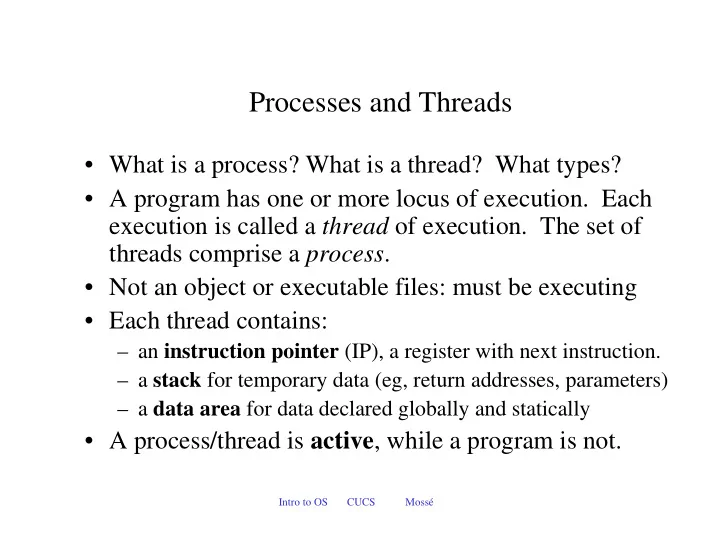
Processes and Threads

  • What is a process? What is a thread? What types?
  • A program has one or more locus of execution. Each

execution is called a thread of execution. The set of threads comprise a process.

  • Not an object or executable files: must be executing
  • Each thread contains:

– an instruction pointer (IP), a register with next instruction. – a stack for temporary data (eg, return addresses, parameters) – a data area for data declared globally and statically

  • A process/thread is active, while a program is not.
slide-2
SLIDE 2

Intro to OS CUCS Mossé

How to run a program

  • The executable code is loaded onto memory (where?)
  • Space is allocated to variables (what types of vars?)
  • A stack is allocated to the process (for what?)
  • Registers are updated (which registers?)
  • Control (of execution) goes to the process (how?)
  • Process runs one instruction at a time, in a cycle:

– fetch the instruction from memory – decode the instruction – update the IP – execute the instruction

slide-3
SLIDE 3

Intro to OS CUCS Mossé

Processes and Threads (revisited)

  • Address space: memory reserved for a process
  • A heavyweight process has a single locus of execution

per address space, a single IP, a single PCB

  • A Process Control Block (PCB) contains information

pertaining to the process itself

– state (running, ready, etc) – registers and flags (stack pointer, IP, etc) – resource information (memory/CPU usage, open files, etc) – process ID – security and protection information – accounting info (who to bill, limits, similar to resource info)

slide-4
SLIDE 4

Intro to OS CUCS Mossé

Processes and Threads (cont)

  • Thread (lightweight process) of a process share some

resources (e.g., memory, open files, etc)

  • Threads have their own stack, IP, local address space
  • With only a single process in memory, easy to manage
  • For example, if a process requests IO (eg, read from

keyboard), it just stays in the memory waiting

  • Several threads or processes complicate things; when

IO is requested, why make other processes wait?

  • Context switching takes place… take a waiting thread

“out of the CPU” and put a thread that is ready in CPU

slide-5
SLIDE 5

Intro to OS CUCS Mossé

State Diagram

  • Create: PCB and other resources are setup
  • End: resources held are returned to the OS (freed)
  • Context switching: saves HW context; updates PCB
  • States are typically implemented as queues, lists, sets

end ready blocked running create

dispatch Quantum expired IO completed IO requested process completed process initialized

slide-6
SLIDE 6

Intro to OS CUCS Mossé

These two states check for sufficient resources in the system

Complete State Diagram

process started

end ready blocked running create

IO completed IO requested process completed

admission control suspended

process submitted temporary suspension process returns dispatch Quantum expired

slide-7
SLIDE 7

Intro to OS CUCS Mossé

Multiple Threads and Processes

  • Several problems with multitasking:

– fairness in usage of CPU – fairness in usage of other resources – coordinated input and output – lack of progress (deadlocks and livelocks) – synchronization: access to the same data item by several processes/threads (typical example, deposits into account)

slide-8
SLIDE 8

Intro to OS CUCS Mossé

Synchronization Example

  • At time t=6 T2 requests the withdrawal of $200 (and

gets preempted); at t=8 T1 requests the deposit of $200; t=9, T1 reads balance ($300); at t=10, T2 adds $200, at t=11, T1 writes new balance; at t=12, T2 resumes and reads balance; at t=13, T2 subtracts $200; at t=14, T2 writes new balance

  • What if order was changed: 6, 8, 9, 12, 13, 14, 10, 11?
  • Other combinations?

6 7 8 9 10 11 12 13 14 15 ... T2req T1req T1r T1c T1w T2r T2c T2w

slide-9
SLIDE 9

Intro to OS CUCS Mossé

More on Synchronization

  • Semaphores and primitives serve to achieve mutual

exclusion and synchronized access to resources

  • Clearly, there is more delays associated with attemp-

ting to access a resource protected by semaphores

  • Non-preemptive scheduling solves that problem
  • As an aside:

– Which scheduling mechanism is more efficient? Preemptive

  • r non-preemptive?

– Within each type of scheduling (pr or non-pr), one can choose which policy he/she wants to use

slide-10
SLIDE 10

Intro to OS CUCS Mossé

Using Semaphores

  • When threads use semaphores, they are attempting to

reserve a resource for usage. Only the threads that succeed are allowed in the CS.

  • If there is a thread in the CS already, other requesting

threads are blocked, waiting on an event

  • When the thread exits the CS, the OS unblocks the

waiting thread, typically during the V(s) sys_call

  • The now unblocked thread becomes ready
  • The OS may decide to invoke the scheduler… or not
slide-11
SLIDE 11

Intro to OS CUCS Mossé

Types of Synchronization

  • There are 2 basic types of sync:

P1:: P(s1) … V(s1) P2:: P(s1) … V(s1) P2:: P(s2) … V(s1) P1:: P(s1) … V(s2)

MUTEX BARRIER SYNC

slide-12
SLIDE 12

Intro to OS CUCS Mossé

Deadlocks

  • When a program is written carelessly, it may cause a…
  • DEADLOCK!!!
  • Each process will wait

for the other process indefinitely

  • How can we deal with

these abnormalities?

  • Avoidance, prevention, or detection and resolution
  • Which one is more efficient?

P1:: P(s1) P(s2) … V(s2) V(s1) P2:: P(s2) P(s1) … V(s1) V(s2)

slide-13
SLIDE 13

Intro to OS CUCS Mossé

Dining Philosophers

  • There were some hungry philosophers, and some angry

philosophers (not the same, not Rastas)

  • Each needed two forks, each shared both his/her forks
  • Possible deadlock situation! HOW?
  • Is it possible to have a (literally) starvation situation?
  • What is the best solution?

– Round-robin? FIFO? How good are FIFO and RR?

  • Important: what is the metric to judge a solution by?

– Least overhead? Minimum starvation? – How to evaluate fairness?