
SLIDE 1
Municipal solid waste incineration (MSWI) bottom ash‐
Characterization, treatments, application
- P. TANG
M.V.A. Florea H.J.H. Brouwers
Eindhoven University of Technology
Municipal solid waste incineration (MSWI) bottom ash - - PowerPoint PPT Presentation
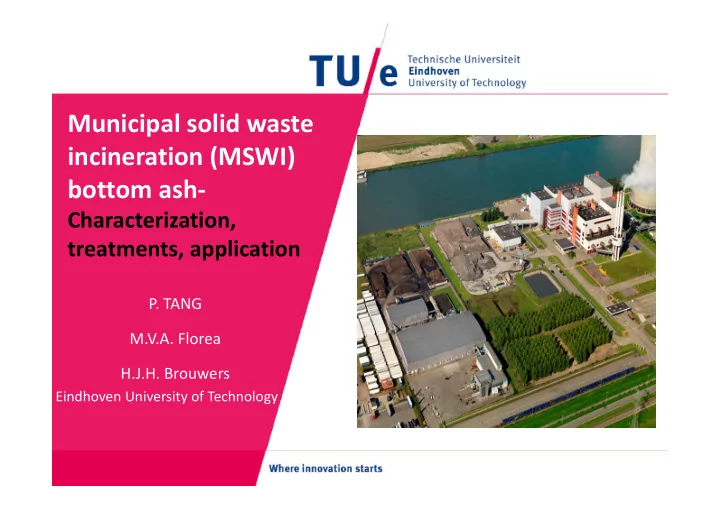
Municipal solid waste incineration (MSWI) bottom ash Characterization, treatments, application P. TANG M.V.A. Florea H.J.H. Brouwers Eindhoven University of Technology Waste to energy plant Waste storage before incineration Scheme of the
M.V.A. Florea H.J.H. Brouwers
Eindhoven University of Technology
Wednesday, 29 June 2016
2
Waste‐to‐energy plant Waste storage before incineration
Scheme of the incineration system
Wednesday, 29 June 2016
3
Municipal solid waste incineration 1) Reduction of solid waste 2) Generation of energy 3) Production of combustion residues 4) Poor physical and chemical properties Building material development 1) Consumption of raw materials 2) Environmental pollution 3) Energy consumption 4) Reuse and recycling of materials
Environment Economy
4
(0.32) (0.9) (616) (1730)
Wednesday, 29 June 2016
General treatments
contaminants
Wednesday, 29 June 2016
5
Influence on cement hydration (binder substitute)
Wednesday, 29 June 2016
6
Influence on mortar strength (sand replacement)
7
Wednesday, 29 June 2016
8
Wednesday, 29 June 2016
Wednesday, 29 June 2016
9
Remove of soluble salts (chloride, sulphate)
Reduction of heavy metals leaching (Cu, Sb, etc.)
Extraction and recycle of metals
Recycle and reuse of fine bottom ash to produce artificial aggregate
10
Pelletizing technique ‐ agglomerating of powdery material into a shape of pellet Application field :
Mining ‐ iron ore Agriculture ‐ Fertilizer Biomedical field ‐ medicine production Recycling powder wastes to produce lightweight aggregate – sludge and dust, coal/MSWI fly ash, GGBS, etc. MSWI bottom ash fines (new) Disc/pan pelletizer
Wednesday, 29 June 2016
Wednesday, 29 June 2016
11
MSWI bottom ash fines properties ‐ negative Highly porous material Containing contaminants (heavy metals and salts) Metallic aluminum (expansion risk) High costs for general treatment Cold bonded pelletization with binders ‐ positive Controlling size for application in concrete Density control Pellet strength Spherical particle size for better flowability Immobilization by binders (S/S) Pre‐reaction of metallic aluminum Low cost
12
Wednesday, 29 June 2016
Waste MSWI bottom ash fines Values Artificial aggregates Application in concrete
Cold bond technique
Stage 1 Characterization Stage 2 Technique study Recipe design Stage 3 Properties of pellet Optimization of recipe according to requirement Stage 4 Properties of concrete Environmental impact of artificial aggregate application Recycling
13
Wednesday, 29 June 2016
1 2 3 1 2 3
Wednesday, 29 June 2016
14
Properties of the artificial aggregates
belong to lightweight aggregate according to EN standards
higher than other artificial aggregate in literature
15
Wednesday, 29 June 2016
16
Wednesday, 29 June 2016
17
Wednesday, 29 June 2016