Multiprocessor Synchronization Multiprocessor Systems Memory - - PDF document

multiprocessor synchronization
SMART_READER_LITE
LIVE PREVIEW

Multiprocessor Synchronization Multiprocessor Systems Memory - - PDF document

CPSC-410/611 Operating Systems Multiprocessor Synchronization Multiprocessor Synchronization Multiprocessor Systems Memory Consistency Simple Synchronization Primitives: Implementation Issues (Much material in this


slide-1
SLIDE 1

CPSC-410/611 Operating Systems Multiprocessor Synchronization 1

Multiprocessor Synchronization

  • Multiprocessor Systems
  • Memory Consistency
  • Simple Synchronization Primitives: Implementation

Issues

(Much material in this section has been freely borrowed from Gernot Heiser at UNSW and from Kevin Elphinstone)

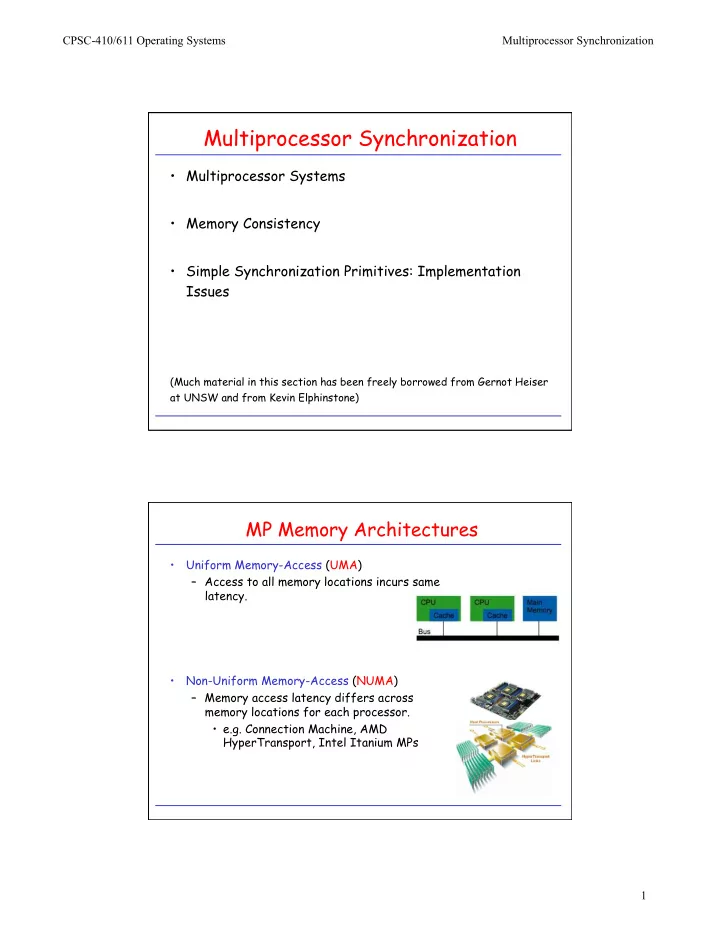
MP Memory Architectures

  • Uniform Memory-Access (UMA)

– Access to all memory locations incurs same latency.

  • Non-Uniform Memory-Access (NUMA)

– Memory access latency differs across memory locations for each processor.

  • e.g. Connection Machine, AMD

HyperTransport, Intel Itanium MPs

slide-2
SLIDE 2

CPSC-410/611 Operating Systems Multiprocessor Synchronization 2

UMA Multiprocessors: Types

  • “Classical” Multiprocessor

– CPUs with local caches – typically connected by bus – fully separated cache hierarchy -> cache coherency problems

  • Chip Multiprocessor (multicore)

– per-core L1 caches – shared lower on-chip caches – cache coherency addressed in HW

  • Simultaneous Multithreading

– interleaved execution of several threads – fully shared cache hierarchy – no cache coherency problems

Cache Coherency

  • What happens if one CPU writes

to (cached) address and another CPU reads from the same address? – similar to replication and migration of data between CPUs.

  • Ideally, a read produces the result of the last write to the same

memory location. (“Strict Memory Consistency”) – Approaches that avoid the issue in software also reduce replication for parallelism – Typically, a hardware solution is used

  • snooping – for bus-based architectures
  • directory-based – for non bus-interconnects
slide-3
SLIDE 3

CPSC-410/611 Operating Systems Multiprocessor Synchronization 3

Snooping

  • Each cache broadcasts transactions on

the bus.

  • Each cache monitors the bus for transactions that affect its

state.

  • Conflicts are typically resolved using the MISE protocol.
  • Snooping can be easily extended to multi-level caches.

The MESI Cache Coherency Protocol

Each cache line is in one of 4 states:

  • Modified:

– The line is valid in the cache and in only this cache. – The line is modified with respect to system memory - that is, the modified data in the line has not been written back to memory.

  • Exclusive:

– The addressed line is in this cache only. – The data in this line is consistent with system memory.

  • Shared:

– The addressed line is valid in the cache and in at least one other cache. – A shared line is always consistent with system memory. That is, the shared state is shared-unmodified; there is no shared-modified state.

  • Invalid:

– This state indicates that the addressed line is not resident in the cache and/ or any data contained is considered not useful.

slide-4
SLIDE 4

CPSC-410/611 Operating Systems Multiprocessor Synchronization 4

MESI Coherence Protocol

  • Events

– RH = Read Hit – RMS = Read miss, shared – RME = Read miss, exclusive – WH = Write hit – WM = Write miss – SHR = Snoop hit on read – SHI = Snoop hit on invalidate – LRU = LRU replacement

  • Bus Transactions

– Push = Write cache line back to memory – Invalidate = Broadcast invalidate – Read = Read cache line from memory

Memory Consistency: Example

  • Example: Critical Section
  • Relies on all CPUs seeing update of counter before

update of mutex

  • Depends on assumptions about ordering of stores to

memory

/* counter++ */ load r1, counter add r1, r1, 1 store r1, counter /* unlock(mutex) */ store zero, mutex

slide-5
SLIDE 5

CPSC-410/611 Operating Systems Multiprocessor Synchronization 5

Example of Strong Ordering: Sequential Ordering

  • Strict Consistency is impossible to implement.
  • Sequential Consistency:

– Loads and stores execute in program order – Memory accesses of different CPUs are “sequentialised”; i.e., any valid interleaving is acceptable, but all processes must see the same sequence of memory references.

  • Traditionally used by many architectures

CPU 0 CPU 1 store r1, adr1 store r1, adr2 load r2, adr2 load r2, adr1

  • In this example, at least one CPU must load the
  • ther's new value.

Sequential Consistency (cont)

  • Sequential consistency is programmer-friendly, but

expensive.

  • Lipton & Sandbert (1988) show that improving the

read performance makes write performance worse, and vice versa.

  • Modern HW features interfere with sequential

consistency; e.g.: – write buffers to memory (aka store buffer, write- behind buffer, store pipeline) – instruction reordering by optimizing compilers – superscalar execution – pipelining

slide-6
SLIDE 6

CPSC-410/611 Operating Systems Multiprocessor Synchronization 6

Weaker Consistency Models: Total Store Order

  • Total Store Ordering (TSO) guarantees that the

sequence in which store, FLUSH, and atomic load-store instructions appear in memory for a given processor is identical to the sequence in which they were issued by the processor.

  • Both x86 and SPARC processors support TSO.
  • A later load can bypass an earlier store
  • peration.
  • i.e., local load operations are permitted to obtain

values from the write buffer before they have been committed to memory.

Total Store Order (cont)

  • Example:

CPU 0 CPU 1 store r1, adr1 store r1, adr2 load r2, adr2 load r2, adr1

  • Both CPUs may read old value!
  • Need hardware support to force global ordering of

privileged instructions, such as: – atomic swap – test & set – load-linked + store-conditional – memory barriers

  • For such instructions, stall pipeline and flush write

buffer.

slide-7
SLIDE 7

CPSC-410/611 Operating Systems Multiprocessor Synchronization 7

It gets weirder: Partial Store Ordering

  • Partial Store Ordering (PSO) does not guarantee that the

sequence in which store, FLUSH, and atomic load-store instructions appear in memory for a given processor is identical to the sequence in which they were issued by the processor.

  • The processor can reorder the stores so that the sequence of

stores to memory is not the same as the sequence of stores issued by the CPU.

  • SPARC processors support PSO; x86 processors do not.
  • Ordering of stores is enforced by memory barrier (instruction

STBAR for Sparc) : If two stores are separated by memory barrier in the issuing order of a processor, or if the instructions reference the same location, the memory order of the two instructions is the same as the issuing order.

Partial Store Order (cont)

  • Example:
  • Store to mutex can “overtake” store to counter.
  • Need to use memory barrier to separate issuing
  • rder.
  • Otherwise, we have a race condition.

load r1, counter add r1, r1, 1 store r1, counter barrier store zero, mutex

slide-8
SLIDE 8

CPSC-410/611 Operating Systems Multiprocessor Synchronization 8

Mutual Exclusion on Multiprocessor Systems

  • Mutual Exclusion Techniques

– Disabling interrupts

  • Unsuitable for multiprocessor systems.

– Spin locks

  • Busy-waiting wastes cycles.

– Lock objects

  • Flag (or a particular state) indicates object is

locked.

  • Manipulating lock requires mutual exclusion.
  • Software-only mutual-exclusion solutions (e.g. Peterson)

do not work with TSO. – Need HW locking primitives (recall: they flush the write buffer)

Mutual Exclusion: Spin Locks

  • Spin locks rely on busy waiting!
  • Bad idea on uniprocessors

– Nothing will change while we spin! – Why not yield immediately?!

  • Maybe not so bad on multiprocessors

– The locker may be running on another CPU – Busy waiting still unnecessary.

  • Restrict spin locks to short critical sections, with little chance of

CPU contention.

void lock (volatile lock_t *lk) { while (test_and_set(lk)) ; } void unlock (volatile lock_t *lk) { *lk = 0; }

slide-9
SLIDE 9

CPSC-410/611 Operating Systems Multiprocessor Synchronization 9

Why bother with Spin Locks?

  • Blocking and switching to other process does not come

for free. – Context switch time – Penalty on cache and TLB – Switch-back when lock released generates another context switch

  • Spinning burns CPU time directly.
  • This is an opportunity for a trade-off.

– Example: spin for some time; if lock not acquired, block and switch.

Conditional Locks

  • Have the application handle the trade-off:
  • Pros:

– Application can select to do something else while waiting.

  • Cons:

– There may be not much else to do… – Possibility of starvation.

bool cond_lock (volatile lock_t *lk) { if (test and set(lk)) return FALSE; //couldn’t lock else return TRUE; //acquired lock }

slide-10
SLIDE 10

CPSC-410/611 Operating Systems Multiprocessor Synchronization 10

Mutex with “Bounded Spinning”

  • Spin for limited time only:
  • Starvation still possible.

void mutex_lock (volatile lock t *lk) { while (1) { for (int i=0; i<MUTEX_N; i++) if (!test_and_set(lk)) return; yield(); } }

Common Multiprocessor Spin Lock

  • As used in practice in small MP systems (Anderson, 1990)
  • Good for short critical sections.
  • Does not scale for large number of CPUs.
  • Relies on bus-arbitration for fairness.
  • No appropriate for user-level. (why?)

void mp_spinlock (volatile lock_t *lk) { cli(); // prevent preemption while (test_and_set(lk)) ; // lock } void mp_unlock (volatile lock_t *lk) { *lk = 0; sti(); }