Chapter 6: Process [& Thread] Synchronization Why is - - PowerPoint PPT Presentation

chapter 6 process thread synchronization
SMART_READER_LITE
LIVE PREVIEW

Chapter 6: Process [& Thread] Synchronization Why is - - PowerPoint PPT Presentation

Chapter 6: Process [& Thread] Synchronization Why is synchronization needed? CSCI [4|6] 730 Synchronization Language/Definitions: What are race conditions? Operating Systems What are critical sections? What are atomic


slide-1
SLIDE 1

Maria Hybinette, UGA

CSCI [4|6] 730 Operating Systems

Synchronization Part 1 : The Basics

Maria Hybinette, UGA

Chapter 6: Process [& Thread] Synchronization

  • Why is synchronization needed?
  • Synchronization Language/Definitions:

» What are race conditions? » What are critical sections? » What are atomic operations?

  • How are locks implemented?

Maria Hybinette, UGA

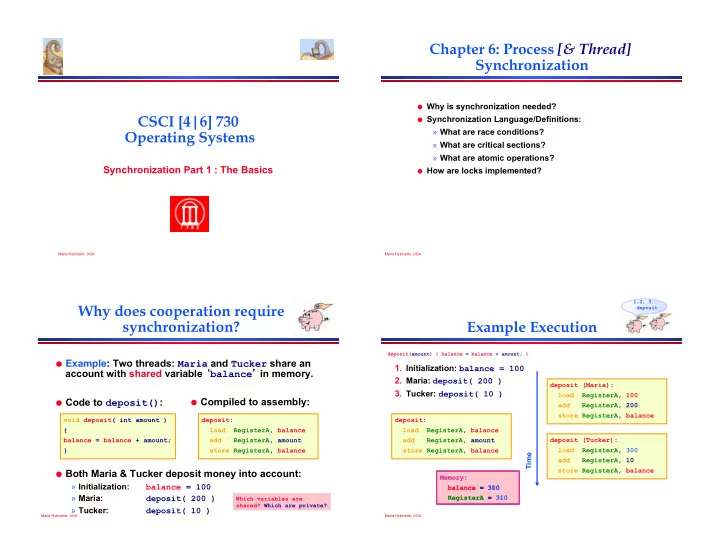
Why does cooperation require synchronization?

  • Example: Two threads: Maria and Tucker share an

account with shared variable balance in memory.

  • Code to deposit():
  • Both Maria & Tucker deposit money into account:

» Initialization: balance = 100 » Maria: deposit( 200 ) » Tucker: deposit( 10 )

void deposit( int amount ) { balance = balance + amount; } deposit: load RegisterA, balance add RegisterA, amount store RegisterA, balance

  • Compiled to assembly:

Which variables are shared? Which are private?

Maria Hybinette, UGA

Example Execution

  • 1. Initialization: balance = 100
  • 2. Maria: deposit( 200 )
  • 3. Tucker: deposit( 10 )

deposit: load RegisterA, balance add RegisterA, amount store RegisterA, balance deposit (Maria): load RegisterA, 100 add RegisterA, 200 store RegisterA, balance deposit (Tucker): load RegisterA, 300 add RegisterA, 10 store RegisterA, balance

Time

Memory: balance = 100 RegisterA = 0 Memory: balance = 100 RegisterA = 100 Memory: balance = 100 RegisterA = 300 Memory: balance = 300 RegisterA = 300 Memory: balance = 300 RegisterA = 300 Memory: balance = 300 RegisterA = 310 Memory: balance = 310 RegisterA = 310

1,2, 3.. deposit deposit(amount) { balance = balance + amount; }

slide-2
SLIDE 2

Maria Hybinette, UGA

Concurrency

  • What happens if M & T deposit the funds

concurrently?

» Strategy:

– Assume that any interleaving is possible

» No assumption about scheduler

» Observation: When a thread is interrupted content of registers are saved (and restored) by interrupt handlers (dispatcher/context switcher)

– Initialization: balance = 100 – Maria: deposit( 200 ) – Tucker: deposit( 10 )

deposit (Maria): load RegisterA, balance add RegisterA, 200 store RegisterA, balance deposit (Tucker): load RegisterA, balance add RegisterA, 10 store RegisterA, balance

Time

  • 1. Memory:

balance = 100 RegisterA = 0

  • 1. Memory:

balance = 100 RegisterA = 0

  • 2. Memory:

balance = 100 RegisterA = 100

  • 2. Memory:

balance = 100 RegisterA = 100

  • 3. Memory:

balance = 100 RegisterA = 300

  • 3. Memory:

balance = 100 RegisterA = 110

  • 4. Memory:

balance = 300 RegisterA = 300

  • 4. Memory:

balance = 110 RegisterA = 110 deposit: load RegisterA, balance add RegisterA, amount store RegisterA, balance

310? 300? 110?

deposit(amount) { balance = balance + amount; }

M T M T M T

Maria Hybinette, UGA

What program data is (or is not) shared?

  • Local variables are not shared (private)

» Each thread has its own stack » Local variables are allocated on private stack

  • Global variables and static objects are shared

» Stored in the static data segment, accessible by any threads » Pass by (variable) ‘reference’ : &data1

  • Dynamic objects and other heap objects are shared

» Allocated from heap with malloc/free or new/delete Beware of Weird Bugs: Never pass, share, or store a pointer * to a local variable on another threads stack

Maria Hybinette, UGA

Race Condition

  • Results depends on the order of execution

» Result in non-deterministic bugs, these are hard to find!

– Deterministic : Input alone determines results, i.e., the same inputs always produce the same results:

  • Example: Sqrt (4) = 2
  • Intermittent –

» A time dependent `bug » a small change may hide the real bug (e.g., print statements can hide the real bug because they slow down processing time and consequently impacts the timing of the threads).

Maria Hybinette, UGA

How to avoid race conditions

  • Idea: Prohibit one or more threads from

reading and writing shared data at the same time! ⇒ Provide Mutual Exclusion (what?)

  • Critical Section: Part of program (or ‘slice”)

where shared memory is accessed

void credit( int amount ) { int x = 5; printf( Adding money ); balance = balance + amount; } void debit( int amount ) { int i; balance = balance - amount; for( i = 0; i < 5; i++ ); } Critical Section

slide-3
SLIDE 3

Maria Hybinette, UGA

THE Critical Section Problem?

  • Problem: Avoiding race conditions (i.e., provide

mutual exclusion) is not sufficient for having threads cooperate correctly (no progress) and efficiently:

» What about if no one gets into the critical section even if several threads wants to get in? (No progress at ALL!) » What about if someone waits outside the critical section and never gets a turn? (starvation, NOT FAIR!)

Maria Hybinette, UGA

10

What We Want: Mutual Exclusion (!)

Process Maria Process Tucker Time Maria enters her critical section Maria leaves her critical section Tucker attempts to enter his critical section Tucker is blocked, and waits Tucker enters his critical section Tucker leaves his critical section

void deposit( int amount ) { balance = balance + amount; } Maria Hybinette, UGA

11

Critical Section Problem: Properties

Memorize

Required Properties:

  • Mutual Exclusion:

» Only one thread in the critical section at a time

  • Progress (e.g., someone gets the CS):

» Not block others out: if there are requests to enter the CS must allow one to proceed » Must not depend on threads outside critical section

– If no one is in CS then someone must be let in…

  • We take no reservations!
  • Bounded waiting (starvation-free):

» Must eventually allow each waiting thread » to enter

Its Available

Maria Hybinette, UGA

12

Solve: THE Critical Section Problem: Proper Synchronization

Required Properties :

  • Mutual Exclusion
  • Progress (someone gets the CS)
  • Bounded waiting (starvation-free, eventually you will run)

Desirable Properties:

  • Efficient:

» Dont consume substantial resources while waiting.

– Example : Do not busy wait (i.e., spin wait)

  • Fair:

» Dont make some processes wait longer than others

  • Simple: Should be easy to reason about and use
slide-4
SLIDE 4

Maria Hybinette, UGA

13

Critical Section Problem: Need Atomic Operations

  • Basics: Need atomic operations:

» No other instructions can be interleaved (low level) » Completed in its entirety without interruption (no craziness)

  • Examples of atomic operations:

» Loads and stores of words

– load register1, B – store register2, A

» Idea: : Code between interrupts on uniprocessors

– Disable timer interrupts, dont do any I/O

» Special hardware instructions (later)

– load, store in one instruction – Test&Set – Compare&Swap

Maria Hybinette, UGA

14

Disabling Interrupts

  • Kernel provides two system calls:

» Acquire() and » Release()

  • No preemption when interrupts are off!

» No clock interrupts can occur

  • Disadvantage:

» unwise to give processes power to turn of interrupts

– Never turn interrupts on again!

» Does not work on multiprocessors

  • When to use?:

» But it may be good for kernel itself to disable interrupts for a few instructions while it is updating variables or lists

void Aquire() { disable interrupts } void Release() { enable interrupts } Who do you trust? Do you trust your kernel? Do you trust your friends kernel? Do you trust your kernels friends?

Maria Hybinette, UGA

15

Software Solutions

  • Assumptions:

» We have an atomic load operation (read) » We have an atomic store operation (assignment)

  • Notation [lock=true, lock=false]

» True: means un-available (lock is set, someone has the lock) » False: means available (e.g., lock is not set, as the CS is available, no one is in the CS)

Maria Hybinette, UGA

16

Attempt 1: Shared Lock Variable

  • Single shared lock variable
  • Uses busy waiting
  • Does this work?

» Are any of the principles violated (i.e., does it ensure mutual, progress and bounded waiting)?

boolean lock = false; // lock available shared variable void deposit(int amount) { while( lock == true ) {} /* while lock is set : wait */ ; lock = true; /* gets the lock */ balance += amount; // critical section lock = false; /* release the lock */ }

Entry CS: CS: Exit CS:

slide-5
SLIDE 5

Maria Hybinette, UGA

17

Attempt 1: Shared Variable

  • M reads lock sees that it is false
  • T reads lock sets it as false
  • M sets the lock
  • T sets the lock

Process Maria Process Tucker

boolean lock = false; // shared variable void deposit(int amount) { while( lock == true ) {} /* wait */ ; lock = true; balance += amount; // critical section lock = false; }

Time Enter CS Enter CS Two threads in critical section

Maria Hybinette, UGA

18

Attempt 1: Lock Variable Problem & Lesson

Mutual Exclusion Progress someone gets the CS Bounded Waiting No Starvation Shared Lock Variable X

  • Problems:

» No mutual exclusion: Both processes entered the CS.

  • Lesson learned: Failed because two threads read the

lock variable simultaneously and both thought it was its turn to get into the critical section

Idea: Take Turns: Add a variable that determine if it is its turn or not!

Maria Hybinette, UGA

19

Attempt 2: Alternate (we want to be fair)

  • Idea: Take turns (alternate) via a turn variable that

determines which thread’s turn it is to be in the CS

» (set to thread IDs: 0 or 1). We are assuming only 2 threads!

  • Does this work?

» Mutual exclusion?

» Progress (someone gets the CS if empty) » Bounded waiting… it will become next sometime?

int turn = 0; // shared variable void deposit( int amount ) { while( turn == 1-tid ) {} /* wait */ ; [me=0; 0 == 1] balance += amount; // critical section turn = 1-tid; }

Entry CS: CS: Exit CS:

Maria Hybinette, UGA

20

int turn = 0; // shared variable void deposit( int amount ) { while( turn == 1-tid ) {} /* wait */ ; balance += amount; // critical section turn = 1-tid; }

Attempt 2: Alternate – Does it work?

  • Initialize: Maria is 0 & Tucker is

1

  • M reads turn sees that it is her

turn

  • M done and change turn to other
  • M want to deposit more money…
  • T never requests CS no money!

0: Process Maria 1: Process Tucker Time Tucker is not interested in the CS (not deadlocked)? Maria is blocking! No progress!

slide-6
SLIDE 6

Maria Hybinette, UGA

21

Attempt 2: Strict Alternation

  • Problems:

» No progress:

– if no one is in a critical section and a thread wants in -- it should be allowed to enter

» Also not efficient:

– Pace of execution: Dictated by the slower

  • f the two threads. IF Tucker uses its CS
  • nly one per hour while Maria would like to

use it at a rate of 1000 times per hour, then Maria has to adapt to Tuckers slow speed.

Mutual Exclusion Progress someone gets the CS Bounded Waiting No Starvation Shared Lock Variable No Strict Alteration Yes No No

Pace limited to slowest process

Maria Hybinette, UGA

22

Lessons: Attempt 2: Strict Alternation

  • Problem: Need to fix the problem of progress!
  • Lesson: Why did strict alternation fail?

» Pragmatically: Problem with the turn variable is that we need state information about BOTH processes.

– We need to know if the other thread is interested in the CS, and [of-course]: – We should not wait for a thread that is not interested!

  • Idea:

» We need to know the needs of others! » Check to see if other needs it.

– Dont get the lock until the other is done with it.

Maria Hybinette, UGA

23

Attempt 3: Check other thread’s state/interest then Lock

  • Idea: Each thread has its own lock; lock

indexed by tid (0, 1). Check others needs

  • Does this work? Mutual exclusion? Progress (someone

gets the CS if empty, no deadlock)? Bounded Waiting (no starvation)?

boolean lock[2] = {false, false} // shared void deposit( int amount ) { while( lock[1-tid] == true ) {} /* wait for other */ ; lock[tid] = true; balance += amount; // critical section lock[tid] = false; }

Entry CS: CS: Exit CS:

Maria Hybinette, UGA

24

boolean lock[2] = {false, false} // shared void deposit( int amount ) { while( lock[1-tid] == true ) {} /* wait */; lock[tid] = true; balance += amount; // critical section lock[tid] = false; }

Attempt 3: Check then Lock

  • M checks if Tucker is interested and

he isnt

  • T checks if Maria is interested and she

isnt

  • Switch back to Maria she now sets his

lock

  • Switch Back to Tucker he sets his lock

0: Process Maria 1: Process Tucker Time Enter CS Enter CS

slide-7
SLIDE 7

Maria Hybinette, UGA

25

Attempt 3: Check then Lock

  • Problems:

» No Mutual Exclusion

  • Lesson: Process locks the critical section

AFTER the process has checked it is available but before it enters the section.

  • Idea: Lock the section first! then lock…

Mutual Exclusion Progress someone gets the CS Bounded Waiting No Starvation Shared Lock Variable No Strict Alteration Yes No No Check then Lock No

Pace limited to slowest process

Maria Hybinette, UGA

26

Attempt 4: Lock then Check

  • Idea: Each thread has its own lock; lock

indexed by tid (0, 1). Check others needs

  • Does this work? Mutual exclusion? Progress (someone

gets the CS if empty, no deadlock)? Bounded Waiting (no starvation)?

boolean lock[2] = {false, false} // shared void deposit( int amount ) { lock[tid] = true; /* express interest */ while( lock[1-tid] == true ) {} /* wait */ ; balance += amount; // critical section lock[tid] = false; }

Entry CS: CS: Exit CS:

Maria Hybinette, UGA

27

boolean lock[2] = {false, false} // shared void deposit( int amount ) { lock[tid] = true; while( lock[1-tid] == true ) {} /* wait */; balance += amount; // critical section lock[tid] = false; }

Attempt 4: Lock then Check

Mutual Exclusion?

  • Marias View: Once Maria sets her

lock:

» Tucker cannot enter until Maria is done » Tucker already in CS, then Maria blocks until Tucker leaves the CS (someone always spins)

  • Tuckers View: Same thing

Time 0: Process Maria 1: Process Tucker

spins

So YES it Provided for Mutual Exclusion

Maria Hybinette, UGA

28

boolean lock[2] = {false, false} // shared void deposit( int amount ) { lock[tid] = true; while( lock[1-tid] == true ) {} /* wait */; balance += amount; // critical section lock[tid] = false; }

Attempt 4: Lock then Check

  • Mutual Exclusion: Yes
  • Deadlock: Each thread waits for the
  • ther. Each one thinks that the other

is in the critical section

Time 0: Process Maria 1: Process Tucker Maria waits for Tucker Tucker waits for Maria

slide-8
SLIDE 8

Maria Hybinette, UGA

29

Attempt 4: Lock then Check

  • Problems:

» No one gets the critical section! » Each thread insisted on its right to get the CS and did not back off from this position.

  • Lesson: Again a state problem, a thread

misunderstood the state of the other thread

  • Idea: Allow a thread to back off to give the other a

chance to enter its critical section.

Mutual Exclusion Progress someone gets the CS Bounded Waiting No Starvation Shared Lock Variable No Strict Alteration Yes No No Check then Lock No Lock then Check Yes No (deadlock)

Pace limited to slowest process

Maria Hybinette, UGA

30

Attempt 5: Defer, back-off lock

  • Idea: Add an delay

boolean lock[2] = {false, false} // shared void deposit( int amount ) { lock[tid] = true; while( lock[1-tid] == true ) /* spin for other to finish */ { lock[tid] = false; delay; lock[tid] = true; } balance += amount; // critical section lock[tid] = false; }

Entry CS: CS: Exit CS:

Maria Hybinette, UGA

31

boolean lock[2] = {false, false} void deposit( int amount ) { lock[tid] = true; while( lock[1-tid] == true ) lock[tid] = false; delay; lock[tid] = true; balance += amount; //critical section lock[tid] = false; }

Attempt 5: Deferral

  • Mutual Exclusion: Yes
  • Live Lock: sequence can be broken if

you are lucky!

» Not really a deadlock (guaranteed not to be able to proceed) » Not starvation - threads starves when a process repeatedly loose to the other threads, here both loose

Time 0: Process Maria 1: Process Tucker OK: after you OK I go! OK I go! You go! OK: after you OK: after you

Maria Hybinette, UGA

32

Attempt 5: Deferral

  • Problems:

Mutual Exclusion Progress someone gets the CS Bounded Waiting No Starvation Shared Lock Variable No Strict Alteration Yes No No Check then Lock No Lock then Check Yes No (deadlock) Deferral Yes No (not deadlock) Not really

Pace limited to slowest process

slide-9
SLIDE 9

Maria Hybinette, UGA

33

Lessons

  • We need to be able to observe the state of both

processes

» Simple lock is not enough

  • We most impose an order to avoid this mutual

courtesy; i.e., after you-after you phenomena

  • Idea:

» If both threads attempt to enter CS at the same time let

  • nly one thread it.

» Use a turn variable to avoid mutual courtesy

– Indicates who has the right to insist on entering his critical section.

Maria Hybinette, UGA

34

Attempt 6: Careful Turns

boolean lock[2] = {false, false} // shared int turn = 0; // shared variable – arbitrarily set void deposit( int amount ) { lock[tid] = true; // I am interested in the lock take my lock. while( lock[1-tid] == true ) // *IS* the OTHER interested? If not get in! { //* WE know he is interested! (we both are) if( turn == 1-tid ) // if it is it OTHER’s turn then *I* SPIN/DEFER { // NOTE if it is MY turn keep the lock lock[tid] = false; // it is – so I will LET him get the lock. while( turn == 1 - tid ) {}; // wait to my turn lock[tid] = true; // my turn – still wants the lock } } /* while */ balance += amount; // critical section turn = 1 - tid; // Set it to the others turn so he stops spinning */ lock[tid] = false; }

Maria Hybinette, UGA

35

Dekkers Algorithm

  • Mutual Exclusion: Two threads cannot be in the

critical region simultaneously – prove by contraction.

» Suppose they are then locks are set according the time line for each point of view (P0, P1).

» P0 :

  • 1. lock[0] = true (sets the lock, then)

  • 2. lock[1] = false (see that lock 1 is false)

» P1 :

  • 3. lock[1] = true

  • 4. lock[0] = false
  • Suppose P0 enters CS no later than P1

» t2 < t4 (so P0 checks lock[1] is false just before entering its CS). » t2 ? t3

– after 3. lock[1] = true it remains true so t2 < t3

» So: t1 < t2 < t3 < t4 » But lock[0] cannot become false until P0 exits and we assumed that both P0 and P1 were in the CS at the same

  • time. Thus it is impossible to have checked flag as false

at t4.

boolean lock[2] = {false, false} int turn = 0; void deposit( int amount ) { lock[tid] = true; while( lock[1-tid] == true ) { if( turn == 1-tid ) lock[tid] = false; while( turn == 1 - tid ){}; lock[tid] = true; } balance += amount; // CS turn = 1 - tid; lock[tid] = false; } https://en.wikipedia.org/wiki/Dekker%27s_algorithm

Maria Hybinette, UGA

36

Attempt 6: Dekkers Algorithm (before 1965)

  • Peterson’s Solution: Change order – A process

sets the turn to the other process right away

boolean lock[2] = {false, false} // shared int turn = 0; // shared variable void deposit( int amount ) { lock[tid] = true; while( lock[1-tid] == true ) // check other { if( turn == 1-tid ) // Whose turn? lock[tid] = false; // then I defer while( turn == 1 - tid ) {}; lock[tid] = true; } balance += amount; // critical section turn = 1 - tid; lock[tid] = false; }

slide-10
SLIDE 10

Maria Hybinette, UGA

37

Attempt 7: Petersons Simpler Lock Algorithm

  • Idea: combines turn and separate locks (recall turn

taking avoids the deadlock)

  • When 2 processes enters simultaneously, setting turn

to the other releases the other process from the while loop (one write will be last).

  • Mutual Exclusion: Why does it work?

» The Key Observation: Turn cannot be both 0 and 1 at the same time

boolean lock[2] = {false, false} // shared int turn = 0; // shared variable void deposit( int amount ) { lock[tid] = true; turn = 1-tid; // set turn to other process while( lock[1-tid] == true && turn == 1-tid ) {}; balance += amount; // critical section lock[tid] = false; }

Maria Hybinette, UGA

38

Petersons Algorithm Intuition (1981)

  • Mutual exclusion: Enter critical section if and only if

» Other thread does not want to enter » Other thread wants to enter, but your turn

  • Progress: Both threads cannot wait forever at while() loop

» Completes if other process does not want to enter » Other process (matching turn) will eventually finish

  • Bounded waiting

» Each process waits at most one critical section

boolean lock[2] = {false, false} // shared int turn = 0; // shared variable void deposit( int amount ) { lock[tid] = true; turn = 1-tid; while( lock[1-tid] == true && turn == 1-tid ) {}; balance += amount; // critical section lock[tid] = false; }

Maria Hybinette, UGA

39

Summary: Software Solutions

Mutual Exclusion Progress someone gets the CS Bounded Waiting No Starvation Shared Lock Variable No Strict Alteration Yes No No Check then Lock No Lock then Check Yes No (deadlock) Deferral Yes No (not deadlock) Not really Dekker Yes Yes Yes Peterson Yes Yes Yes

Pace limited to slowest process Simpler

Maria Hybinette, UGA

40

2 Processes

  • So far, only 2 processes and it was tricky!
  • How about more than 2 processes?

» Enter Leslie’s Lamport’s Bakery Algorithm

slide-11
SLIDE 11

Maria Hybinette, UGA

41

Lamports Bakery Algorithm (1974)

  • Idea: Bakery -- each thread picks next highest ticket

(may have ties –ties broken by a threads priority number)

  • A thread enters the critical section when it has the

lowest ticket.

  • Data Structures (size N):

» choosing[i] : true iff Pi in the entry protocol » number[i] : value of ticket, one more than max » Threads may share the same number

  • Ticket is a pair: ( number[tid], i )
  • Lexicographical order:

» (a, b) < (c, d) : if( a < c) or if( a == c AND b < d ) » (number[j],j) < (number[tid],tid))

https://en.wikipedia.org/wiki/Lamport%27s_bakery_algorithm

Maria Hybinette, UGA

42

Bakery Algorithm

choosing[tid] = true; // Enter bakery shop and get a number (initialized to false) number[tid] = max( number[0], … , number[n-1] ) + 1; /*starts at 0 */ choosing[tid] = false; for( j = 0; j < n; j++ ) /* checks all threads */ { while( choosing[j] ){}; // wait until j receives its number // iff j has a lower number AND is interested then WAIT while( number[j]!= 0 && ( (number[j],j) < (number[tid],tid)) ); } balance += amount; number[tid] = 0; / //* unlocks

  • Pick next highest ticket (may have ties)
  • Enter CS when my ticket is the lowest (combination of number and

my tid)

Maria Hybinette, UGA

43

Bakers Algorithm Intuition

  • Mutual exclusion:

» Only enters CS if thread has smallest number

  • Progress:

» Entry is guaranteed, so deadlock is not possible

  • Bounded waiting

» Threads that re-enter CS will have a higher number than threads that are already waiting, so fairness is ensured (no starvation)

choosing[tid] = true; number[tid] = max( number[0], … , number[n-1] ) + 1; choosing[tid] = false; for(j = 0; j < n; j++) while( choosing[j] ){}; // wait until j is done choosing // wait until number[j] = 0 (not interested) or me smallest number while( number[j]!= 0 && ( (number[j],j) < (number[tid],tid)) ); balance += amount; number[tid] = 0;