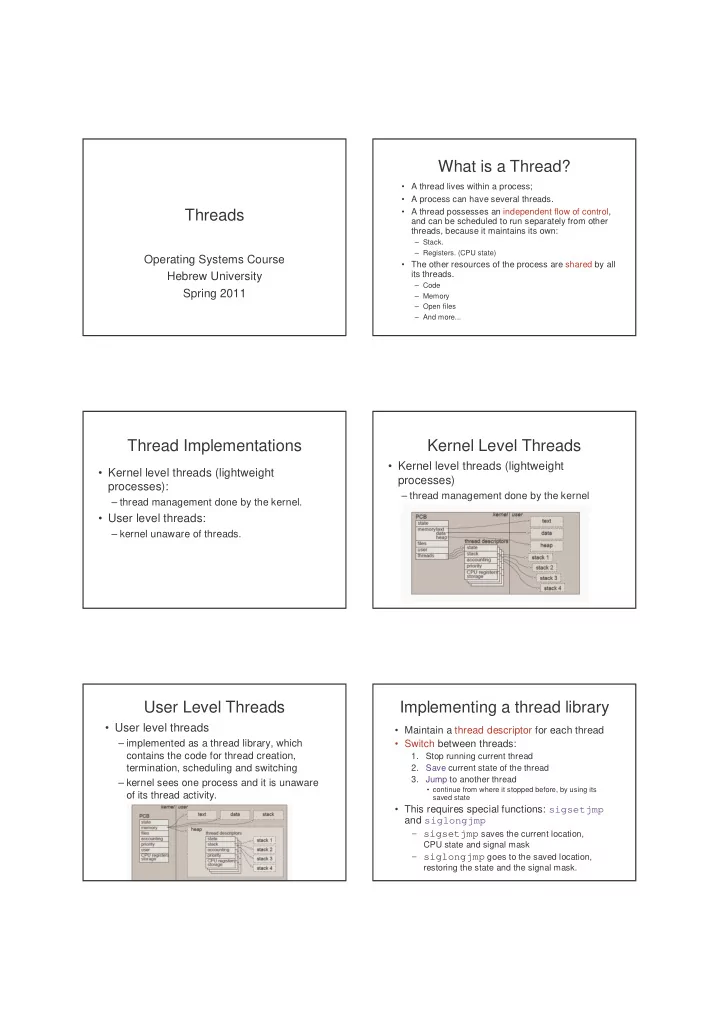

SLIDE 1
Operating Systems Course Hebrew University Spring 2011
Threads What is a Thread?
- A thread lives within a process;
- A process can have several threads.
- A thread possesses an independent flow of control,
and can be scheduled to run separately from other threads, because it maintains its own:
– Stack. – Registers. (CPU state)
- The other resources of the process are shared by all
its threads.
– Code – Memory – Open files – And more...
Thread Implementations
- Kernel level threads (lightweight
processes):
– thread management done by the kernel.
- User level threads:
– kernel unaware of threads.
Kernel Level Threads
- Kernel level threads (lightweight
processes)
– thread management done by the kernel
User Level Threads
- User level threads
– implemented as a thread library, which contains the code for thread creation, termination, scheduling and switching – kernel sees one process and it is unaware
- f its thread activity.
Implementing a thread library
- Maintain a thread descriptor for each thread
- Switch between threads:
1. Stop running current thread 2. Save current state of the thread 3. Jump to another thread
- continue from where it stopped before, by using its
saved state
- This requires special functions: sigsetjmp
and siglongjmp – sigsetjmp saves the current location,
CPU state and signal mask
– siglongjmp goes to the saved location,
restoring the state and the signal mask.