Overview Extracting Product Feature Motivation & Terminology - - PDF document

overview extracting product feature
SMART_READER_LITE
LIVE PREVIEW

Overview Extracting Product Feature Motivation & Terminology - - PDF document

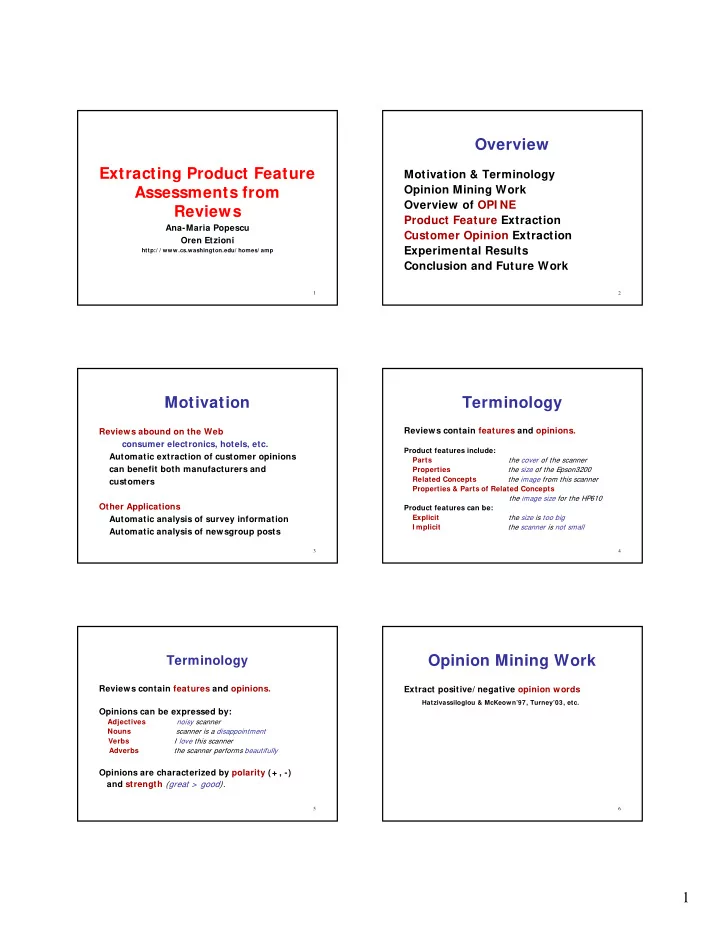
Overview Extracting Product Feature Motivation & Terminology Opinion Mining Work Assessments from Overview of OPI NE Reviews Product Feature Extraction Ana-Maria Popescu Customer Opinion Extraction Oren Etzioni Experimental Results


slide-1
SLIDE 1

1

1

Extracting Product Feature Assessments from Reviews

Ana-Maria Popescu Oren Etzioni

http:/ / www.cs.washington.edu/ homes/ amp

2

Overview

Motivation & Terminology Opinion Mining Work Overview of OPI NE Product Feature Extraction Customer Opinion Extraction Experimental Results Conclusion and Future Work

3

Motivation

Reviews abound on the Web consumer electronics, hotels, etc. Automatic extraction of customer opinions can benefit both manufacturers and customers Other Applications Automatic analysis of survey information Automatic analysis of newsgroup posts

4

Terminology

Reviews contain features and opinions.

Product features include: Parts the cover of the scanner Properties the size of the Epson3200 Related Concepts the image from this scanner Properties & Parts of Related Concepts the image size for the HP610 Product features can be: Explicit the size is too big I mplicit the scanner is not small

5

Terminology

Reviews contain features and opinions. Opinions can be expressed by:

Adjectives noisy scanner Nouns scanner is a disappointment Verbs I love this scanner Adverbs the scanner performs beautifully

Opinions are characterized by polarity (+ , -) and strength (great > good).

6

Opinion Mining Work

Extract positive/ negative opinion words

Hatzivassiloglou & McKeown’97, Turney’03, etc.

slide-2
SLIDE 2

2

7

Opinion Mining Work

Extract positive/ negative opinion words

Hatzivassiloglou & McKeown’97, Turney’03, etc.

Classify reviews as positive or negative

Turney’02, Pang’02, Kushal’03

8

Opinion Mining Work

Extract positive/ negative opinion words

Hatzivassiloglou & McKeown’97, Turney’03, etc.

Classify reviews as positive or negative

Turney’02, Pang’02, Kushal’03

I dentify feature-opinion pairs together with the polarity of each opinion

Hu & Liu’04, Hu & Liu’05

9

Opinion Mining Work

Extract positive/ negative opinion words

Hatzivassiloglou & McKeown’97, Turney’03, etc.

Classify reviews as positive or negative

Turney’02, Pang’02, Kushal’03

I dentify feature-opinion pairs together with the polarity of each opinion

Hu & Liu’04, Hu & Liu’05

OPI NE: High-precision feature-opinion extraction, opinion polarity and strength extraction

10

The OPI NE System

Hotel Majestic, Barcelona: HotelNoise OpinionPhrase Rank Polarity Frequency Deafening 1

  • 2

Loud 2

  • 7

Silent 3 + 3 Quiet 4 + 4 Sample OPI NE output in the Hotel domain

11

KI A Overview

OPI NE is built on top of KI A, a domain-independent I E system which extracts concepts and relationships from the Web. Given relation R and pattern P KI A instantiates P into extraction rules for R KI A extracts candidate facts from the Web Each fact is assessed using a form of PMI : Hits(“Seattle is a city”) PMI (Seattle, is a city) = Hits(“Seattle”) is a city = discriminator for the I S-A relationship

12

OPI NE Overview

I nput: product class C, reviews R Output: set of feature-opinion pairs { (f,o)} . R’ parseReviews( R ) E findExplicitProductFeatures(R’, C) O findOpinions(R’, E) CO clusterOpinions(O) I findI mplicitFeatures(CO, E) RO solveOpinionRankingCSP(CO) { (f, o)}

  • utputFeatureOpinionPairs(RO, I ∪ E)
slide-3
SLIDE 3

3

13

Explicit Feature Extraction

Given product class C

  • 1. Extract parts and properties of C

Recursively extract parts and properties of C’s parts and properties, etc.

  • 2. Extract related concepts of C

(Popescu & all, 2004) Extract parts and properties of related concepts

14

Parts and Properties

Extract review noun phrases with frequency f > k as potential meronyms. Assess candidates using discriminators D derived from patterns P: Example: C= scanner, M= size, P= [M] of C P = [M] of C D0= [M] of scanner … Dk= [M] of Epson 3200. Hits(“size of scanner”) PMI (size, [M] of scanner) = Hits(“ of scanner”) * Hits(“size”) … Hits(“size of Epson 3200”) PMI (size, [M] of Epson3200) = Hits(“ of Epson 3200 ”) * Hits(“size”) Compute PMI T(M, P) = f(PMI (M,D0), … PMI (M, Dk)). Convert PMI T(M, P0) … PMI T(M, Pj) into binary features for a NB classifier (NBC). Retain meronyms M with p(meronym(M, C)) > t. Separate parts from properties using WordNet and Web information.

15

OPI NE Overview

I nput: product class C, reviews R Output: set of feature-opinion pairs { (f,o)} . R’ parseReviews( R ) E findExplicitFeatures(R’, C) O findOpinions(R’, E) CO clusterOpinions(O) I findI mplicitFeatures(CO, E) RO solveOpinionRankingCSP(CO); { (f, o)}

  • utputFeatureOpinionPairs(RO, I ∪ E)

16

Opinion Extraction

Given feature f and sentence s containing f Extract phrases whose head modifies head(f) Example f = resolution s = … great resolution … f = scanner s = … . scanner is white … f = scanner s = … scanner is a horror … f = scanner s = I hate this scanner. f = scanner s = The scanner works well. OPI NE then determines the polarity of each potential

  • pinion phrase.

17

Polarity Extraction

Each potential opinion op has a semantic orientation label L(op): + , -, | I nitial SO Label Assignment OPI NE derives an initial label for each potential opinion: SO(op) = PMI (op, good) - PMI (op, bad). I f SO(op) < t or Hits(op) < t1, L(op) = “| ” (neutral). Else I f SO(op) > 0, L(op) = “+ ”. Else L(op) = “-”. Final SO Label Assignment OPI NE uses constraints to derive a final set of labels WordNet constraints antonym(operative, inoperative) Conjunction/ disjunction constraints attractive, but expensive I teration i : Li(op) = f(Li-1(op0), Li-1(op1)… Li-1(opk)) Termination Condition: Labels remain constant over consecutive iterations.

18

OPI NE Overview

I nput: product class C, reviews R Output: set of feature-opinion pairs { (f,o)} . R’ parseReviews( R ) E findExplicitFeatures(R’, C) O findOpinions(R’, E) CO clusterOpinions(O) I findI mplicitFeatures(CO, E) RO solveOpinionRankingCSP(CO) { (f, o)}

  • utputFeatureOpinionPairs(RO, I ∪ E)
slide-4
SLIDE 4

4

19

I mplicit Properties

Adjectival opinions refer to implicit or explicit properties Example: slow driver speed, slow driver OPI NE extracts properties corresponding to adjectives and uses them to derive implicit features Clarity: intuitive understandable clear straightforward Noise: silent noisy quiet loud deafening Price: cheap inexpensive affordable expensive I mplicit Features: the interface is intuitive clarity(interface): intuitive straightforward interface clarity(interface): straightforward

20

Clustering Adjectives

Generate initial clusters using WordNet syn/ antonyms. Clusters Ai and Aj are merged if there exist multiple elements ai , aj s.t. ai is similar to aj with respect to WordNet: similar(a1, a2): derived(a1, C), att(C, a2). similar(a1, a2): att(C1, a1), att(C2, a2), subclass(C1, C2), etc. For each cluster Ai OPI NE uses queries such as [a1, a2 and X] [a1, even X] , [a1, or even X], etc. to extract additional related adjectives ar from the Web. I f multiple ar are elements of cluster Ar Ai + Ar = A’ { intuitive} + { clear, straightforward} Generate adjective cluster labels WordNet: big= valueOf(size) Add suffixes to cluster elements -iness, -ity

21

Rank Opinion Phrases

I nitial opinion phrase ranking Derived from the magnitude of the SO scores: |SO(great)| > |SO(good)|: great > good Final opinion phrase ranking Given cluster A Use patterns such as [a, even a’] [a, just not a’] [a, but not a’], etc. to derive set S of constraints on relative opinion strength c = silent > quiet c= deafening > loud Augment S with antonymy/ synonymy constraints Solve CSPS to find final opinion phrase ranking

HotelNoise: deafening > loud > silent > quiet

22

Opinion Sentences

Opinion sentences are sentences containing at least one product feature and at least one corresponding opinion. Determining Opinion Sentence Polarity Determine the average strength s of sentence opinions op I f s > t, Sentence polarity is indicated by the sign of s Else Sentence polarity is that of the previous sentence

23

Experimental Results

Datasets: 7 product classes, 1621 reviews 5 product classes from Hu&Liu’04 2 additional classes: Hotels, Scanners Experiments: Feature Extraction: Hu&Liu’04 vs. OPI NE Opinion Sentences: Hu&Liu’04 vs. OPI NE Opinion Phrase Extraction & Ranking: OPI NE

24

OPI NE vs. Hu&Liu

Feature Extraction OPI NE improves precision by 22% with a 3% loss in recall. I ncreased precision is due to Web-based feature assessment. Opinion Sentence Extraction OPI NE outperforms Hu & Liu on opinion sentence extraction: 22% higher precision, 11% higher recall OPI NE outperforms Hu & Liu on sentence polarity extraction: 8% higher accuracy OPI NE handles adjectives, noun, verb, adverb opinions and limited pronoun resolution. OPI NE also uses a more restrictive definition of opinion sentence than Hu & Liu.
slide-5
SLIDE 5

5

25

OPI NE Experiments

Extracting opinion phrases for a given feature: P = 86% , R = 82% Parser errors reduce precision Some neutral adjectives can acquire a pos/ neg polarity in context - these adjectives can lead to reduced precision/ recall Opinion Phrase Polarity Extraction P = 91% Precision is reduced by adjectives which can acquire either a positive or a negative connotation: visible Ranking Opinion Phrases Based on Strength P = 93%

26

Conclusion & Future Work

OPI NE is a high-precision opinion mining system which extracts fine-grained features and associated opinions from reviews. OPI NE successfully uses the Web in order to improve precision. Future Work Use OPI NE’s output to generate review summaries at different levels of granularity. Augment the opinion vocabulary. Allow comparisons of different products with respect to a given feature.