Multiple change-point analysis k k k f s g f h g - - PDF document

multiple change point analysis
SMART_READER_LITE
LIVE PREVIEW

Multiple change-point analysis k k k f s g f h g - - PDF document

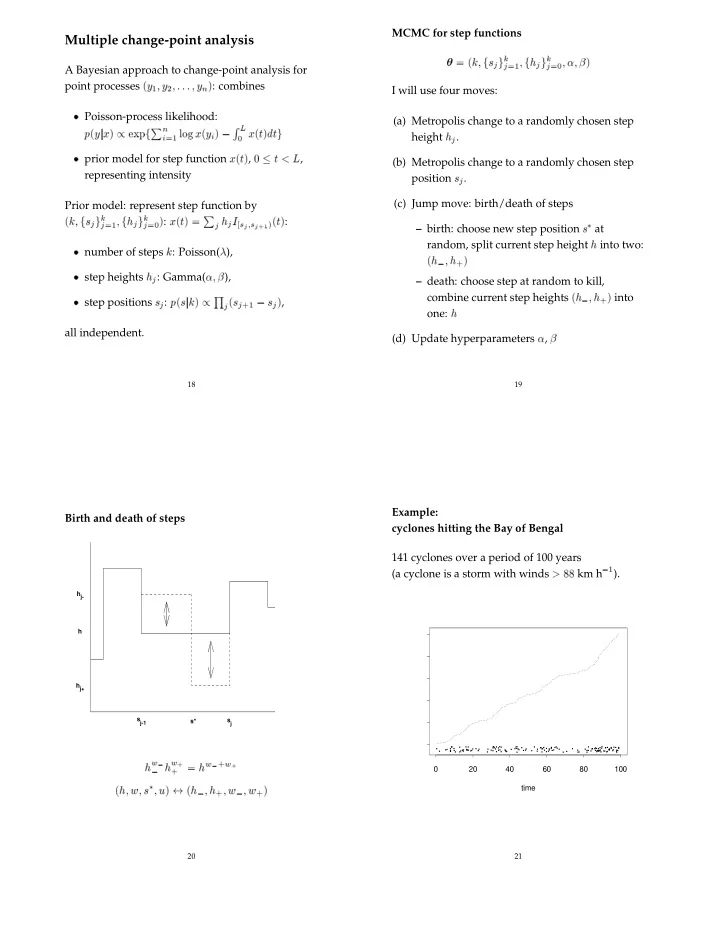
MCMC for step functions Multiple change-point analysis k k k f s g f h g j j j j A Bayesian approach to change-point analysis for y y y


slide-1
SLIDE 1

Multiple change-point analysis

A Bayesian approach to change-point analysis for point processes

y
  • y
  • y
n : combines Poisson-process likelihood: py jx
  • exp
f P n i log xy i
  • R
L
  • xtdtg
prior model for step function xt,
  • t
  • L,

representing intensity Prior model: represent step function by

k
  • fs
j g k j
  • fh
j g k j
  • :
xt
  • P
j h j I s j s j
  • t:
number of steps k: Poisson(), step heights h j: Gamma(
  • ),
step positions s j: psjk
  • Q
j s j
  • s
j ,

all independent.

18

MCMC for step functions

  • k
  • fs
j g k j
  • fh
j g k j
  • I will use four moves:

(a) Metropolis change to a randomly chosen step height

h j.

(b) Metropolis change to a randomly chosen step position

s j.

(c) Jump move: birth/death of steps – birth: choose new step position

s at

random, split current step height

h into two: h
  • h
  • – death: choose step at random to kill,

combine current step heights

h
  • h
  • into
  • ne:
h

(d) Update hyperparameters

,
  • 19

Birth and death of steps

j-

h hj+ s* sj sj-1 h

h w
  • h
w
  • h
w
  • w
  • h
w
  • s
  • u
  • h
  • h
  • w
  • w
  • 20

Example: cyclones hitting the Bay of Bengal 141 cyclones over a period of 100 years (a cyclone is a storm with winds

  • km h
).

time 20 40 60 80 100

.. . .. . . . .. ... . .. . .. . . . . .. . ... . . ... . . . .. . .. . . .. .. . . ... . . . . . .... . ... .. . . . . . .. .. . .. . .. .. .... . . . . .. . . .. . .. . . . . . . . . . . . . . . . .. . . . . . .. . . .. . . . .. . . . . . .

21

slide-2
SLIDE 2

Choices of hyperparameters:

Prior on k: Poisson(), with
  • .
Prior on h j: Gamma(,), with

  • nL

Sample of step functions from the posterior:

time intensity 20 40 60 80 100 1 2 3 22

Posterior for the number of change points

k
  • k

probability 2 4 6 8 10 12 0.0 0.10 0.20

Zero change points is ruled out;

k
  • r
more

probable than under the prior.

23

Posterior density estimates for change-point positions

time density 20 40 60 80 100 0.0 0.05 0.10 0.15 24

Model-averaged estimate:

E xjy
  • time

intensity 20 40 60 80 100 0.0 0.5 1.0 1.5 2.0 2.5

.. . .. . . . .. ... . .. . .. . . . . .. . ... . . ... . . . .. . .. . . .. .. . . ... . . . . . .... . ... .. . . . . . .. .. . .. . .. .. .... . . . . .. . . .. . .. . . . . . . . . . . . . . . . .. . . . . . .. . . .. . . . .. . . . . . . (the expectation of a random step function is not a step function).

25

slide-3
SLIDE 3

Ordinary smoothing methods (in this case a kernel smoother) can’t match that mean curve

time intensity 20 40 60 80 100 0.0 0.5 1.0 1.5 2.0 2.5

.. . .. . . . .. ... . .. . .. . . . . .. . ... . . ... . . . .. . .. . . ... . . ... . . . . . .... . ... .. . . . . . .. .. . .. . .. .. .... . . . . .. . . .. . .. . . . . . . . . . . . . . . . .. . . . . . .. . . .. . . . .. . . . . . . – fixed-bandwidth smoothers either over-smooth the steps, or under-smooth the plateaux.

26