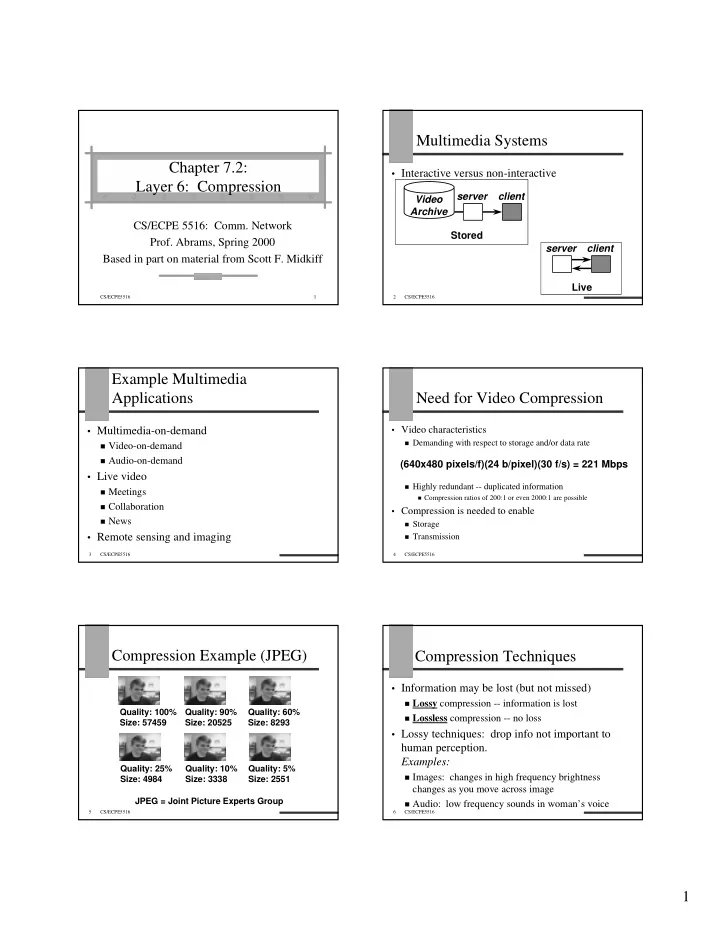
Multimedia Systems Chapter 7.2: Interactive versus non-interactive - - PDF document

multimedia systems chapter 7 2
SMART_READER_LITE
LIVE PREVIEW

Multimedia Systems Chapter 7.2: Interactive versus non-interactive - - PDF document

Multimedia Systems Chapter 7.2: Interactive versus non-interactive Layer 6: Compression server client Video Archive CS/ECPE 5516: Comm. Network Stored Prof. Abrams, Spring 2000 server client Based in part on material from Scott F.


slide-1
SLIDE 1

1

CS/ECPE5516 1

Chapter 7.2: Layer 6: Compression

CS/ECPE 5516: Comm. Network

  • Prof. Abrams, Spring 2000

Based in part on material from Scott F. Midkiff

CS/ECPE5516 2

server client Live

Multimedia Systems

  • Interactive versus non-interactive

Video Archive server client Stored

CS/ECPE5516 3

Example Multimedia Applications

  • Multimedia-on-demand

n Video-on-demand n Audio-on-demand

  • Live video

n Meetings n Collaboration n News

  • Remote sensing and imaging

CS/ECPE5516 4

Need for Video Compression

  • Video characteristics

n Demanding with respect to storage and/or data rate n Highly redundant -- duplicated information

n Compression ratios of 200:1 or even 2000:1 are possible

  • Compression is needed to enable

n Storage n Transmission

(640x480 pixels/f)(24 b/pixel)(30 f/s) = 221 Mbps

CS/ECPE5516 5

Compression Example (JPEG)

Quality: 100% Size: 57459 Quality: 90% Size: 20525 Quality: 60% Size: 8293 Quality: 25% Size: 4984 Quality: 10% Size: 3338 Quality: 5% Size: 2551 JPEG = Joint Picture Experts Group

CS/ECPE5516 6

Compression Techniques

  • Information may be lost (but not missed)

n Lossy compression -- information is lost n Lossless compression -- no loss

  • Lossy techniques: drop info not important to

human perception. Examples:

n Images: changes in high frequency brightness

changes as you move across image

n Audio: low frequency sounds in woman’s voice

slide-2
SLIDE 2

2

CS/ECPE5516 7

Lossless Compression Algorithms (1)

  • Run Length Encoding

“AAABB” ⇒ “3A2B” Can actually increase file size Can be applied to images by comparing adjacent pixels

  • Differential Pulse Code Modulation

“AAABBC” ⇒ “A00112” since B is 1 away from A, …

  • Delta encoding

“AAABBC” ⇒ “A00101” since C is 1 away from B, …

CS/ECPE5516 8

Lossless Compression Algorithms (2)

  • Dictionary-based methods

n Build table of variable length strings

“to be or not to be is Shakespeare’s line – is it not?” Dictionary: 0=“to be” 1=“not” 2=“is” ⇒ “0 or 1 0 2 Shakespeare’s line – 2 it 1?”

n Cost: must send dictionary before file n Examples: Lempel-Ziv (Unix compress)

CS/ECPE5516 9

Lossy Compression – Images (1)

  • GIF

n Given 24-bit pixels, pick the 256 most used colors.

Map each 24-bit pixel into 1-of-256.

n Achieves 3x compression. n Then run Lempel-Ziv, maybe achieving 10x

compression.

CS/ECPE5516 10

Lossy Compression – Images (2)

  • JPEG

n

DCT Phase:

n

Divide image into 8x8 pixel blocks.

n

If you move across x-axis, you see pixels vary with some frequency.

n

Compute something like Fourier transform, called Discrete Cosine Transform (DCT) – maps intensity to frequency domain with 64 intensities.

high DC

CS/ECPE5516 11

JPEG

  • DCT Phase
  • Quantization Phase
  • Use table of coefficients; divide step 1 values by coefficients.

Maps many frequencies to zero.

  • Encoding phase

n

Huffman code: use few bits for most popular numbers

n

Use delta encoding for subsequent array values

  • Color: repeat 3 times (RGB)

33 27 21 15 27 21 15 11 21 15 11 7 15 11 7 3

CS/ECPE5516 12

Video Compression Techniques

  • Scope of compression

n Intraframe -- eliminate or reduce redundancy within a

single frame

n Interframe -- eliminate or reduce redundancy between

consecutive frames

n Prediction, interpolation –

predict frame based on previous/subsequent values

n Sample to take advantage of human perception

slide-3
SLIDE 3

3

CS/ECPE5516 13

MPEG Overview (1)

  • Features

n Can achieve compression ratios of 200:1

n Would reduce data rate to around 1.2 Mbps for a 640x480

image

n MPEG-1 compresses 320x240 images and requires at

least 1.5 Mbps

n Also includes audio compression with compression

ratios of 5:1 to 10:1

CS/ECPE5516 14

MPEG Overview (2)

  • Compression techniques

n Uses DCT for intraframe compression n Uses interframe compression by storing differences between

successive frames

  • There are three frame types

n Intraframes (I frames) are encoded using intraframe

compression

n Predicted frames (P frames) are predicted from previous I

frames

n Bidirectional frames (B frames) are interpolated from previous

and future frames

CS/ECPE5516 15

MPEG Overview (3)

I B B B P B B B I

1 2 3 4 5 6 7 8 9

forward prediction bidirectional prediction time

  • Repeated pattern of frames (pictures) is a group
  • f pictures (GOP)

n Example: IBBBPBBB

CS/ECPE5516 16

Transmission of MPEG

  • If stored video, send IBBBPBBBI as

IPBBBBBBI

  • Might use Differentiated Services, with I’s and

P’s as high priority

  • Can change quantization matrix during video

CS/ECPE5516 17

MPEG: Motion Pictures Expert Group ITU-T: International Telecommunication Union -- Telecommunication JPEG: Joint Photographic Experts Group

Some Video Compression Standards

  • MPEG-1, MPEG-2, MPEG-3, and MPEG-4
  • ITU-T (CCITT) standards

n H.320 (H.261) — ISDN (64 Kbps increments) n H.323 — LAN n H.324 — POTS

  • MJPEG (Motion JPEG)