
SLIDE 1
iCUB
a shared platform for research in robotics & AI
Alessandro Roncone
Postdoctoral Associate Social Robotics Lab http://alecive.github.io
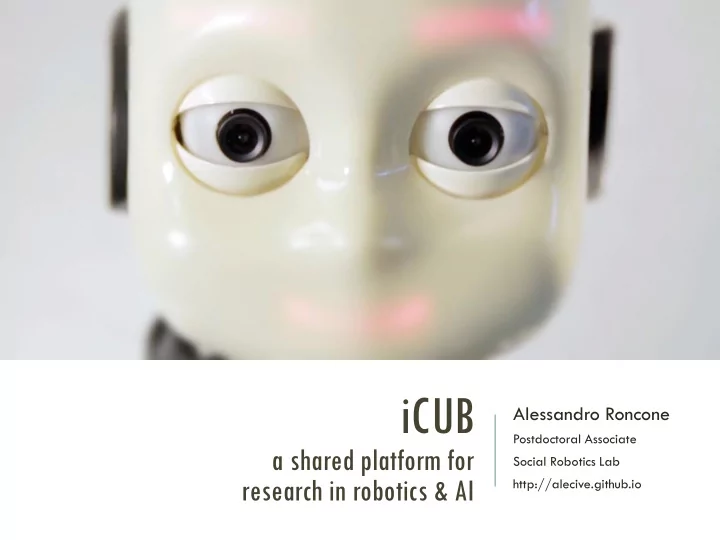
iCUB Alessandro Roncone Postdoctoral Associate a shared platform - - PowerPoint PPT Presentation
iCUB Alessandro Roncone Postdoctoral Associate a shared platform for Social Robotics Lab research in robotics & AI http://alecive.github.io IIT - Italian Institute of Technology Italy Genoa IIT Robotics @ IIT IIT - iCub Facility The
Alessandro Roncone
Postdoctoral Associate Social Robotics Lab http://alecive.github.io
Italy Genoa IIT Robotics @ IIT
■ Full humanoid robot (104cm, 25 kg) ■ 53 degrees of freedom (DoFs) ■ Hands: 5 fingers, 9 degrees of freedom, 19 joints ■ Human-like sensors: cameras, microphones, joint encoders, IMUs (accelerometer/gyroscope), force/torque sensors ■ Artificial skin ■ Large software repository (~2M lines of code) ■ Open source HW & SW
■ Scientific reasons (elephants don’t play chess) ■ Natural human-robot interaction ■ Challenging mechatronics
■ Repeatable experiments ■ Benchmarking ■ Quality of the HW & SW ■ This resonates with industry-grade R&D in robotics
Force/Torque Sensor Artificial Skin Inertial Sensor
YARP Kinematics/Dynamics Computer Vision & Machine Learning
■ placed on the proximal part of the limb ■ able to sense force up to the end-effector ■ critical for many applications: safety, dynamics/control, HRI, ...
capacitor ■ ground plane: conductive fabric ■ soft material: e.g. silicone ■ electrodes: flexible PCB
upper body: 1868 legs and feet: 1310x2
total: 4488 taxels!!
Without tactile feedback
With tactile feedback
Force/Torque Sensor Artificial Skin Inertial Sensor
YARP Kinematics & Dynamics Computer Vision & Machine Learning
■ Peer-to-peer, loosely coupled, communication ■ Very stable code base ~15 years old (older than ROS) ■ Flexibility and minimal dependencies, fits well with other systems ■ Easy install with binaries on many OSes/distributions (Ubuntu, Debian, Windows, MacOs) ■ Many protocols: ■ Built-in: tcp/udp/mcast ■ Plug-ins: ROS tcp, xml rpc, mjpeg etc..
■ Using YARP without hardware: dataset player ■ Available in binary releases for Linux and Windows
■ Using YARP without hardware: simulators
■ iCub_SIM, and ODE-based simulator ■ Gazebo, the VRC/DRC simulator
■ Inverse Kinematics Solver + Controller ■ IK Solver → Non linear constrained optimization ■ Controller → Able to generate smooth, human-like velocity profiles at the end-effector given the desired joint configuration
■ Quick convergence (<10ms) ■ Scalability ■ Singularities and joints bound handling ■ Complex constraints:
■ The iCub's head has 6DoF ■ The fixation point can be seen as the end-effector of a virtual kinematic chain that starts from the neck base ■ Similar techniques apply
■ The red ball is detected thanks to a particle filter tracker ■ The tracker provides the 3D position of the ball w.r.t. the robot ■ The Cartesian controller steers the arm toward the target 3D point ■ The Gaze controller moves the robot’s gaze in the same direction ■ The Force/Torque sensors make the robot compliant
Please put those into the dishwashing machine Could you please help me with the TV set?
The iCub puts the plates into the dishwashing machine
actions
tools
Actions learning actions Objects learning objects Tools learning tools Learn recognizing actions recognizing objects using tools Use
Teleoperation Markers Structured Environment 3D reconstruction & strong supervision
Approaching human performance
Deep Learning + Big Datasets =
kinematics motion
HRI is a natural application for visual recognition In robotics strong cues are often available, therefore object detectors can be avoided Recognition as tool for complex tasks: grasp, manipulation, affordances, pose
■ Growing dataset collecting images from a real robotic setting ■ Tool for benchmarking visual recognition systems in robotics ■ 28 Objects, 7 categories, 4 different acquisition sessions → ~50K Images ■ http://www.iit.it/en/projects/data-sets.html
■ Growing dataset collecting images from a real robotic setting ■ Tool for benchmarking visual recognition systems in robotics ■ 28 Objects, 7 categories, 4 different acquisition sessions → ~50K Images ■ http://www.iit.it/en/projects/data-sets.html
TRAIN TEST day1 day2 day3 day4
Giorgio Metta Lorenzo Natale, Francesco Nori Ugo Pattacini, Vadim Tikhanoff, Marco Randazzo, Carlo Ciliberto, Daniele Pucci, Francesco Romano, Giulia Pasquale, Sean Ryan Fanello, Ali Paikan, Jorhabib Eljaik, Silvio Traversaro The iCub Facility