
SLIDE 1
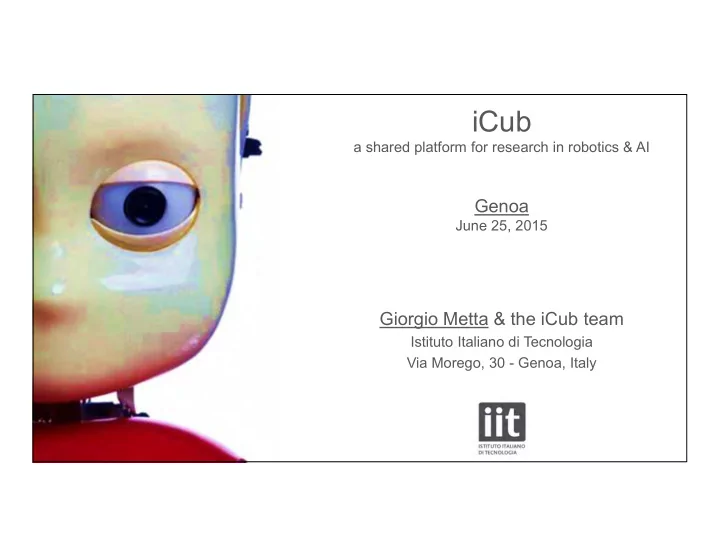
iCub
a shared platform for research in robotics & AI
Genoa
June 25, 2015
Giorgio Metta & the iCub team
Istituto Italiano di Tecnologia Via Morego, 30 - Genoa, Italy
iCub a shared platform for research in robotics & AI Genoa - - PowerPoint PPT Presentation
iCub a shared platform for research in robotics & AI Genoa June 25, 2015 Giorgio Metta & the iCub team Istituto Italiano di Tecnologia Via Morego, 30 - Genoa, Italy we have a dream 6/25/2015 3 the iCub price: 250K 30 iCub
a shared platform for research in robotics & AI
Genoa
June 25, 2015
Giorgio Metta & the iCub team
Istituto Italiano di Tecnologia Via Morego, 30 - Genoa, Italy
6/25/2015 3
6/25/2015 4
price: 250K€ 30 iCub distributed since 2008 about 3-4 iCub’s/year
6/25/2015 5
– 5 fingers, 9 degrees of freedom, 19 joints
– cameras, microphones, gyros, encoders, force, tactile…
– custom electronics, small, programmable (DSPs)
− reproducible & maintainable yet evolvable platform − large software repository (~2M lines of code)
6/25/2015 6
– e.g. elephants don’t play chess
6/25/2015 7
this resonates with industry-grade R&D in robotics
6/25/2015 8
6/25/2015 9
6/25/2015 10
– stiffness by design – no preloading necessary (easy assembly) – requires only 4 custom mechanical parts – high resolution encoder for torque sensing
6/25/2015 11
middleware for humanoid robotics
– an MIT / Univ. of Genoa collaboration – born on Kismet, grew on COG, under QNX – with a major overhaul, now used by the iCub project
platforms
2000-2001 2001-2002 2003 2004-Today
6/25/2015 12
– Adaptive Communication Environment, C++ OS wrapper: e.g. threads, semaphores, sockets
– CMake
– via Swig: Java (Matlab), Perl, Python, C#
C/C++ library C/C++ library C/C++ library C/C++ library
6/25/2015 13
wiki & manual SVN & GIT part lists drawings
6/25/2015 14
6/25/2015 15
̂ ∙
∙ ∙ ∙ ∙ ∙
6/25/2015 16
6/25/2015 17
m i i i
x x k c x f
1
,
y I K c
1
D d j w T i w j i
x z x z D E x x k
d d
1
1 ,
x w x w x z
T T w
sin , cos
y I w
T T
1
+ Cholesky rank-1 update
x w x f
T
2 2
2 1 2 min Xw y w J
w
y X X X I w
T T 1
accuracy
mapping
6/25/2015 18
6/25/2015 19
6/25/2015 20
6/25/2015 21
6/25/2015 22
6/25/2015 23
6/25/2015 24
6/25/2015 25
6/25/2015 26
– 200RF: 400μs – 500RF: 2ms – 1000RF: 7ms
6/25/2015 27
6/25/2015 28
static configuration:
an additional six axis F/T sensor is placed at the end effector to measures the external wrenches we
Joint Joint 0 Joint Joint 1 Joint Joint 2 Joint Joint 3 E ( E (τj-τ
ft)
0.127 Nm
σ ( σ (τj-τ
ft)
0.186 Nm 0.131 Nm 0.013 Nm 0.042 Nm E ( E (τj-(τ
+τe)) )) 0.075 Nm
0.006 Nm σ ( σ (τj-(τ
+τe)) )) 0.191 Nm 0.173 Nm 0.020 Nm 0.032 Nm
additional F/T sensor at the end-effector in this experiment we consider the following quantities:
at the end effector: te=JTwe
6/25/2015 29
capacitor
electrodes: etched on a flexible PCB parameters: shape, folding, etc. soft material: e.g. silicone parameters: dielectric constant, mechanical stiffness, etc. ground plane: e.g. conductive fabric parameters: mechanical properties, impedance, etc.
6/25/2015 30
principle
lots of sensing points structure of the skin
6/25/2015 31 2 4 6 8 10 12 14 16 18 20 40 60 80 100 120
LC [kPa] C [bit]
Soma Foama Hard PDMS Soma Foama Soft Neoprene2mm SpongeRubberLycra NeopreneGrid2mm NeoGridNeobulkLycra NeoGridNeobulkLycra2 Neoprene2mmLycra NeopreneGrid3mm
Others (discarded)
6/25/2015 32
advantages:
6/25/2015 33
6/25/2015 34
performed manually by poking the robot with a tool works iteratively with different datasets taken in different robot positions
force/torque measurements”, in Intelligent Robots and Systems (IROS), 2011
6/25/2015 35
6/25/2015 36
6/25/2015 37
6/25/2015 38
project CoDyCo, Nori et al.
6/25/2015 39
6/25/2015 40
6/25/2015 41
6/25/2015 42
6/25/2015 43
6/25/2015 44
6/25/2015 45
. .
min
,
1 2 . . ∙
6/25/2015 46
6/25/2015 47
6/25/2015 48
6/25/2015 49
Please put those into the dishwashing machine Could you please help me with the TV set?
The iCub puts the plates into the dishwashing machine Trueswell, J. C., & Gleitman, L. R. (2007) Learning to parse and its implications for language acquisition, in G. Gaskell (ed.) Oxford Handbook of Psycholing. Oxford: Oxford Univ. Press.
6/25/2015 50
actions
tools
6/25/2015 51
actions
learning actions recognizing actions
learning objects recognizing objects
tools
learning tools using tools learn use
6/25/2015 52
Ranked 2nd at Microsoft Kinect Demonstration Competition, CVPR 2012 Providence, Rhode Island
6/25/2015 53
self-supervised strategies kinematics motion
Human Robot Interaction is a new and natural application for visual recognition In robotics settings strong cues are often available, therefore object detectors can be avoided Recognition as tool for complex tasks: grasp, manipulation, affordances, pose
S.R. Fanello, C. Ciliberto, L. Natale, G. Metta – Weakly Supervised Strategies for Natural Object Recognition in Robotics, ICRA 2013
Recognition in Robotics, IROS 2013
6/25/2015 54
6/25/2015 55
6/25/2015 56
http://www.iit.it/en/projects/data-sets.html
6/25/2015 57
6/25/2015 58
Sparse Coding [yang et al. ’09] Learned on iCubWorld Sparse Coding [yang et al. ’09] Learned on iCubWorld Overfeat [sermanet et al. ’14] Learned on Imagenet Overfeat [sermanet et al. ’14] Learned on Imagenet
6/25/2015 59
6/25/2015 60
We started by addressing ins instance ance recognition cognition
6/25/2015 61
6/25/2015 62
6/25/2015 63
past days
(current not included)
current day only Cumulative learning on the 4 days of acquisition. Tested on:
1 2 3 4 0.65 0.7 0.75 0.8 0.85 0.9 0.95 1
day accuracy (avg. over classes)
OF present OF causal OF future OF Independent
6/25/2015 64 1 2 3 4 5 6 7 0.65 0.7 0.75 0.8 0.85 0.9 0.95 1
day accuracy (avg. over classes)
OF present OF causal OF future OF Independent
6/25/2015 65 1 6 11 16 21 26 30 0.65 0.7 0.75 0.8 0.85 0.9 0.95 1
day accuracy (avg. over classes)
OF present OF causal OF future OF Independent
6/25/2015 66
6/25/2015 67
6/25/2015 68
6/25/2015 69
6/25/2015 70
6/25/2015 71
6/25/2015 72
6/25/2015 73
Input Segmentation Disparity
6/25/2015 74
Gori,I; Pattacini, U; Tikhanoff, V; Metta G; (submitted 2013) Ranking the Good Points: A Comprehensive Method for Humanoid Robots to Grasp Unknown Objects 2013 IEEE/RSJ International Conference on Intelligent Robots and Systems (IROS 2013)
point cloud from stereo minimum bounding box segmentation surface extraction grasp points from curvature + bias (task dependent) grasp selection from experience
6/25/2015 75
6/25/2015 76
6/25/2015 77
6/25/2015 78
6/25/2015 79
6/25/2015 81 from: Fogassi L., Gallese V., Fadiga L., Luppino G., Matelli M., Rizzolatti G. Coding of peripersonal space in inferior premotor cortex (area F4). Journal of Neurophysiology 76 (1) 1996.
From: Graziano 1999 From: Graziano et al. 2006
6/25/2015 82
walking behavior: cat rehabilitated to walk after complete spinal cord transection wiping reflex: an irritating stimulus elicits a wiping movement precisely directed at the stimulus location
from: Poppele, R., & Bosco, G. (2003). Sophisticated spinal contributions to motor control. Trends in Neurosciences, 26(5), 269-276.
6/25/2015 83
6/25/2015 84
From two fixed-base chain to a single floating-base serial chain 12 dof
6/25/2015 85
6/25/2015 86
6/25/2015 87
6/25/2015 88
6/25/2015 89
6/25/2015 90
6/25/2015 91
6/25/2015 92
6/25/2015 93
6/25/2015 94
6/25/2015 95
6/25/2015 96
6/25/2015 97
6/25/2015 98
6/25/2015 99 iCub2.0 iCub3.0 now the future? iCub new tech
6/25/2015 100
6/25/2015 101
6/25/2015 102
“How old are you?” she wanted to know. “Thirty-two,” I said. “Then you don’t remember a world without robots. There was a time when humanity faced the universe alone and without a friend. Now he has creatures to help him; stronger creatures than himself, more faithful, more useful, and absolutely devoted to
6/25/2015 103
– RobotCub, grant FP6-004370, http://www.robotcub.org – CHRIS, grant FP7-215805, http://www.chrisfp7.eu – ITALK, grant FP7-214668, http://italkproject.org – Robotdoc, grant FP7-ITN-235065 http://www.robotdoc.org – Roboskin, grant FP7-231500 http://www.roboskin.eu – eMorph, grant FP7-231467 http://www.emorph.eu – Poeticon, grant FP7-215843 http://www.poeticon.eu
http://www.iCub.org
completed projects – Poeticon++, grant FP7-288382 http://www.poeticon.eu – Xperience, grant FP7-270273 http://www.xperience.org – EFAA, grant FP7-270490 http://efaa.upf.edu/ – Codyco, grant FP7-600716 http://www.codyco.eu – Tacman, grant FP7-610967 – Wysiwyd, grant FP7-612139 – Walk-man, grant FP7-611832 – Koroibot, grant FP7-611909
new projects