Summary User-centric Social Social Multimedia Multimedia Computing - - PowerPoint PPT Presentation

summary
SMART_READER_LITE
LIVE PREVIEW

Summary User-centric Social Social Multimedia Multimedia Computing - - PowerPoint PPT Presentation

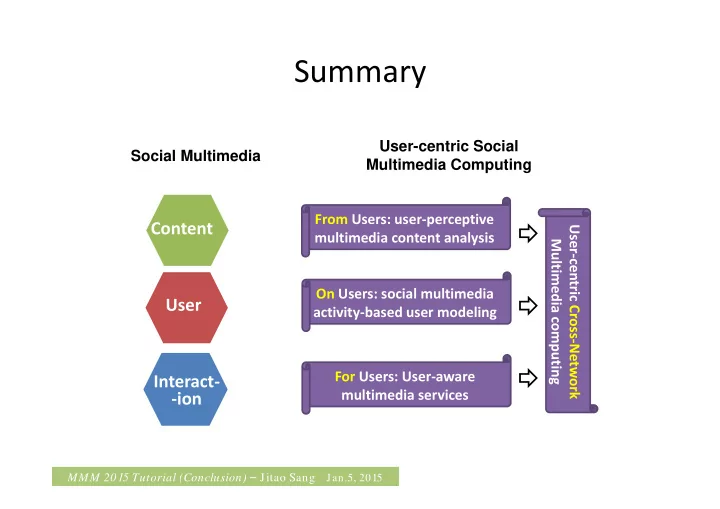
Summary User-centric Social Social Multimedia Multimedia Computing From Users: user-perceptive Content User-centric Cross-Network multimedia content analysis Multimedia computing On Users: social multimedia User activity-based user


slide-1
SLIDE 1

Interact-

  • ion

Content

Social Multimedia

User

User-centric Social Multimedia Computing From Users: user-perceptive multimedia content analysis User-centric Cross-Network Multimedia computing On Users: social multimedia activity-based user modeling For Users: User-aware multimedia services

Summary

MMM 2015 Tutorial (Conclusion) – Jitao Sang Jan.5, 2015

slide-2
SLIDE 2

Practical Challenges

slide-3
SLIDE 3

Lack of Benchmark Dataset

 Due to the problem variety, most researches conduct experiments

  • n the self-collected dataset.

 The lack of benchmark dataset discourages the follow-ups of other researchers and the progress of new problems.

MMM 2015 Tutorial (Conclusion) – Jitao Sang Jan.5, 2015

 Large-scale benchmark dataset on respective multimedia, user, and social network, but none including all of them.

slide-4
SLIDE 4

Evaluation Dilemma

 User ground-truth intent and demands are difficult to obtain in open network environment, especially for the personalized information services.  Existing data-driven evaluation strategies are either unable to reflect real intent/preferences or limited in scale (e.g., favorite record as indication of preference).

MMM 2015 Tutorial (Conclusion) – Jitao Sang Jan.5, 2015

slide-5
SLIDE 5

Privacy

MMM 2015 Tutorial (Conclusion) – Jitao Sang Jan.5, 2015

 Privacy breach: learn the private information of an individual from the publicly available user data.

( “We know where you live.” LBSN 2012. )

slide-6
SLIDE 6

Privacy

MMM 2015 Tutorial (Conclusion) – Jitao Sang Jan.5, 2015

 Privacy breach: learn the private information of an individual from the publicly available user data.  Data anonymization is not adequate to preserve privacy: social media data exhibit rich dependencies.

slide-7
SLIDE 7

Promising Topics

slide-8
SLIDE 8

From Users: Knowledge Base Construction

 Social multimedia involves with rich multimedia information and complicated user and community social information.  To facilitate user services as well as pursue multimedia understanding, it is of particular significance to construct social multimedia knowledge base that: (1) connects between heterogeneous data, and (2) integrates user awareness/perception.

MMM 2015 Tutorial (Conclusion) – Jitao Sang Jan.5, 2015

slide-9
SLIDE 9

On Users: Heterogeneous Data Integration

 User-MM + User-User: Social media users interact with each other, (e.g., adding friends, joining in interest groups), and with multimedia content, (e.g., sharing, annotation, commenting).  Cross-network: Users data are distributed on various social media networks, e.g., acquiring news via Twitter, sharing videos via YouTube, and chatting with friends via Facebook.

MMM 2015 Tutorial (Conclusion) – Jitao Sang Jan.5, 2015

slide-10
SLIDE 10

For Users: Unified Theoretical Framework

 Social multimedia computing is still in the primary stage.

MMM 2015 Tutorial (Conclusion) – Jitao Sang Jan.5, 2015

 It is a promising research line to refer to classical theoretical work from information retrieval, multimedia analysis and social network analysis, to develop the theoretical framework for social multimedia computing.

13 9 12 11 17 13 5 10 15 20 ~2009 2010 2011 2012 2013 2014

slide-11
SLIDE 11

The Prospects

slide-12
SLIDE 12

User connects cyber to the physical worlds.

MMM 2015 Tutorial (Conclusion) – Jitao Sang Jan.5, 2015

slide-13
SLIDE 13

Common user mining User

Cyber activities Physical attributes

Information Integration Aggregated User Modeling Social Network Analysis Cyber-Physical Collaboration

User-centric Cyber-Physical Association and Collaboration

 Overlapping user-based cyber-physical collaboration.

MMM 2015 Tutorial (Conclusion) – Jitao Sang Jan.5, 2015

slide-14
SLIDE 14

Socio space Physical space Cyber space

Event

Socio space

Cyber-Social-Physical Spaces

Cyber-social-physical spaces

MMM 2015 Tutorial (Conclusion) – Jitao Sang Jan.5, 2015

slide-15
SLIDE 15

Online activity Physical behavior Time

Physical space Cyber space

Jan, 2011 May, 2011 Sep, 2011 Jan, 2012

Cyber-Social-Physical Computing

 Social event detection and tracking in cyber-social-physical spaces.

MMM 2015 Tutorial (Conclusion) – Jitao Sang Jan.5, 2015

slide-16
SLIDE 16

视频语义特征提取

User will be the fundamental computing terminal.

MMM 2015 Tutorial (Conclusion) – Jitao Sang Jan.5, 2015

slide-17
SLIDE 17

Computing is tending decentralized

MMM 2015 Tutorial (Conclusion) – Jitao Sang Jan.5, 2015

slide-18
SLIDE 18

Individual computational capability has significantly increased

MMM 2015 Tutorial (Conclusion) – Jitao Sang Jan.5, 2015

slide-19
SLIDE 19

Social Multimedia + Pervasive Computing

Internet of Things

Social Multimedia Computing Pervasive Computing

MMM 2015 Tutorial (Conclusion) – Jitao Sang Jan.5, 2015

content understanding application scenario user modeling resource allocation

slide-20
SLIDE 20
  • User is the basic data collection unit.
  • User is the ultimate information service target.
  • User connects cyber to the physical worlds.
  • User will be the fundamental computing

terminal.

Take Home Message

MMM 2015 Tutorial (Conclusion) – Jitao Sang Jan.5, 2015

slide-21
SLIDE 21

Quan Fang, 3nd-year PhD student Research Topic: Geographical Multimedia Mining and Location-based personalized services Zhengyu Deng, 4th -year PhD student Research Topic: Cross-network User Modeling and Personalized Recommendation Ming Yan, 2nd -year PhD student Research Topic: Cross-network Knowledge Association Mining

Collaborators

Changsheng Xu Professor, Multimedia Computing Group, NLPR, CASIA

slide-22
SLIDE 22

Thank you.

Contact

  • jtsang@nlpr.ia.ac.cn
  • http://www.nlpr.ia.ac.cn/mmc/homepa

ge/jtsang.html

  • Multimedia Computing Group,

National Lab of Pattern Recognition, CASIA