
SLIDE 1
Multimedia Representation
2011-10-31
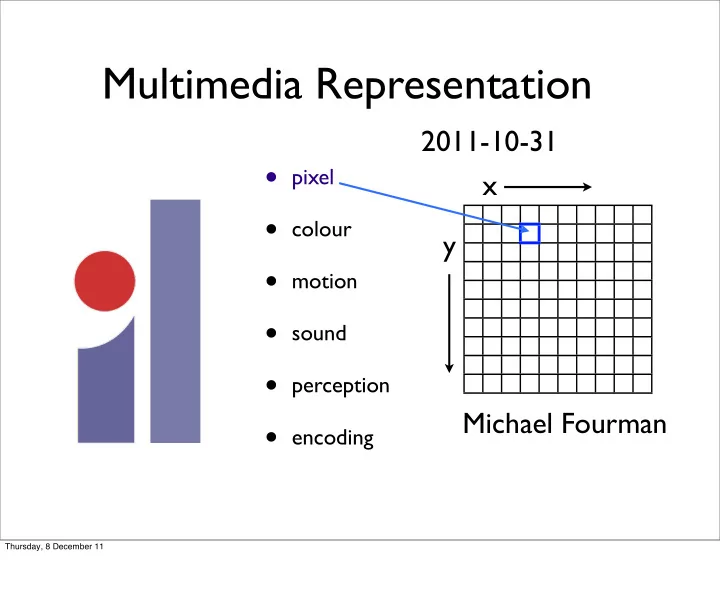
- pixel
- colour
- motion
- sound
- perception
- encoding
Michael Fourman x y
Thursday, 8 December 11
Multimedia Representation 2011-10-31 pixel x colour y motion - - PowerPoint PPT Presentation
Multimedia Representation 2011-10-31 pixel x colour y motion sound perception Michael Fourman encoding Thursday, 8 December 11 Thursday, 8 December 11 Thursday, 8 December 11 Thursday, 8 December 11 Pixel (picture
Thursday, 8 December 11
Thursday, 8 December 11
Thursday, 8 December 11
Thursday, 8 December 11
Thursday, 8 December 11
Smallest item of information in an image. Pixels are arranged in a 2-D grid. Resolution is measured in dots per inch. Each pixel stores a uniform colour or grey-scale value. A digital scanner selects a value for each pixel by sampling from the original image. A RAW image file contains raw data from the image sensor
More samples – more dots-per-inch (dpi) – typically provide more-accurate representations of the original. A 10ʺ x 8ʺ picture requires 400 kilopixels @ 72 dpi 7 megapixels @ 300 dpi 700 megapixels @ 3,000 dpi
Thursday, 8 December 11
modern systems use square pixels
traditional TV formats led to rectangular pixels
Thursday, 8 December 11
Thursday, 8 December 11
response of short, medium & long human cones
wavelength in nanometres
Thursday, 8 December 11
single-colour sensitivity of the human eye
Thursday, 8 December 11
Thursday, 8 December 11
Thursday, 8 December 11
RGB red-green-blue additive HSB hue-saturation- brightness perceptual CMYK cyan-magenta- yellow-black subtractive
Brightness
Thursday, 8 December 11
Thursday, 8 December 11
Thursday, 8 December 11
Thursday, 8 December 11
Thursday, 8 December 11
Thursday, 8 December 11
Thursday, 8 December 11
Thursday, 8 December 11
Thursday, 8 December 11
Thursday, 8 December 11
Thursday, 8 December 11
Thursday, 8 December 11
Thursday, 8 December 11
Thursday, 8 December 11
is the art of creating moving images with the use of computers.
Thursday, 8 December 11
is the art of creating moving images with the use of computers.
To create the illusion of movement, an image is displayed on the computer screen and repeatedly replaced by a new image that is similar to the previous image, but advanced slightly in the time domain (usually at a rate
technique is identical to how the illusion of movement is achieved with television and motion pictures.
Thursday, 8 December 11
Thursday, 8 December 11
Thursday, 8 December 11
Thursday, 8 December 11
Thursday, 8 December 11
Thursday, 8 December 11
For 3D animations,
are built on the computer monitor (modeled) and 3D figures are rigged with a virtual skeleton.
Thursday, 8 December 11
Thursday, 8 December 11
Thursday, 8 December 11
Thursday, 8 December 11
Thursday, 8 December 11
Thursday, 8 December 11
Thursday, 8 December 11
Thursday, 8 December 11
Thursday, 8 December 11
Anaglyph Anaglyph images were, until recently, the most popular method of presenting 3-D and the one 3-D method most commonly associated with stereoscopy by the public at large. They were made popular both because of the ease of their production, and also due to the fact that this technology was the first 3-D technology widely adopted by the Hollywood film industry. In an anaglyph, the two images are either superimposed in an additive light setting through two filters, one red and one cyan. In a subtractive light setting, the two images are printed in the same complementary colours on white paper. Glasses with coloured filters in either eye separate the appropriate images by cancelling the filter colour out and rendering the complementary colour black.
Thursday, 8 December 11
Most recently, the anaglyph 3-D system has been superseded in popularity by the polarization 3-D system. The polarization system has been found to generally appear more life-like, and to also be more easily viewed with less eye-strain over longer periods of time.
Thursday, 8 December 11
Using circular polarization, two images are projected superimposed
right-handed analyzer; while right-circularly polarized light is extinguished by the left-handed analyzer. The result is similar to that of stereoscopic viewing using linearly polarized glasses; except the viewer can tilt his or her head and still maintain left/right separation.
Polarization is also more popular since the introduction of digital movie projectors.
Thursday, 8 December 11
Thursday, 8 December 11
Thursday, 8 December 11
Thursday, 8 December 11