
SLIDE 1
Muddy Waters
Joey Betland Lindsay Cox Matt Rolchigo Donald Wilhite II
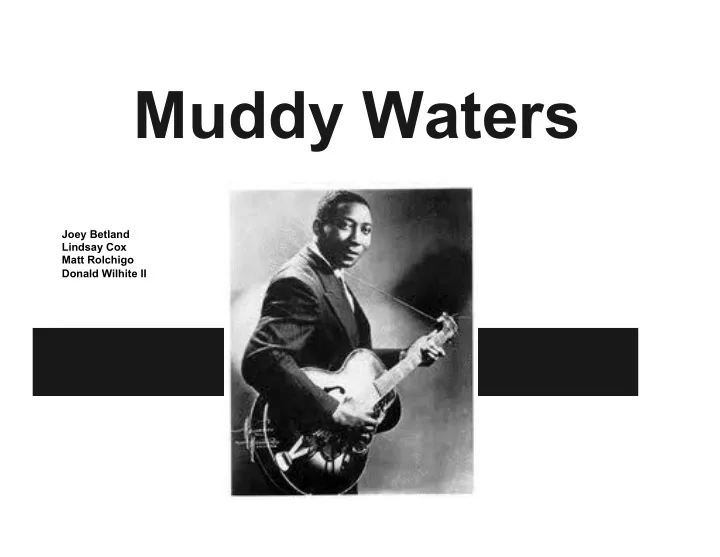
Muddy Waters Joey Betland Lindsay Cox Matt Rolchigo Donald - - PowerPoint PPT Presentation
Muddy Waters Joey Betland Lindsay Cox Matt Rolchigo Donald Wilhite II Early Life McKinley Morganfield was born April 4th 1915 in Rolling Fork Mississippi. He was Raised by his Grandmother as his mother died at the age of three.
Joey Betland Lindsay Cox Matt Rolchigo Donald Wilhite II
4th 1915 in Rolling Fork Mississippi. He was Raised by his Grandmother as his mother died at the age of three.
years at the age of 13 he began to play and master the harmonica. Four years later he would switch to the bottleneck guitar
when Alan Lomax visited him for the folk song collection of the Library of Congress.
never looked back. He would begin by playing house parties and small taverns across the slums
the owners of the small independent records to sign and begin to record his first songs
Can't Be Satisfied” and “I Feel Like Going Home” and his career began to take off.
most acclaimed bands of blues history in America with Little Walter on harmonica, Crawford on the Bass Water’s Bottleneck Guitar and later Jimmy Rodgers.
biggest hits with "I Just Want To Make Love To You," "Hoochie Coochie Man" and "I'm Ready" (1954), "Just To Be With You" (1956) and several others
dominant post war blues styles. Many would go on to emulate his style and artists that worked with him would go
blues sounds began to take a backseat to the various forms of modern black dance music
become enchanted with blues along with the blues boom in Britain keeping Water’s music popular.
died quietly in his sleep on April 30th 1983 in Westmont, Illinois
icon singing "Mississippi- Delta" styled music
single (1948) that contained instant hit songs such as "I Can't Be Satisfied" and "I Feel Like Going Home"
a new technique in the 1950's
sharp, powerful, exciting vocals of Muddy Waters dragged in listeners
audiences around the country
South with his characteristic, pain-filled voice
(1938)
bottleneck guitar style that fit so seamlessly with his vocals
singing playing at any venue he could find over the next couple of years
made a few immediate hits playing the harmonica and singing while accompanied by a bottleneck guitar style
strictly urban
career by multiple now-famous artists, all who adapted to his postwar Blues style and learned from him
players and singers owe their careers to the deep, powerful singing and pain-driven, exceptional guitar playing of the great Muddy Waters
style of guitar playing that Waters picked up around age 13
§
Johnson influence can be heard in Waters' earlier commercial recordings
§
Delta blues musicians had influence on Waters' voice
Johnson, Son House, Tommy Johnson
when he was young
influenced by Waters' guitar playing - it's what kept him playing
style
form their own separate groups, which spread the Muddy Waters' style further
some aspect
Luther Johnson, Otis Spann, James Cotton, among
indebted to Waters - his music is the "yardstick" for which to compare other groups to.
also was black and played the guitar, show some similarity to the blues style of Muddy Waters
Muddy Waters, as it was also derived from R&B music as was Muddy Waters’ music background
levees along the Mississippi River to fail, flooding 27,000 square miles of land
flooding) strongly favored the white and wealthier residents
forced to work on rebuilding the levees without pay, and were even driven back at gunpoint by the National Guard if they tried to leave
the disaster area, refusing to visit
“hero” by assembling a special committee to handle the emergency and also gain publicity for himself
president largely based on this, but…
Commission secret from the media as he refused to do anything about the unfair treatment of blacks until after the election
blacks to switch allegiance from Hoover’s Republicans to FDR and the Democrats due to Hoover’s lack of help for the black community
northward to Chicago as blacks attempted to leave the Delta and farming jobs for industry to the north, where Muddy Waters would acquire his fame as a blues legend
Ambrose, S. (2001, May 01). National geographic news. Retrieved from http://news.nationalgeographic.com/news/ 2001/05/0501_river4.html Barrett, P. (n.d.). Illinois periodicals online. Retrieved from http://www.lib.niu.edu/2001/iht810125.html Great mississippi flood of 1927. (2012, April 16). Retrieved from http://bluffdwellerscavern.com/2012/04/16/great- mississippi-flood-of-1927/ Palmer, R. (1983, May 01). Muddy waters, blues performer, dies. New York Times. Retrieved from http:// www.nytimes.com/learning/general/onthisday/bday/0404.html [Web log message]. (2007, October 17). Retrieved from http://www.npr.org/templates/story/story.php?storyId=15333469 Welding, P. (1992). Muddy waters. Retrieved from http://www.muddywaters.com/bio.html