
SLIDE 1
ISG BUS G BUSINESS S PLAN AN RE REVIEW
5th OCTOBER 2018
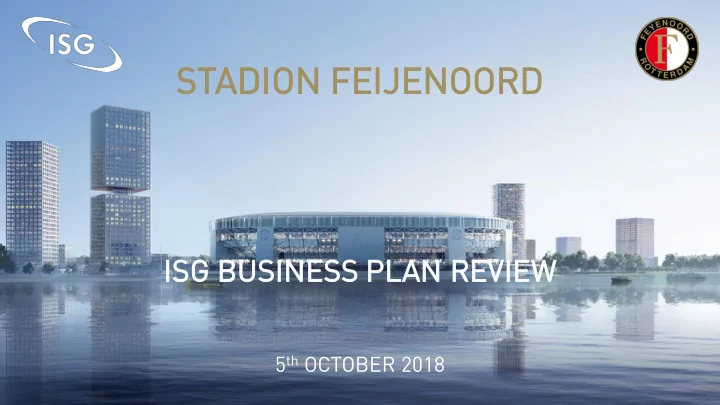
ST STADI ADION ON FE FEIJ IJEN ENOOR OORD 5 th OCTOBER 2018 - - PowerPoint PPT Presentation
ISG BUS G BUSINESS S PLAN AN RE REVIEW ST STADI ADION ON FE FEIJ IJEN ENOOR OORD 5 th OCTOBER 2018 ISGS ROLE ISG was appointed by Stadion Feijenoord in January 2018 to undertake a thorough review of the business model for the
5th OCTOBER 2018
ISG’S ROLE
model for the new stadium
would update the financial projections to reflect the risks and opportunities highlighted in ISG’s draft report
reasonable and can be relied upon. Hence ISG’s ultimate fiduciary obligations and duty of care is to these banks
APPOINTMENT (JAN 2018) PHASE 1 (Q1 2018) PHASE 2 (Q2/Q3 2018) DRAFT FINDINGS (AUG 2018) UPDATES TO PROJECTIONS (ONGOING) FINAL REPORT (PENDING) RELIANCE LETTER (2019/20)
PR PROCES CESS
IS ISG
with around 30,000 employees. Legends’ main offices are in Los Angeles, Dallas, New York and London
and planning division specialising in providing analytics and consulting services to the sports, convention, entertainment and leisure industries
in over 1,800 projects worldwide
and runs Legends’ Global Planning activity in Europe. Prior to joining ISG in 2009, Richard worked in finance and private equity, including the financing of the new Wembley Stadium in London in 2002.
Udinese Calcio, Tottenham Hotspur FC, Galatasaray SK, AC Milan, Twickenham Stadium and the All England Lawn Tennis Club.
Manchester City FC and Liverpool FC.
IS ISG
unparalleled track record of success. As such Goldman Sachs, as well as many other banks, rely on ISG and CSL’s reports in the provision of financing to multiple stadia
SUM UMMA MARY RY OF FIN INDINGS INGS
Revenue Area ISG Adjustments Impact (v Total Revenue) GA Tickets Forecasts are reasonable
Forecasts are reasonable, ISG believe potential to increase revenues through higher yield per seat
Forecasts are reasonable
One fewer theme room and lower concourse spend per head
Sponsorship Slightly lower value of stadium related assets 0% Touring/Attraction
attraction/sightseeing.
BVO Forecasts are reasonable Commercial rent Forecasts are reasonable Parking Forecasts are reasonable Total Revenue
Operating Costs 1% EBITDA 5% reduction (equivalent to 2% of revenue)
projections are reasonable and well considered.
reflect the analysis
revenue of 3% of Stadion Feijenoord’s projections and a 5% reduction in EBITDA.
per seat in the Business Seats to increase revenue at the new stadium, and as this is higher margin than F&B, were it to be undertaken the majority of these increases will flow through to EBITDA.
the reductions above.
that Feyenoord finish in the top 3 of the league and hence qualify for European competition.
Stadion Feijenoord have prepared base case projections (“Projections”) for a new stadium(“New Stadium”) and are seeking to raise financing in 2019/2020
have requested a two phase review of the Projections
revenue and expenses line items in the Projections
PR PROJEC ECT T OVER ERVIEW VIEW
PH PHASE E 1 1 – KEY EY FIN INDINGS INGS
projections were reasonable/appropriate, including:
investigation into the Projections was required, the major items being as follows:
concourse catering SPH and non-match day restaurants
European competition would have a substantial impact across the business.
PH PHASE E 2 2 – MUL ULTI TI-LA LAYERED YERED APP PPROACH CH
Robust Survey/Fieldwork
Business Units and Seats General Admission Food and Beverage (match day and non- match day)
Historical Analysis
General admission Business Units and Seats Food and Beverage (match day)
Benchmarking
All of above Naming Rights Non-match day
approach to provide reliable projections for Business Seat / Business Unit income and to understand likely behaviour of season ticket holders.
including a Season Ticket Conjoint exercise and a smaller Hospitality Conjoint exercise testing only seating products.
MATCH CH DAY FI Y FIEL ELDWORK ORK OVERV ERVIEW IEW
TARGET ET GROUPS UPS (IN INCLUDING UDING SEA EASON ON TI TICKE KET T SUR URVEYS) EYS)
Season Ticket Holders (24,420 sent survey link) Season Ticket Holders spending over €500 on their Season Ticket (2,791)
Current Feyenoord VIP Clients (995) Prospective new clients & Cold Lead Prospects (2,895) Cold Lead Corporates in ISG Defined Catchment (50,000)
robust result from the work. With all groups the required levels were achieved.
the market research industry. The objective of conjoint is a trade-off exercise to determine what combination of product features is the most influential on a respondent’s choice of a product.
quantify respondents' preferences for each level of each attribute.
price sensitivities.
simulated market shares of preference.
products and attribute features.
CONJ NJOINT OINT ANA NALYS YSIS IS
EX EXAMPLE PLE CONJO NJOINT INT QU QUES ESTIO TION
questions where they must trade-off the features and pricing of the various plans to select the offering they most prefer.
each respondent in order to determine the underlying value utilities that quantify respondents' preferences for each level of each attribute.
based on these utilities and allows for “what if” testing of any combination of features and pricing, whether or not that combination was shown in the survey.
MATCH CH DAY SH Y SHOWCARDS RDS
the respondents, so they are well positioned to understand the concepts.
B2 B2C SHOWCARD ARDS S – TE TEST PR T PRODUC UCTS TS - ALL
B2 B2B B SHOWCARDS RDS – TE TEST PR T PRODUC UCTS TS
22/05/2018
Lead Screener Calls Begin
29/05/2018
Data) Survey launches
08/06/2018
launches
18/06/2018
(Club Data) Surveys close
13/07/2018
Lead Fieldwork complete
MATCH CH DAY ON Y ONLINE INE SUR URVEY EY TI TIMEL ELINE INE
UNDERSTAND CURRENT MARKET DEFINE POTENTIAL MARKET DETERMINE NECESSARY SAMPLE SIZE FROM EACH SEGMENT OF MARKET RECRUIT SUFFICIENT RESPONDENTS FROM MARKET GATHER RESPONSES AND FEEDBACK FROM RESPONDENTS ANALYSE AND SCALE TO SEGMENTS WITHIN OVERALL MARKET
DEM EMAND ND FOREC RECAST ST PR PROCES ESS
PH PHASE E 2 C 2 CONC NCLUSION USION
and a high willingness to pay significant prices for best product
and highlight potential for upside
GEN ENER ERAL AL ADMIS ISSION ION APP PPROACH CH
analysis of potential general admission revenue at the stadium
long history of high demand for Feyenoord matches including during periods of varying performance on the pitch and stability of the club
to understand preferences and pricing sensitivity, as well as propensity to buy in the new Stadium
TIME AS SEASON TICKET HOLDER
Base: 7,420
NUMBER OF MATCHES PER SEASON (Av 17.7)
Gender
Base: 7,420
Occupation Age 90% 90% 10% 10%
DEM EMOG OGRAPHICS RAPHICS
AVERAGE AGE:
42
length of support and also match attendance
holders, in general the response was within the normal range of ISG experience
pricing policy is revealed, most STHs will buy
and pricing
PH PHASE E 2 C 2 CONC NCLUSION USION
factors:
LE DEALS. A potential partner will analyze comparable naming rights agreements in European football and around the world.
ET SIZE E + M MEDIA COV OVERA RAGE
more media coverage. The increased Club visibility also drives sponsorship value as Sponsors are typically willing to pay more for clubs that generate a considerable amount of media coverage — TV, radio, print, online and social.
DCAST EXPOSURE
vast majority of matches broadcast on television; however, broadcast exposure is often directly linked to historical success and market size. Sponsors are typically willing to pay a premium for clubs that receive a higher degree of global broadcast exposure.
ORIC ICAL L SUCCES
ESS OF THE FACILI
stadium than for an older one. New stadiums tend to be state-of-the-art and architecturally significant, whereas properties can face obstacles in renaming older facilities that have been known by a certain name for an extended period of time.
MBER ER OF EVENTS. More is better when it comes to naming rights dollars. The more events a stadium hosts on an annual basis, the more fans in the stands, the more value to a naming rights partner. The type of events a stadium hosts on an annual basis can also impacts the amount a venue can command for naming rights.
ITATIVE IVE VALUE. Provides corporations an opportunity to align their brand with the image, emotions, popularity and lifestyle
NA NAMIN ING G RIG IGHT HTS S OVERV ERVIEW IEW
visible signage, static signage, LED or video boards, and numerous other forms of signage. On-site signage for the Sponsor is based on signage locations, size and quantities.
Assets that are typically used to activate naming rights include interactive displays, product sampling, retail activation, and promotional giveaways. Valuation of activation and promotional opportunities varies depending on the desirability of the audience being sampled, the number, quality and frequency of touch points and other factors.
receives from being associated with the venue. In this analysis, ISG utilizes impressions data supplied by Meltwater and MVPindex to produce the number of stories for television, radio, online and social media articles.
radio and Internet purchased by the property or provided by its media partners. It also includes sponsor ID on the Club website, mentions in social media, as well as a Sponsor’s inclusion in collateral materials distributed by the Club and the
advertisement, ISG applies a discount to the advertising buy.
AREA EAS OF EV EVALUA UATIO TION
To determine impressions, we multiplied the seconds of exposure by the number of broadcasts and the average viewers per broadcast. The product is divided by 30 to represent the impressions generated through equivalent 30-second units. Because a series of visual and audio exposure is not necessarily equivalent to the value of a continuous 30-second adverting message, the value per impression (VPI) is adjusted based on the overall quality of the exposure element. To arrive at the total value, we multiplied the impressions by the adjusted VPI.
property prestige, activation ability, sponsor protection and media coverage. The qualitative premium is almost always the driving force behind sponsorship deals and typically accounts for a significant portion of the total value of a deal. This is valued as a percentage of the total impressions value of all other sponsor benefits (excluding hospitality benefits).
AREA EAS OF EV EVALUA UATIO TION
PH PHASE E 2 C 2 CONC NCLUSION USION
projections
VIP CATERING
purchased as an add on
F&B allowances supports the projections in this area
THEME ROOMS
bitterballen”
CONCOURSE F&B
MATCH CH DAY F& Y F&B B OVER ERVIEW VIEW
DEM EMAND ND ES ESTI TIMA MATIO TION N – OVERV ERVIEW IEW
Feyenoord are considering new theme rooms where ordinary fans can have a dedicated place to eat and drink before and after the match. These would have a fixed cost and include drinks and food. Which of the these options would you be interested in? Tick all that apply:
FULL BUFFET BIER & SNACKS NEITHER
How would you describe your interest in if the cost were…?
€35 €30 €25 €18 €15 €12 DEFINITELY PURCHASE LIKELY PURCHASE POSSIBLY PURCHASE WOULD NOT PURCHASE
SKIP
DEM EMAND ND ES ESTI TIMA MATIO TION N – SAMPLE PLE DIS ISTRIBUTION TRIBUTION
Gr Gros
ean sample bases es
Base: 6,009
91% from the current level.
compared to benchmarks from other stadia
hence depressing concourse spending
PR PROJEC ECTIO TIONS NS
PH PHASE E 2 C 2 CONC NCLUSION USION
substantial increases from today, but lower than Stadion Feijenoord’s projections
stadium revenue). However, given the profit margin, these two recommendations have only a small impact on the EBITDA projections
be 840 restaurants, generating revenues of €627m per annum
502 respondents, comprised to 250 inhabitants and 252 visitors of Rotterdam.
in the survey, we can estimate that this sample represents around 0.138% of the Rotterdam market
ROTT TTERD ERDAM M MARKE KET
NO NON-MA MATCH CH DAY CO Y CONCL NCLUSION USION
around 21.8% of their current level of restaurant spending in Feyenoord City upon
generate €78.5m
Von Spronsen expects €10.65m
performance of the proposed restaurants is reliant on several factors which are not included in this analysis, such as: the quality of the restaurant offering, weekend bookings, the development of other restaurant clusters in Rotterdam, the wider economy - among other factors. These should be borne in mind when considering this analysis.
LIK IKEL ELIH IHOO OOD D OF VIS ISITING ITING NE NEW STADIUM IUM ATT TTRACTIO TIONS NS
Base: 6,009
expressed concern that the multiple alternative non-match day activities would cannibalise each other, rather than driving incremental cross selling
restaurant business which brings visitors to the site, the survey data analysed by ISG and benchmarks analysed from other attractions during Phase 2 have alleviated our concerns somewhat
the projections are somewhat over ambitious and should be reduced.
TE TEAM PE PERFORMAN ORMANCE CE
finish in the top-3 each season and hence qualify for European competition
Feyenoord with a competitive advantage over all, or nearly all, the other teams in the Dutch league
period, then there will likely be a significant impact on key revenue streams, including
SUM UMMA MARY RY OF FIN INDINGS INGS
Revenue Area ISG Adjustments Impact (v Total Revenue) GA Tickets Forecasts are reasonable
Forecasts are reasonable, ISG believe potential to increase revenues through higher yield per seat
Forecasts are reasonable
One fewer theme room and lower concourse spend per head
Sponsorship Slightly lower value of stadium related assets 0% Touring/Attraction
attraction/sightseeing.
BVO Forecasts are reasonable Commercial rent Forecasts are reasonable Parking Forecasts are reasonable Total Revenue
Operating Costs 1% EBITDA 5% reduction (equivalent to 2% of revenue)
projections are reasonable and well considered.
reflect the analysis
revenue of 3% of Stadion Feijenoord’s projections and a 5% reduction in EBITDA.
per seat in the Business Seats to increase revenue at the new stadium, and as this is higher margin than F&B, were it to be undertaken the majority of these increases will flow through to EBITDA.
the reductions above.
that Feyenoord finish in the top 3 of the league and hence qualify for European competition.
CONT NTEN ENTS TS
ISG heeft in overeenstemming met de regels van de AVG, voor haar marktonderzoek gebruik gemaakt van de klant-bestanden van Feyenoord. Het gaat daarbij om een survey onder de seizoenkaarthouders en onder bestaande en mogelijke zakelijke klanten van Feyenoord. Op basis van de survey zijn analyses uitgevoerd onder andere met betrekking tot klantprofielen en klantvoorkeuren over aantallen, prijzen en hospitality- arrangementen die mogelijk in het nieuwe stadion kunnen worden aangeboden. Deze klantvoorkeuren zijn vervolgens onder andere vertaald naar vraag-patronen en prijs-elasticiteiten die op hun beurt weer zijn gebruikt om de projecties uit de business case uit 2016 te toetsen. De resultaten van de analyse door ISG bevatten commercieel vertrouwelijke informatie die door Stadion en Feyenoord gebruikt worden voor de actualisatie en optimalisatie van de business case. Commercieel vertrouwelijke informatie maken wij niet openbaar. ISG have, in accordance with applicable privacy-regulations, made use of the Feyenoord database on GA and B2B contacts. Using this information surveys were held on GA and B2B-clients, both actual as warm and cold-leads. On the basis of the surveys analyses were performed, among other things, on customer preferences with respect to demand, pricing and hospitality-arrangements that could be offered in the new stadium. These analyses were then used to deduct demand- and price-patterns and e.g. elasticity of prices. Finally these results were used to validate the projections in the Feyenoord business case (version 2016). The analyses and findings from the phase 2 research contain commercially and strategically confidential information, in a competitive market, that Feyenoord will use to improve its business case. Commercially confidential information will not be made publicly available by Feyenoord.
This document is prepared solely for the use and benefit of Stadion Feijenoord (the “client”) pursuant to the terms of the Engagement Letter dated January 31st 2018. Accordingly the contents of this document are strictly confidential and save as expressly provided for in the Engagement Letter or as approved in writing by International Stadia Group Limited (“ISG) are not to be copied or disclosed in any medium to any person. Any person who, notwithstanding the foregoing, elects to place reliance upon this Report does so at their own risk and neither ISG nor any
such company (“ISG Persons”) any assumes any duty of care or responsibility towards them. Neither ISG nor any ISG Person makes any representation or warranty in relation to the Report nor accepts nor assumes any responsibility or duty of care to any third party in respect of the contents of this Report save as expressly provided for in the Engagement Letter. This Report has been prepared for the purposes as set out in the Engagement Letter and the limitations expressed therein. It is issued
The Report contains certain statements, estimates and projections with respect to the anticipated future cash flows in relation to the
at the facility, the competitive landscape and other elements made by ISG or the management of the Project and its advisors concerning anticipated results, which assumptions may or may not prove to be correct. As events and circumstances frequently do not
is particularly true at the current time due to present economic uncertainties. We take no responsibility for the achievement of predicted results. We have not carried out anything in the nature of an audit nor, except where otherwise stated, have we subjected the financial or
responsibility and make no representations with respect to the accuracy or completeness of this information in this report, except where otherwise stated. Please refer also to the Engagement Letter for the full terms and conditions which apply to the preparation and use of this Report.
IM IMPO PORT RTANT NT NO NOTI TICE CE