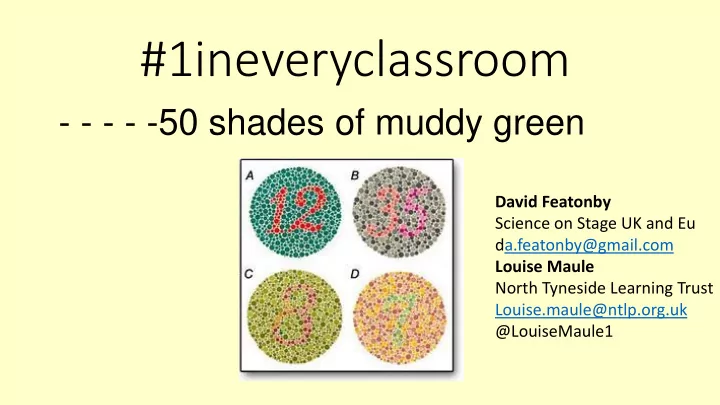
SLIDE 1 #1ineveryclassroom
David Featonby Science on Stage UK and Eu da.featonby@gmail.com Louise Maule North Tyneside Learning Trust Louise.maule@ntlp.org.uk @LouiseMaule1
- - - - -50 shades of muddy green
SLIDE 2 Colour is complex !
- People use colour to recognise objects (is that my coffee cup?) and to
assess material properties (is this banana ripe? Is his skin jaundiced?)
- The neural processes that underlie colour perception begin in the
retina and continue through multiple areas of cortex. * But what we “see” may be just a little more complex than first thought
SLIDE 3
SLIDE 4
Colour Vision ..not so simple !!
SLIDE 5
Colour Vision ..not so simple !!
SLIDE 6
Colour vision is a complex phenomenon
SLIDE 7
What if your pupils don’t see what you see?
SLIDE 8
www.colourblindawareness.org
SLIDE 9 Colour Vision Deficiency
- Inability to distinguish colours, for example red, green, orange, brown.
- 1 in 12 boys or more, 1 in 200 girls.
- (Approximately 2.7 million people in the UK)
- Most are mild to moderate, but 25% are severe.
- Not currently recognised as special educational need or disability.
- Not routinely tested for in UK, or in many parts of Europe.
SLIDE 10 Different types Different severities External factors can affect colour perception, particularly for those with CVD
SLIDE 11 The genes for red / green colour vision are
For a female to be colour blind these genes must be present
chromosomes. A female can be a carrier.
SLIDE 12
‘normal’
Confuse blacks with
greens, blues, purples.
- Deuteranopia. Green
- light. Confusion of
reds and greens, blues and purples.
SLIDE 13
- Trichromacy – ‘normal’ 3 cones
working together
deficiency.
deficiency
- Some mothers are tetrachromic
which means they have an additional cone! Extra colour sensitive!
UNDERSTANDING CVD ………….. CONE SENSITIVITY
SLIDE 14
- Trichromacy – ‘normal’ 3 cones
working together
deficiency.
deficiency
- Some mothers are tetrachromic
which means they have an additional cone! Extra colour sensitive!
UNDERSTANDING CVD ………….. CONE SENSITIVITY in ANIMALS
SLIDE 15 This is what normal vision humans see This is what bulls see. Bulls are colour-blind. They charge the red cape because it is moving, not because it is red.
A red rag to a bull ?
SLIDE 16
SLIDE 17
Additional material
SLIDE 18
- By secondary school, less than 50% of children with mild colour vision
deficiency are aware of it, and 20 – 30% of severe cases are unaware.
SLIDE 19 An eccentric uncle , with no sense of colour
SLIDE 20 Kimberly Steward says her dad’s unique sense of colour comes from the fact that he is colour blind. Kimberly, revealed: 'Well, my dad is colour blind, so he puts extremely bright colours together. The house I grew up in was bright pink. It wasn't normal. The 35-year-old blonde told The Sunday Times Style magazine: 'He doesn't actually recognise the colour situation, so it's not as if he actually knows that he's taking a risk.
http://www.skynews.com.au/culture/showbi z/music/2015/07/29/singer-rod-stewart-is- colour-blind.html#sthash.6mZ1y0B9.dpuf
Rod Stewart
SLIDE 21 A novelty….?
but….decisions will be more difficult
SLIDE 22
…Or a condition that could limit potential?
SLIDE 23
A problem in sport….??
SLIDE 25 But there can be advantages …. Spot the spider !
SLIDE 26 Jamie Oliver* *UK chef Bill Clinton USA President John Dalton Scientist
SLIDE 27 Colour blue the balloon with the largest number. Colour green the balloon with the smallest number. Colour yellow the balloon with the number in between.
Is this boy silly? Naughty? Did he not listen or pay attention? Or is it that he just likes red?
SLIDE 28 Is the liquid a strong acid, weak acid, or neutral? How easy is the task for normal vision How difficult is this task for someone with CVD?
SLIDE 29 The spectrum
What will a CVD pupil see?
Protanopia simulation
SLIDE 30 Identification
What will a CVD pupil see?
SLIDE 31 Inattentive
‘Silly’ mistakes
Lazy Doesn’t try, and rushes their work Shows frustration Does not take part, or is disruptive Poor, or inappropriate presentation Does not follow instructions Does not listen Does not help to tidy up (into coloured boxes)
SLIDE 32 A child with colour vision deficiency may try and hide it. They may not be able to put it into words, and will develop coping strategies. It can also frustrate both the teacher and the child when it appears they can sometimes do a task, and other times not.
SLIDE 33
Impact on self esteem
SLIDE 34 How mig ight you be in inadvertently making lif life dif ifficult for your colo lour bli lind pupils?
– use a traffic light system for assessment? – place pots of mixed unlabelled coloured pencil crayons on tables? – have coloured labels on library books to indicate different reading levels? – use games e.g. counting games with coloured counters? – use worksheets/software which rely on colour? – use books which highlight familiar sounds using colours? – highlight teaching points in red and green on the white board or in books?
SLIDE 35 By the end of the lesson you will be able to:
- Define key words from the unit
- Apply the key words when explaining
SLIDE 36 Colour coded marking will have less, or no, impact on a colour blind child.
SLIDE 37
Normal vision Deuteranopia ?
SLIDE 38 What areas of your subject might be affected?
- Reading litmus paper accurately
- Undertaking chemical titrations in practical chemistry
- Identification of metals by the colour of the flame produced when the
metal is burnt
- Accurately reading stained slides under a microscope
- Carrying out dissections in biology
- Identification of species of plants or insects correctly
- Fully understanding coloured diagrams in textbooks, particularly in
biology, nature
- Use of prisms in physics.
- Wiring of plugs in electricity etc
SLIDE 39 Electric Wiring UK …. with NORMAL VISION
Pre 1980 Now
SLIDE 40 Electric Wiring Deuteranopia
SLIDE 41 Electric Wiring Now Normal Deuteranopia
SLIDE 42
SLIDE 43 Displays, animations, and websites can all pose problems for children with colour vision deficiency.
SLIDE 44
SLIDE 45
SLIDE 46 Top tips
- Awareness is the most important.
- Natural light
- Secondary indicators. e.g. signs on
labels, or underline words
- Yellow, blue and white
- Colour buddy
- Clear boundary between colours
- Set of labelled pencils
- Large objects, held apart
- Contrasts, e.g. red on a white
background but not red and green together on a white background
- NOT extra time
- The sight of the pupil is not the
problem
- Don’t try and do the testing
yourself
- Don’t make a big deal of it
- Exam allowance may or may not
be given
SLIDE 48
- Try Vischeck on Your Image Files
- Select the type of colour vision to simulate:
- Deuteranope (a form of red/green colour deficit)
- Protanope (another form of red/green colour deficit)
- Tritanope (a blue/yellow deficit- very rare)
- Image file:
http://www.vischeck.com/vischeck/visch eckImage.php
SLIDE 49
Will eliminate “red” light… not quite the same but it will give you an idea of what someone might see.
SLIDE 50 http://www.colourblindawareness.org
@colourblindorg
www.youtube.com/watch?v=l5OYL3Kw8L8
SLIDE 51 http://www.colourblindawareness.org
@colourblindorg
SLIDE 52
Additional material
SLIDE 53