Guidelines for Screening for Cervical Cancer and its Precursors, 2010 - - PDF document

guidelines for screening for cervical cancer and its
SMART_READER_LITE
LIVE PREVIEW

Guidelines for Screening for Cervical Cancer and its Precursors, 2010 - - PDF document

Guidelines for Screening for Cervical Cancer and its Precursors, 2010 San Francisco General Hospital These are guidelines for use of cervical cytology in asymptomatic women as a screening tool for cervical cancer and its precursors. Tests performed


slide-1
SLIDE 1

1- Sawaya & Smith-McCune, August 2010

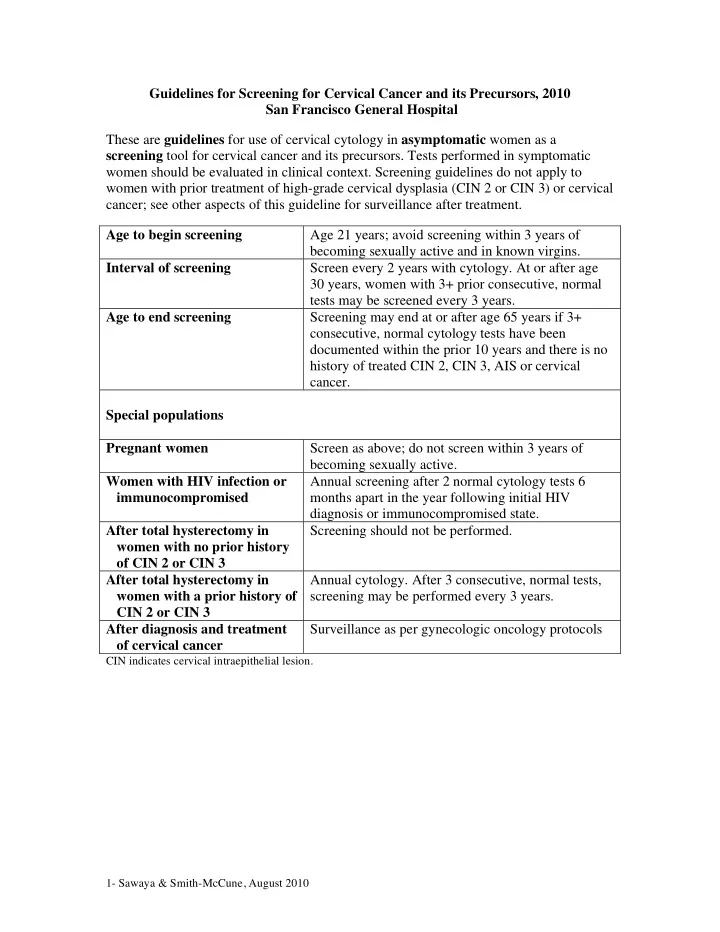
Guidelines for Screening for Cervical Cancer and its Precursors, 2010 San Francisco General Hospital These are guidelines for use of cervical cytology in asymptomatic women as a screening tool for cervical cancer and its precursors. Tests performed in symptomatic women should be evaluated in clinical context. Screening guidelines do not apply to women with prior treatment of high-grade cervical dysplasia (CIN 2 or CIN 3) or cervical cancer; see other aspects of this guideline for surveillance after treatment. Age to begin screening Age 21 years; avoid screening within 3 years of becoming sexually active and in known virgins. Interval of screening Screen every 2 years with cytology. At or after age 30 years, women with 3+ prior consecutive, normal tests may be screened every 3 years. Age to end screening Screening may end at or after age 65 years if 3+ consecutive, normal cytology tests have been documented within the prior 10 years and there is no history of treated CIN 2, CIN 3, AIS or cervical cancer. Special populations Pregnant women Screen as above; do not screen within 3 years of becoming sexually active. Women with HIV infection or immunocompromised Annual screening after 2 normal cytology tests 6 months apart in the year following initial HIV diagnosis or immunocompromised state. After total hysterectomy in women with no prior history

  • f CIN 2 or CIN 3

Screening should not be performed. After total hysterectomy in women with a prior history of CIN 2 or CIN 3 Annual cytology. After 3 consecutive, normal tests, screening may be performed every 3 years. After diagnosis and treatment

  • f cervical cancer

Surveillance as per gynecologic oncology protocols

CIN indicates cervical intraepithelial lesion.

slide-2
SLIDE 2

2- Sawaya & Smith-McCune, August 2010

Guidelines for Initial Management of Abnormal Cervical Cytology, 2010 San Francisco General Hospital

Cytology Interpretation Action Common Benign Findings Unsatisfactory Repeat cytology next available Satisfactory, but no endocervical cells Repeat cytology in 12 months Benign-appearing endometrial cells Pre-menopausal: No action. Post-menopausal: Endometrial biopsy. Epithelial Cell Abnormalities Atypical squamous cells of undetermined significance (ASC-US) Three different strategies may be adopted, but colposcopy is the least preferred:

  • 1. Repeat cytology at 6 and 12 months. If ASC-US+, colposcopy. After 2

normal cytology tests, resume routine screening.

  • 2. HPV testing for high-risk types. If positive, colposcopy. If negative,

repeat cytology in one year; do not do HPV testing in women age 20 or less.

  • 3. Colposcopy†

If age 20 or less, repeat cytology at 12 months (colposcopy if ASC-H or HSIL+) and at 24 months (colposcopy if ASC-US+). If normal, resume routine screening. For pregnant women age 21+, repeat cytology at 6 months; if ASC-US+, colposcopy 6 weeks post-partum. ASC, cannot exclude HSIL (ASC-H) Colposcopy† Low-grade SIL (LSIL) Colposcopy† If age 20 or less, repeat cytology at 12 months (colposcopy if ASC-H or HSIL+) and at 24 months (colposcopy if ASC-US+). If normal, resume routine screening. For pregnant women age 21+, colposcopy may be deferred to 6 weeks post- partum. For post-menopausal women, LSIL may be managed identically to ASC-US. High-grade SIL (HSIL) Colposcopy† Squamous cell carcinoma Colposcopy† Glandular Cell Abnormalities Atypical glandular cells (AGC)

  • endocervical

Colposcopy† with endocervical curettage (ECC)

  • endometrial

Colposcopy† with ECC and EMB

  • not otherwise specified

Colposcopy† with ECC; add EMB if abnormal bleeding, chronic anovulation or age 35+ Adenocarcinoma in situ (AIS) Colposcopy† with ECC and EMB Common Infections

  • shift in flora suggestive of bacterial

vaginosis (BV) Consider evaluation of and treatment for BV if symptomatic. Repeat cytology at appropriate screening interval.

  • fungal organisms consistent with

Candida. Consider evaluation of and treatment for yeast vaginitis if symptomatic. Repeat cytology at appropriate screening interval.

  • cellular changes consistent with

herpes simplex virus (HSV) Diagnostic of HSV. Finding may indicate other STIs. Repeat cytology at appropriate screening interval.

  • Trichomonas vaginalis (TV)

Consider evaluation of and treatment for TV if symptomatic. Finding may indicate other STIs. Repeat cytology at appropriate screening interval. DEP indicates diagnostic excisional procedure (e.g., cone biopsy, loop excision). HSIL+ indicates HSIL, AGC, AIS and/or

  • cancer. ASC-US + indicates ASC-US, ASC-H, LSIL and/or HSIL+. ECC indicates endocervical curettage.

†ECC should be performed in all non-pregnant women with unsatisfactory colposcopy and in those with cytology interpreted as AGC, AIS and cancer. Vaginal colposcopy with Lugol’s solution should be performed in all women with no

  • bvious lesion seen and cytology interpreted as HSIL, AGC, AIS or cancer. In pregnant women, ECC is contraindicated.
slide-3
SLIDE 3

3- Sawaya & Smith-McCune, August 2010

Guidelines for Follow-up after Initial Colposcopy, 2010 San Francisco General Hospital

These are guidelines for the most common clinical scenarios. Patients may be managed individually based on clinical judgment.

Referral Cytology (pre-colposcopy) Findings at initial colposcopy No visible lesion Visible lesion, biopsy-proven CIN 1 Biopsy-proven CIN 2 or 3

ASC-US once Cytology in 12 months. If normal, resume routine screening; if ASC+, repeat colposcopy at the next available appointment. ASC-US twice (unknown HPV status) ASC-US, positive high-risk HPV Atypical squamous cells, cannot exclude HSIL (ASC-H) Low- grade SIL (LSIL) Cytology in 6 and 12 months. The 6-month cytology result should be managed as follows:

  • If ASC or LSIL, repeat colposcopy at the next scheduled appointment (6 months).
  • If ASC-H or HSIL+, repeat colposcopy at the next available appointment.
  • If normal, repeat cytology at the next scheduled appointment (6 months); if cytology is

normal at that time (i.e., at the 12-month visit), resume routine screening; if ASC+, repeat colposcopy at the next available appointment. If colposcopy is satisfactory, ECC is normal and the vagina has no lesions, colposcopy and cytology every 6 months for 1 year is

  • acceptable. DEP may also be performed

(non-pregnant women only); review of

  • utside cytology suggested prior to DEP.

Treatment is preferred. High-grade SIL (HSIL) If colposcopy is unsatisfactory, DEP is preferred (non-pregnant women only). Atypical glandular cells (AGC) Cytology in 6, 12, 18 and 24 months. Repeat colposcopy if ASC-US+. After 4 normal cytology tests, resume routine screening. If AGC recurs, perform cone biopsy. Pelvic sonogram to rule

  • ut adnexal malignancy is recommended in women with persistent AGC.

See “Guidelines for Treatment of biopsy- proven cervical intraepithelial neoplasia (CIN) 2 (moderate dysplasia) and CIN 3 (CIS, severe dysplasia)” Adenocarcinoma in situ, cancer Cone biopsy CIN indicates cervical intraepithelial neoplasia. SIL indicates squamous intraepithelial lesion. HSIL+ indicates HSIL, AGC, adenocarcinoma in situ and/or

  • cancer. ASC-US + indicates ASC-US, ASC-H, LSIL and/or HSIL+. DEP indicates diagnostic excisional procedure (e.g., cone biopsy, loop excision).

Smoking cessation is advised in all patients. HIV testing should be offered in all women with biopsy-proven CIN 3.

Additional information on colposcopy by UCSF authors can be found by typing “GLOWM” and “colposcopy” into your search engine.

slide-4
SLIDE 4

4- Sawaya & Smith-McCune, August 2010

Guidelines for treatment of biopsy-proven cervical intraepithelial neoplasia (CIN) 2 (moderate dysplasia) and CIN 3 (CIS, severe dysplasia), 2010 San Francisco General Hospital

  • CIN 2 and 3 can be treated by either an ablative or an excisional procedure in non-pregnant women.
  • Ablative methods include laser and cryotherapy; excisional methods include loop excision and cone biopsy.
  • In adolescents and young women with satisfactory colposcopy, CIN 2 may be managed with colposcopy

and cytology surveillance every 6 months; routine screening may resume after 2 normal cytology tests and colposcopic exams. If surveillance is chosen, CIN 2 may be followed for up to 24 months without treatment. Alternatively, ablative therapy (e.g., cryotherapy) is the preferred treatment.

Treatment Factors affecting choice

Cryotherapy Appropriate for CIN 2 or CIN 3 if following general criteria met:

  • Satisfactory colposcopy
  • No prior cervical treatment
  • Lesion(s) completely visible and <2 cm in diameter
  • Lesion(s) can be covered entirely with the cryoprobe

Laser ablation Often used for large lesions (>2 cm) with or without vaginal

  • extension. Candidacy same as for cryotherapy.

Loop excision (aka LEEP) Choose for CIN 2 or CIN 3 lesions in which cryotherapy is inappropriate (e.g., unsatisfactory colposcopy, endocervical curettage with dysplasia). Cone biopsy Choose instead of loop excision if suspicion for malignancy or recurrent atypical glandular cells (AGC) on cytology and/or cervical architecture disrupted.

Guidelines for follow-up after treatment of CIN 2 and CIN 3 Treatment Follow-up

Cryotherapy or laser ablation Cytology in 6 and 12 months; colposcopy for ASC-US+. After 2 normal tests, annual cytology. Loop excision (LEEP) or cone biopsy Dysplasia in specimen, negative endocervical margin No dysplasia in specimen Cytology in 6 and 12 months; colposcopy for ASC-US+. After 2 normal tests, annual cytology. Dysplasia in specimen, positive endocervical margin Cytology and ECC in 6 months; colposcopy for ASC-US+. Then, cytology alone in 12 months; colposcopy for ASC-US+. Repeat excision if HSIL+ at any time. After 2 normal tests, annual cytology. Hysterectomy Annual cytology. After 3 consecutive, normal tests, screening may be performed every 3 years. ECC indicates endocervical curettage. ASC-US indicates atypical squamous cell of undetermined

  • significance. HSIL indicates high-grade squamous intraepithelial lesion. HSIL+ indicates HSIL, AGC,

adenocarcinoma in situ and/or cancer. ASC-US + indicates ASC-US, ASC-H, LSIL and/or HSIL+.

Guidelines for treatment and follow-up of adenocarcinoma in situ Treatment Follow-up

Hysterectomy (treatment of choice) Annual cytology. After 3 consecutive, normal tests, screening may be performed every 3 years. Cone biopsy Cytology and ECC every 4 months for 2 years, then every 6 months until hysterectomy.

Smoking cessation is advised in all patients. HIV testing should be offered in all women with biopsy-proven CIN 3.