MSc (APSC) Candidate Saint Marys University Halifax, NS Why do we - - PowerPoint PPT Presentation

msc apsc candidate
SMART_READER_LITE
LIVE PREVIEW

MSc (APSC) Candidate Saint Marys University Halifax, NS Why do we - - PowerPoint PPT Presentation

Logan Gray Supervisor: Dr. Gavin Kernaghan (MSVU) MSc (APSC) Candidate Saint Marys University Halifax, NS Why do we care? < 2 mm diam. absorb water + nutrients ephemeral = huge carbon input Live in/on/around fine roots


slide-1
SLIDE 1

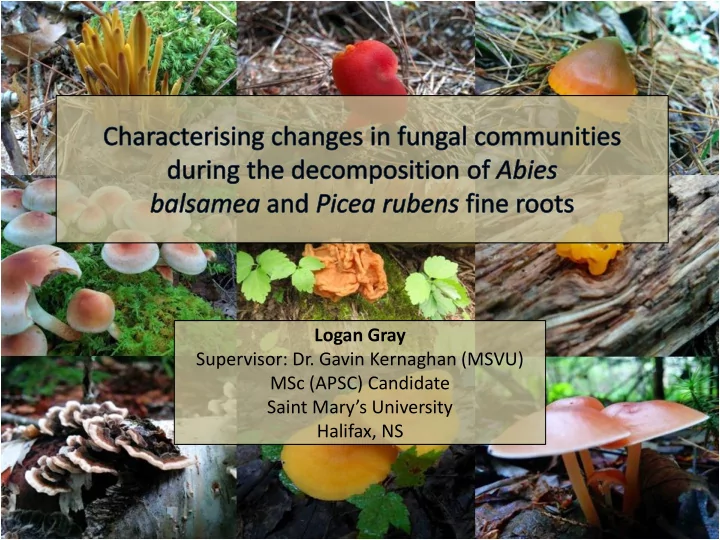
Logan Gray Supervisor: Dr. Gavin Kernaghan (MSVU) MSc (APSC) Candidate Saint Mary’s University Halifax, NS
slide-2
SLIDE 2

Why do we care?

< 2 mm diam. –absorb water + nutrients –ephemeral = huge carbon input –Live in/on/around fine roots –3 different types

slide-3
SLIDE 3

–trade nutrients for tree sugars –often necessary for

  • ptimal tree growth

–sheath root tip with fungal tissue

slide-4
SLIDE 4
  • Commensalists ?

– live between plant cells – not well understood – cryptic

  • Latent saprotrophs ?

– some have pathogenic genes

  • Difficult (for me) to

photograph!

wikipedia.com

slide-5
SLIDE 5

eatlas.org.au

slide-6
SLIDE 6

http://web.ethlife.ethz.ch/

slide-7
SLIDE 7
slide-8
SLIDE 8
slide-9
SLIDE 9
slide-10
SLIDE 10
slide-11
SLIDE 11
slide-12
SLIDE 12

Then brought them to MSVU

Visually identified ectomycorrhizal fungi and rated decomposition Extracted, amplified, and sequenced fungal DNA

+

slide-13
SLIDE 13

What the data show us

– some decompose slower than others

slide-14
SLIDE 14
slide-15
SLIDE 15
slide-16
SLIDE 16
slide-17
SLIDE 17

Hyphae Latex

slide-18
SLIDE 18

www.mushroomobserver.org

Calcium Oxalate crystals

slide-19
SLIDE 19
slide-20
SLIDE 20
slide-21
SLIDE 21

What the data show us

– show initial increase in abundance

slide-22
SLIDE 22
slide-23
SLIDE 23
slide-24
SLIDE 24
slide-25
SLIDE 25

What the data show us

– almost non-existent for the first 16 months

slide-26
SLIDE 26
slide-27
SLIDE 27
slide-28
SLIDE 28
slide-29
SLIDE 29
slide-30
SLIDE 30

Summary of findings

fungi

– vary in decomposition rate – C. geophilum is tough

experience “bump”

– may be eating former host

are slow

– didn’t show up in large numbers

slide-31
SLIDE 31