Mr David Gornall, Chairman, LBMA Thank you very much for asking me - - PDF document

mr david gornall chairman lbma thank you very much for
SMART_READER_LITE
LIVE PREVIEW

Mr David Gornall, Chairman, LBMA Thank you very much for asking me - - PDF document

Mr David Gornall, Chairman, LBMA Thank you very much for asking me to be one of your keynote speakers. Its been a while since I was in India , so I have to apologise for leaving it until your tenth anniversary before attending. Congratulations


slide-1
SLIDE 1

1

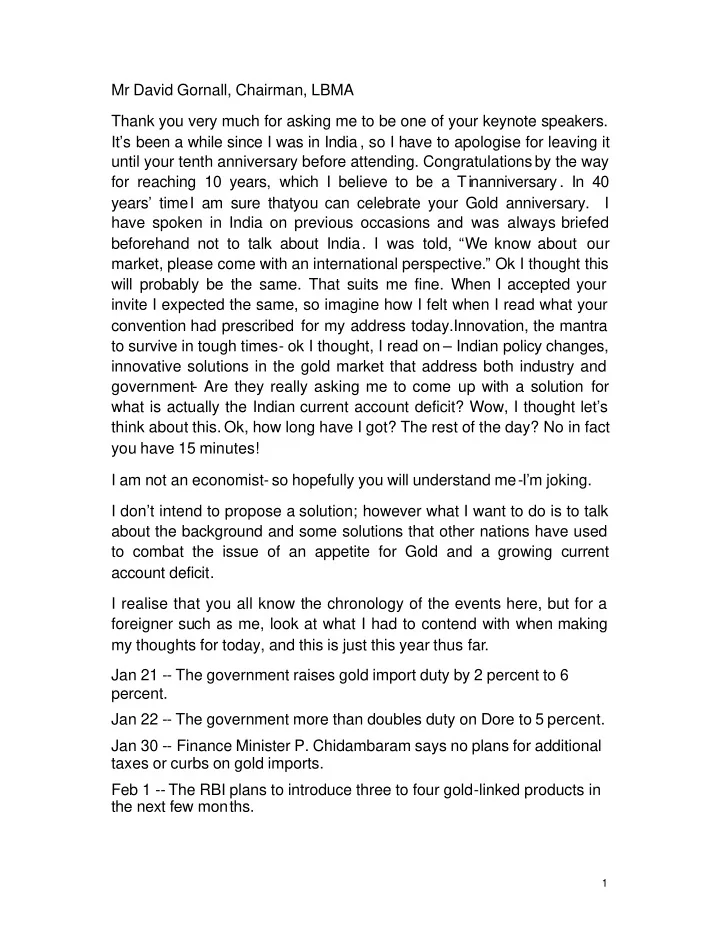
Mr David Gornall, Chairman, LBMA Thank you very much for asking me to be one of your keynote speakers. It’s been a while since I was in India , so I have to apologise for leaving it until your tenth anniversary before attending. Congratulations by the way for reaching 10 years, which I believe to be a Tinanniversary. In 40 years’ timeI am sure thatyou can celebrate your Gold anniversary. I have spoken in India on previous occasions and was always briefed beforehand not to talk about India. I was told, “We know about our market, please come with an international perspective.” Ok I thought this will probably be the same. That suits me fine. When I accepted your invite I expected the same, so imagine how I felt when I read what your convention had prescribed for my address today.Innovation, the mantra to survive in tough times- ok I thought, I read on – Indian policy changes, innovative solutions in the gold market that address both industry and government- Are they really asking me to come up with a solution for what is actually the Indian current account deficit? Wow, I thought let’s think about this. Ok, how long have I got? The rest of the day? No in fact you have 15 minutes! I am not an economist- so hopefully you will understand me-I’m joking. I don’t intend to propose a solution; however what I want to do is to talk about the background and some solutions that other nations have used to combat the issue of an appetite for Gold and a growing current account deficit. I realise that you all know the chronology of the events here, but for a foreigner such as me, look at what I had to contend with when making my thoughts for today, and this is just this year thus far. Jan 21 -- The government raises gold import duty by 2 percent to 6 percent. Jan 22 -- The government more than doubles duty on Dore to 5 percent. Jan 30 -- Finance Minister P. Chidambaram says no plans for additional taxes or curbs on gold imports. Feb 1 -- The RBI plans to introduce three to four gold-linked products in the next few months.

slide-2
SLIDE 2

2

Feb 6 -- The RBI says it would consider imposing value and quantity restrictions on gold imports by banks. Feb 14 -- The central bank relaxes rules on gold deposit schemes

  • ffered by banks by allowing lenders to offer the products with shorter

maturities. Feb 20 -- Trade ministry recommends suspending cheaper gold jewellery imports from Thailand. Feb 28 -- India keeps its gold import duty unchanged in its annual national budget, defying industry expectations. Feb 28 -- India proposes a transaction tax of 0.01 percent on non- agricultural futures contracts including precious metals. March 1 -- Finance minister appeals to people not to buy so much gold. March 18 -- The Reserve Bank of India says it is examining banks that sell gold coins and wealth managem ent products to identify "systemic issues", with a view to closing any legal loopholes. April 2 -- Finance Minister suggests unlikely to raise the import tax on gold further to avoid smuggling and would instead introduce inflation- indexed instruments. May 3 -- The RBI restricts the import of gold on a consignment basis by banks. June 3 -- Finance minister says India cannot afford high levels of gold imports and may review its import policy. June 5 -- India hikes gold import duty by a third to 8 percent. June 24 -- India's biggest jewellers' association asks members to stop selling gold bars and coins, about 35 percent of their business. July 10 -- India's jewellers could continue a voluntary ban on sales of gold coins and bars for six months. July 22 -- The RBI moves to tighten gold imports again, making them dependent on export volumes, but offers relief to domestic sellers by lifting restrictions on credit deals. Aug 07 – Finance Minister inform a delegation from Gems & Jewellery Trade Federation the country (industry) needs to manage with less gold, lest the Government comes out with harsher steps. So the first problem I can see here are the multiple adjustments affecting the market.

slide-3
SLIDE 3

3

Clearly the country has tried to curb the deficit but with so many communications no one can plan ahead and therefore uncertainty prevails and uncertainty in financial markets usually equals negative sentiment and it’s not just the goldmarket that I am referring to. To try and understand this I looked at us in the in the West. For us, when we can identify that our currency may be subject to adverse economic and monetary conditions, we would normally look for a hedge, be it bonds, other currencies or simply invest for example in real estate. When in 2008 none of these options w as viable, we saw a dramatic increase in purchases of precious metal. In other words, for us Gold buying is a symptom of financial malaise it isn’t in itself the cause of the deficit; the buying is a result of the deficit. So when I first looked at this issue in India, I believed that what should be treated was the cause and not the effect. But of course this is India and it’s not that straight forward. You have vast reserves of coal but still import this along with state subsidies for energy products , food and

  • fertiliser. I don’t want to delve into that area; just point out that Gold isn’t

the main cause of the issues facing you. We in the Gold industry of course understand that Gold buying is not only a hedge but also what I would call a cultural asset that has been enshrined in the financial doctrines of families for generations past and I am sure for generations in the future. In other words, Gold buying in India isn’t facing extinction. There are other factors negatively affecting the deficit, however, realistically, we’re not about to propose changes to the policies regarding India’s import bill; we shall concentrate on Gold. One key question is. Should the current account deficit decrease, would there be less buying of Gold due to Indian’s feeling more comfortable holding Rupees? The other factor I needed to understand was why, when we saw gold above 1900 and oil in the 100s the current account deficitwasn’t as bad as it is today or if it was, why no one was talking about it as much as

  • today. India has always had a deficit, a structural deficit, so what’s

different today. Of course the answer was due to FDI or expansion of CB balance sheets through foreign investment in Emerging markets. These capital

slide-4
SLIDE 4

4

inflows have masked the problem for a number of years and it’s not just India that is suffering from the Bernanke statement that begun the reverse of these flows due to the tapering of QE. You need to keep in mind here what happened to USD price of Gold from the moment that the Fed mentioned QE tapering. Let’s return to that one later. Having heard what the authorities have done, what else has happened. The Gold Rupee trade using ETFs doesn’t work as the material has to be imported. Switch to Capital Account? Fine as a presentation exercise but again the material has to be paid for in Foreign Currency. So although many of you have written on this subjectfrom the perspective of weakening the Rupee, for me, this is a non-starter. Solutions So what can you do if you still want access to Gold and cannot produce it; and if importing Gold doesn’t work for the public purse. High taxes will only result in smuggling. Even if Gold isn’t the cause, I believe we in the Gold market can make some positive suggestions that relate to Gold. In 2001 and 2009 one country saw a rising current account deficit,a falling currency and therefore diminished FX reserves plus 10% inflation. This country also had more than a good appetite for Gold. The country is Turkey. In 2010 faced with the same problems

  • nce more with a current account

deficit rising to secondplace in the current account deficitleague, inflationat 10% and a 10% current account deficitvs GDP, they decided to come up with something radical. Not an entirely a new scheme but based on what South Korea effected in 1998 by using Gold. Unlike Korea, its citizens didn’t donate the Gold. I am referring to a gold deposit scheme; The first task was a challenge. When trying to attract deposits, you have to be careful what rate is used as too high will result in arbitrage imports

slide-5
SLIDE 5

5

  • f fresh Gold (something that did happenin Turkey and totally counter-

productive) and of course too low and you do not attract enough. The interesting part of the story was not the amount of Gol d that was

  • mobilised. Once the plan was announced, the markets decided to buy

Turkish Lira, when all they had to go on at the time was positive

  • sentiment. Not only did Turkey see its exchange rate improve it’scurrent

account deficitfell before the scheme became fully operational. There’s a lesson to be learnt here. This was a strong message from Ankara but more importantly it was heard by all. The LBMA and the World Gold Council have supported the idea of a Basel III agreement that allows Gold to be used as acceptable

  • collateral. It seems that Turkey didn’t wait for the decision of the Basel

Commission on Banking Supervision. By allowing commercial banks to leverage debt based on Gold deposits whilst being able to deposit the same at its Central Bank, Turkey created a potentially large Gold deposit scheme that would, including a number

  • f another measures, see Turkey reduce is Current account

deficitvsGDp to 4%; Inflation declined to 6.5 and GDP growth increase to above 2%. Another effort that could benefit both Government and industry is the use of India’s Gold reserve. As we all know, negative FX movements and deficits are not just a problem for India. Other countries faced with these issues have also employed the use of their own Central Bank held gold reserves’. By swapping Gold for a payable currency, in your case and most cases this is USD, you can benefit by having access to USD for a period of your choice, whilst remaining a long term holder of Gold as the swap is a transfer of asset over time. Yes you will have a bullion bank counterparty risk, but these are managed successfully at the RBI who has some of the strictest lending criteria of any Central Bank in the world. Let me be clear I am not advocating a sale of the Gold only a swap where the lender of Gold, in this case the RBI, is collateralised with USD and the Bullion bank lender of USD is collateralised by the RBI’s Gold.

slide-6
SLIDE 6

6

This is not a new concept in the capital markets and should be seriously considered as the cost of borrowing the USD is reduced by the interest rate of Gold. The most important number here is 17.9 as there are 17.9mln oz of Gold held by the Indian state, this is the equivalent of 23 bln USD. Other Central banks have employed this method rather than simply issuing debt. Thereare several reasons why these central banks employ this method of FX cash management. First, the market for Gold Fx swaps is very liquid, very easy to do. The other benefits are that when Gold has a positive interest rate it reduces the cost of the FX

  • borrowing. They can also be booked for short term dates and well as

longer term. Finally, the market may lend a helping hand. First let me say that the LBMA is agnostic as far as price is concerned so this is not a prediction. We have identified that the link between money printing and the USD Gold price is very strong. The correlation between monetary expansion through QE and the USD price of Gold from 2002 to 2013 is between 0.8 and 1.0 In other words if you expand liquidity through the printing of cash you increase the value of Gold. Therefore, if you believe that QE is over in the G10 economies then you will come to the conclusion that the price of Gold in those currencies will fall. If that happens, the pressure will be relieved on the Indiancurrent account deficit. So in conclusion, allow me to summarize my points. Make longer term plans with clear communication so as to create positive sentiment; This will lead to credibility and help to achieve a workable Gold industry. Use previous ideas that have worked such as Turkeys’ and improve on them and adapt them to suit India. The RBI could organise Gold swaps vs USD without divesting its holding

  • r incurring any further interest charges which could access $23bln of

positive flows without further interest rate cost The new Governor of the Bank of England has followed the US in making clear that interest rates would be linked to growth and

slide-7
SLIDE 7

7

  • unemployment. Even with the second largest

current account deficit, sterling managed to rally on this news. You too have a new Governor who has already stated his intentions. Let’s hope that the discussions over the next t wo days here and I am sure subsequently debated in India, will find a way of allowing official Gold imports without further changes to the market and that the current account deficitdecreases to the 3.7% of GDP target. Ladies and Gentlemen, Thank you very much for your attention.