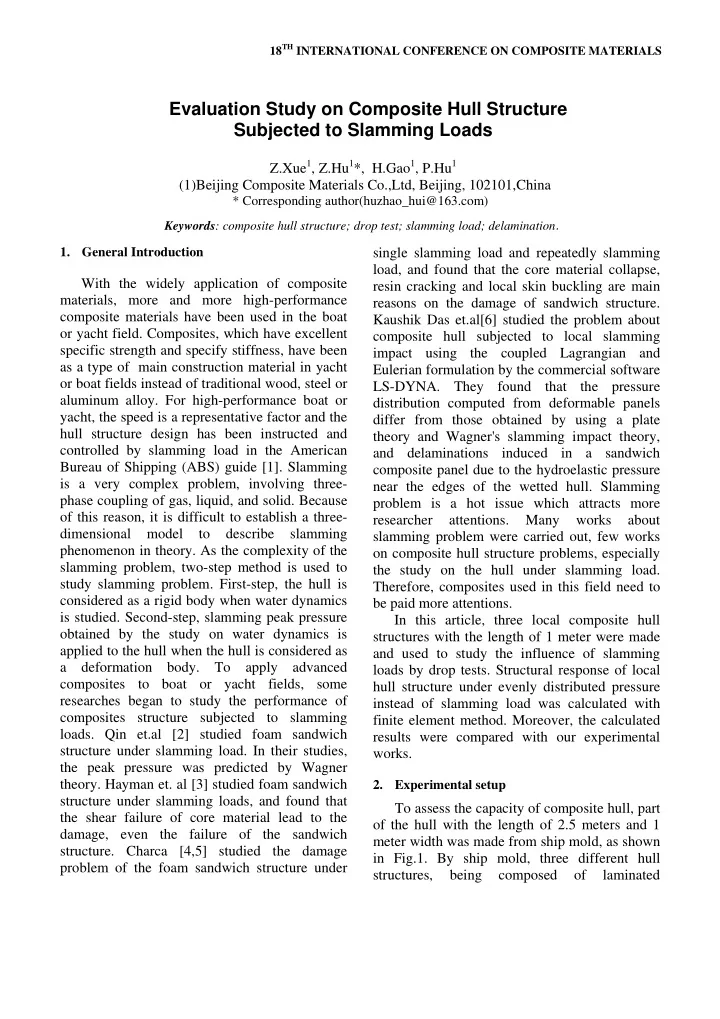
Evaluation Study on Composite Hull Structure Subjected to Slamming - - PDF document

evaluation study on composite hull structure subjected to
SMART_READER_LITE
LIVE PREVIEW

Evaluation Study on Composite Hull Structure Subjected to Slamming - - PDF document

18 TH INTERNATIONAL CONFERENCE ON COMPOSITE MATERIALS Evaluation Study on Composite Hull Structure Subjected to Slamming Loads Z.Xue 1 , Z.Hu 1 *, H.Gao 1 , P.Hu 1 (1)Beijing Composite Materials Co.,Ltd, Beijing, 102101,China * Corresponding


slide-1
SLIDE 1

18TH INTERNATIONAL CONFERENCE ON COMPOSITE MATERIALS

Evaluation Study on Composite Hull Structure Subjected to Slamming Loads

Z.Xue1, Z.Hu1*, H.Gao1, P.Hu1 (1)Beijing Composite Materials Co.,Ltd, Beijing, 102101,China

* Corresponding author(huzhao_hui@163.com) Keywords: composite hull structure; drop test; slamming load; delamination.

  • 1. General Introduction

With the widely application of composite materials, more and more high-performance composite materials have been used in the boat

  • r yacht field. Composites, which have excellent

specific strength and specify stiffness, have been as a type of main construction material in yacht

  • r boat fields instead of traditional wood, steel or

aluminum alloy. For high-performance boat or yacht, the speed is a representative factor and the hull structure design has been instructed and controlled by slamming load in the American Bureau of Shipping (ABS) guide [1]. Slamming is a very complex problem, involving three- phase coupling of gas, liquid, and solid. Because

  • f this reason, it is difficult to establish a three-

dimensional model to describe slamming phenomenon in theory. As the complexity of the slamming problem, two-step method is used to study slamming problem. First-step, the hull is considered as a rigid body when water dynamics is studied. Second-step, slamming peak pressure

  • btained by the study on water dynamics is

applied to the hull when the hull is considered as a deformation body. To apply advanced composites to boat or yacht fields, some researches began to study the performance of composites structure subjected to slamming

  • loads. Qin et.al [2] studied foam sandwich

structure under slamming load. In their studies, the peak pressure was predicted by Wagner

  • theory. Hayman et. al [3] studied foam sandwich

structure under slamming loads, and found that the shear failure of core material lead to the damage, even the failure of the sandwich

  • structure. Charca [4,5] studied the damage

problem of the foam sandwich structure under single slamming load and repeatedly slamming load, and found that the core material collapse, resin cracking and local skin buckling are main reasons on the damage of sandwich structure. Kaushik Das et.al[6] studied the problem about composite hull subjected to local slamming impact using the coupled Lagrangian and Eulerian formulation by the commercial software LS-DYNA. They found that the pressure distribution computed from deformable panels differ from those obtained by using a plate theory and Wagner's slamming impact theory, and delaminations induced in a sandwich composite panel due to the hydroelastic pressure near the edges of the wetted hull. Slamming problem is a hot issue which attracts more researcher attentions. Many works about slamming problem were carried out, few works

  • n composite hull structure problems, especially

the study on the hull under slamming load. Therefore, composites used in this field need to be paid more attentions. In this article, three local composite hull structures with the length of 1 meter were made and used to study the influence of slamming loads by drop tests. Structural response of local hull structure under evenly distributed pressure instead of slamming load was calculated with finite element method. Moreover, the calculated results were compared with our experimental works.

  • 2. Experimental setup

To assess the capacity of composite hull, part

  • f the hull with the length of 2.5 meters and 1

meter width was made from ship mold, as shown in Fig.1. By ship mold, three different hull structures, being composed

  • f

laminated

slide-2
SLIDE 2

composite, sandwich, and the mix of above, were made by vacuum assisted resin injection method, as shown in Fig.2. To evaluate reasonably, three hull structures with same weight was required. Three hull structures were designed with kevlar fiber in right side and glass fiber left side in the section of the hull, which mainly assessed the capacity of different fiber for bearing slamming

  • load. Before the drop test, girds with certain

dimension (5cm × 5cm) instructed by laser equipment was draw inside the hull structure, by which the extent of the damage or failure may be

  • evaluated. Drop test was carried out from the height

12 meters by auto crane with five tons.

Fig.1 The position of test boat structure Fig.2 Three structures (I) laminated composite (II) sandwich structure (III)mix structure

  • 3. Results and discussion

3.1 Experimental results 3.1.1 Comparison three hull structures

Before drop test, the balance of the hull needs to be tested, which may be sure the success of the test, as shown in Fig.3. In this analysis, the mix of laminated composite and hull structure, being the representative of three composite hulls, was used to describe the damage under slamming load. From Fig.4, most delaminations occurred near the stiffener in the structure, especially in intersection of the stiffener, which exhibited the concentration of stresses in this position. Moreover, more delaminations also occurred near the junction between laminated composite and sandwich structure, as shown in Fig.4. Meanwhile, more fractures taken place near that junction, and the fractures lead to the failure of whole structure subjected to slamming load. Therefore, the junction should be paid more attentions when the structure was used to be designed for bearing slamming load. To be compared, delamination area of three composite hulls was chosen to be a criterion to evaluate the capacity for bearing slamming load. Experimental results were listed in

table.1. From table.1, it can be seen that the delamination area of sandwich structure was smaller than other hull structures, and it can be concluded that sandwich structure has better impact resistance, and mix structure was provided as follows. Due to

the cost of sandwich structure, mix structure can be adopted to improve the capacity for bearing slamming loads.

Laminated composites

(I)

Sandwich structure

(II)

Mix structure

(III)

Fig.3 The balance test of boat structure

slide-3
SLIDE 3

3

Evaluation Study on Composite Hull Structure Subjected to Slamming Loads Fig.4 The delamination and fracture of the mix hull structure

fracture delamination

Fig.5 The delamination and fracture of the mix hull structure Table.1 Comparison of the damage of hull structure Right (kevlar fiber) Left Item (structure) Delamination (cm2) Fracture Delamination (cm2) Fracture Laminated 531 Small 615 Large Sandwich 20

  • 200
  • Mix

90

  • 335

Small

3.1.2 Comparison different fibers Based on above results, delamination may lead to the damage even the failure of the hull. Compared other conventional fiber, kevlar fiber is considered as the capacity with better impact

  • resistance. Therefore, to assess the capacity of

the kevlar fiber for bearing slamming load, it was placed in the right side and conventional glass fiber was in the other side in same hull

  • structure. Experimental results showed that the

area of delamination was smaller in the right side than that of left side, and certified that kevlar fiber has better impact resistance. Moreover, the probability of the fracture

  • ccurred in the hull structure was reduced due

to kevlar fiber, as shown in table.1. Those facts confirmed that kevlar fiber has better impact resistance by drop test. By compared, kevlar fiber with better impact resistance was confirmed and should be adopted in the design

  • f hull structure firstly as much as possible

when the hull need to bear slamming load. delamination

Fig.6 The delamination of the sandwich hull structure

3.2 Calculated results In the analysis, finite element software

ANSYS were used to calculate the deformation and stress of composite hull. Composite element shell 281 was chosen to calculate composite hull structure, which is built on Mindlin_Reissner shear theory. Constitutive relation of this theory was expressed as followed:

1 1 11 2 22 12 12 12

E E G

2

                                     (1)

slide-4
SLIDE 4

23 23 23 13 13 13

G G                        (2)

Where  ,  is stress item, E ,

module item, G  , strain item. Using finite element method,

the analysis of the  hull structure subjected to static equivalent pressure instead of slamming load was carried out. In the analysis, slamming load was predicted by Wagner theory [7], that is

2 max 2

1 1 [1 ] 2 ( P V u c    )

(3)

where is half width of the infiltration, c  is water density, u c . To assess resist slamming capacity, three hull structures were calculated by finite element method respectively, and calculated results were listed in table.2. In the analysis, and sandwich structure was analyzed, the deformation, maximum stresses and maximum strain were 2.05cm, 132MP and 0.03492 respectively, as shown in Fig.7. Compared those results, it was concluded that the stresses, strain and deformation of sandwich were lower than other types by comparison the calculated results, which is in accord with the test results that sandwich structure has better capacity for bearing slamming loads. However, the fact that kevlar fiber has better impact resistance was not confirmed in the calculated process, which was due to static analysis and not transient analysis. In fact, to assess the capacity for bearing slamming load, the transient analysis may be better than static analysis, which needs materials data under dynamic condition. This work may become an emphasis in our future work. ( ) / Vdt dc  (a)

MN MX

X Y Z

  • .659E+07

.881E+07 .242E+08 .396E+08 .550E+08 .704E+08 .858E+08 .101E+09 .117E+09 .132E+09

MN MX

X Y Z .730E-04 .00176 .003447 .005134 .00682 .008507 .010194 .011881 .013568 .015255

Fig.7 Calculated results of sandwich plate (a) stress distribution; (b) strain distribution (c)

(b) (c)

Table.2 The calculated results of three hull structures 1# 2# 3# Left Right Left Right left right Deformation (mm) 6.040 5.6628 2.0556 2.0008 2.8445 2.5962 Stress (MPa) 413 419 132 139 237 236 Strain 0.03791 0.03491 0.01525 0.01456 0.02489 0.02200

slide-5
SLIDE 5

5

Evaluation Study on Composite Hull Structure Subjected to Slamming Loads

  • 4. Conclusions

(1) By drop test, it was seen that sandwich structure has better impact resistance, mix structure was follow. And the fact that kevlar fiber has better impact resistance than conventional fiber was confirmed by comparison, this fiber should firstly be adopted in the design for bear slamming loads. (2) The structure analysis was carried out under the pressure instead of slamming loads. Stress concentration occurred in the intersection position, which was verified by drop tests. However, the capability of kevlar fiber for bearing slamming load was not proved because

  • f static structure analysis.
  • 5. References

[1] ABS publication. Guide for building and classing high-speed naval craft (2007), USA. [2] Z. Qin, R.C. Batra. Local slamming impact of sandwich composite hulls. International Journal of Solids and Structures, 2009, 46(10) pp: 2011~2035. [3] Hayman. B, Haug.T, Valsgard. S. Slamming drop tests

  • n a GRP sandwich hull model. Sandwich Constructions
  • 2. Vol. II; Gainesville, Florida; United States; 9-12 Mar.

1992 pp: 583~604. [4] S. Charca, B. Shafiq, F. Just. Repeated slamming of sandwich composite panels on water,Journal of Sandwich Structures and Materials, 2009, 11(5) pp: 409~424. [5] S. Charca, B. Shafiq. Damage assessment due to repeated slamming of foam Core Sandwich Composites. Journal of Sandwich Structures and Materials, 2011,13(1) pp: 97~109 . [6] Kaushik Das, Romesh C.Batra. Local water slamming impact on sandwich composite hulls. Journal of Fluids and Strcutures. (doi: 10.1016/j.jfluidstrcuts.2011.02.001). [7] H.Wagner. Über Stoß-und Gleitvorgänge an der Oberfläche von Flüssigkieten. Zeitschrift für Angewandte Mathematik und Mechanik, 1932,12,pp:192–215.