Robert Petersson Naval Architect M.Sc. Composite & Strength - - PowerPoint PPT Presentation

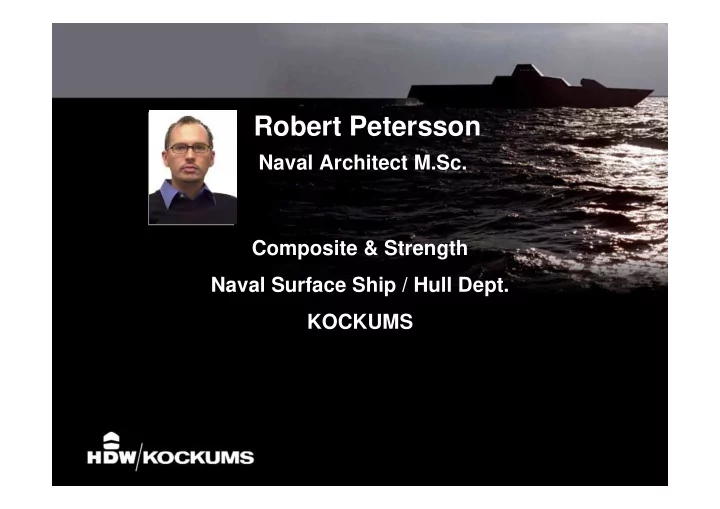
robert petersson
SMART_READER_LITE
LIVE PREVIEW

Robert Petersson Naval Architect M.Sc. Composite & Strength - - PowerPoint PPT Presentation

Naval Composite Technology Transfer Transfer of Naval Technology to Commercial Shipbuilding Applications Robert Petersson Naval Architect M.Sc. Composite & Strength Naval Surface Ship / Hull Dept. KOCKUMS Naval Composite Technology

slide-1
SLIDE 1

Naval Composite Technology Transfer

Transfer of Naval Technology to Commercial Shipbuilding Applications

Composite & Strength Naval Surface Ship / Hull Dept. KOCKUMS Naval Architect M.Sc.

Robert Petersson

slide-2
SLIDE 2

Naval Composite Technology Transfer

Transfer of Naval Technology to Commercial Shipbuilding Applications

Introduction

Naval Composite Technology Transfer

Feasible Transfer of Naval Technology to Commercial Shipbuilding Applications

slide-3
SLIDE 3

Naval Composite Technology Transfer

Transfer of Naval Technology to Commercial Shipbuilding Applications

Introduction

Naval Composite Technology Transfer

Transfer of Naval Technology to Commercial Shipbuilding Applications

  • Company background
  • The Naval Corvette Project
  • Advantages and disadvantages
  • Benefits from Naval Corvette Project
  • LCC perspective
  • Feasible applications
slide-4
SLIDE 4

Naval Composite Technology Transfer

Transfer of Naval Technology to Commercial Shipbuilding Applications

Composite History

1963 1980 1974 1984 1987 1988 1990 1992 1995 1998

40 Years Experience in Advanced Composite Ship Design and Manufacturing

slide-5
SLIDE 5

Naval Composite Technology Transfer

Transfer of Naval Technology to Commercial Shipbuilding Applications

Composite History 40 Years Experience in Advanced Composite Ship Design and Manufacturing The Visby Class Naval Corvette (2001)

Naval Composite Technology Transfer

Transfer of Naval Technology to Commercial Shipbuilding Applications

slide-6
SLIDE 6

Naval Composite Technology Transfer

Transfer of Naval Technology to Commercial Shipbuilding Applications

The Visby Corvette The world’s largest moving

  • bject built in CFRP sandwich:
  • Length

73 m

  • Breadth

10.4 m

  • Displacement

600 ton

  • Speed

40 knots Each ship consists of ~160 ton composite materials… Series of totally five (5) ships...

slide-7
SLIDE 7

Naval Composite Technology Transfer

Transfer of Naval Technology to Commercial Shipbuilding Applications

Military Advantages

  • Non-magnetic material (mines)

Military advantages of CFRP sandwich:

  • Extremely flat surfaces (radar)
  • High thermal insulation (IR)
  • High underwater shock resistance
  • High EMC protection
slide-8
SLIDE 8

Naval Composite Technology Transfer

Transfer of Naval Technology to Commercial Shipbuilding Applications

General Advantages

  • Low structural weight, which gives (either):

General advantages of CFRP sandwich:

  • Fuel savings
  • Higher payload
  • Increased service speed
  • Longer range
  • Non-corroding structure (low maintenance cost)
  • Built in thermal insulation (also rust proofing)
  • Built in acoustic insulation
  • Engineered materials for optimised design solutions
  • Composites less sensitive to fatigue
slide-9
SLIDE 9

Naval Composite Technology Transfer

Transfer of Naval Technology to Commercial Shipbuilding Applications

Disadvantages

  • Higher acquisition costs
  • Combustible material (fire)
  • Lack of Class Rules (Lloyd´s, DNV, ABS)
  • Complicated QA/QC
  • Recycling

Commercial disadvantages of composites in shipbuilding: Solutions from Naval Corvette Project…

slide-10
SLIDE 10

Naval Composite Technology Transfer

Transfer of Naval Technology to Commercial Shipbuilding Applications

Solutions and Benefits

  • Structural fire integrity
  • Influence on Legislation and

Class Rules

  • NDT methods suited for efficient

QA on very large structures

  • Studies on disposal of composites

Solutions and benefits from the Naval Corvette Project:

slide-11
SLIDE 11

Naval Composite Technology Transfer

Transfer of Naval Technology to Commercial Shipbuilding Applications

  • Material test methods

Solutions and Benefits Additional benefits from the Naval Corvette Project:

  • Structural analysis methods (FEM)
  • Large-scale production of planar

sandwich panels

  • Rational NC water jet tooling of

sandwich panels

  • Assembling, housing and post-curing
  • f very large structures
slide-12
SLIDE 12

Naval Composite Technology Transfer

Transfer of Naval Technology to Commercial Shipbuilding Applications

Life Cycle Cost LCC comparison on High Speed Ferry Life Cycle Costs:

  • Acquisition costs
  • Operational costs
  • Disposal costs

Three versions:

  • Steel / Aluminium
  • All Aluminium
  • All CFRP Sandwich

Length 128 m Cars 250 Passengers 1000 Lifetime 25 years

slide-13
SLIDE 13

Naval Composite Technology Transfer

Transfer of Naval Technology to Commercial Shipbuilding Applications

Life Cycle Cost LCC comparison on High Speed Ferry

50 100 150 200 250 300 350 400 450 Steel Aluminium Composite M€ Operation & Maintenance Acquisition cost

  • 22 % lower LCC for composite
  • Up to 30 % savings in LCC possible
slide-14
SLIDE 14

Naval Composite Technology Transfer

Transfer of Naval Technology to Commercial Shipbuilding Applications

LCC Break-Even LCC comparison on High Speed Ferry

50 100 150 200 250 300 350 400 5 10 15 20 25 30 Years M€ Steel Aluminium Composite

Composite vs Steel B-E after 4 years (2 years of operation) Composite vs Aluminium B-E after 12 years (10 years of operation)

slide-15
SLIDE 15

Naval Composite Technology Transfer

Transfer of Naval Technology to Commercial Shipbuilding Applications

Commercial Applications Superstructures in GRP sandwich?

slide-16
SLIDE 16

Naval Composite Technology Transfer

Transfer of Naval Technology to Commercial Shipbuilding Applications

Commercial Applications Cargo (RoRo) decks of sandwich panels?

slide-17
SLIDE 17

Naval Composite Technology Transfer

Transfer of Naval Technology to Commercial Shipbuilding Applications

Commercial Applications Cargo hatches of sandwich panels?

slide-18
SLIDE 18

Naval Composite Technology Transfer

Transfer of Naval Technology to Commercial Shipbuilding Applications

Feasible Advantages

  • Fuel savings
  • Lower maintenance costs
  • Increased hydrodynamic stability

Feasible advantages of CFRP (or GRP) sandwich for commercial shipbuilding applications: Superstructures Cargo decks Cargo hatches

slide-19
SLIDE 19

Naval Composite Technology Transfer

Transfer of Naval Technology to Commercial Shipbuilding Applications

Superstructures Pure Car/Truck Carrier Length 200 m Height 50 m Deadweight 15 000 tons Capacity 6 000 cars

slide-20
SLIDE 20

Naval Composite Technology Transfer

Transfer of Naval Technology to Commercial Shipbuilding Applications

Superstructures Steel VCG GRP VCG Composite Superstructure?

  • Steel superstructure

weight ~ 600 tons

  • GRP sandwich

weight ~ 300 tons Increased stability Increased payload!

  • Lowered VCG
slide-21
SLIDE 21

Naval Composite Technology Transfer

Transfer of Naval Technology to Commercial Shipbuilding Applications

Summary To conclude:

  • Advanced composite materials

have advantages for commercial shipbuilding applications

  • LCC analysis show break-even

in a few years "A strong Chain of Composite Design "A strong Chain of Composite Design and Manufacturing Know-how" and Manufacturing Know-how"

50 100 150 200 250 300 350 400 5 10 15 20 25 30 Years M€ Steel Aluminium Composite

  • Beneficial solutions from Naval Corvette project
  • Feasible transfer to commercial shipbuilding applications
  • Solutions for composite superstructures on steel ships
slide-22
SLIDE 22

Naval Composite Technology Transfer

Transfer of Naval Technology to Commercial Shipbuilding Applications

The End

Thank You !