– a concept design for a new Handysize bulk carrier
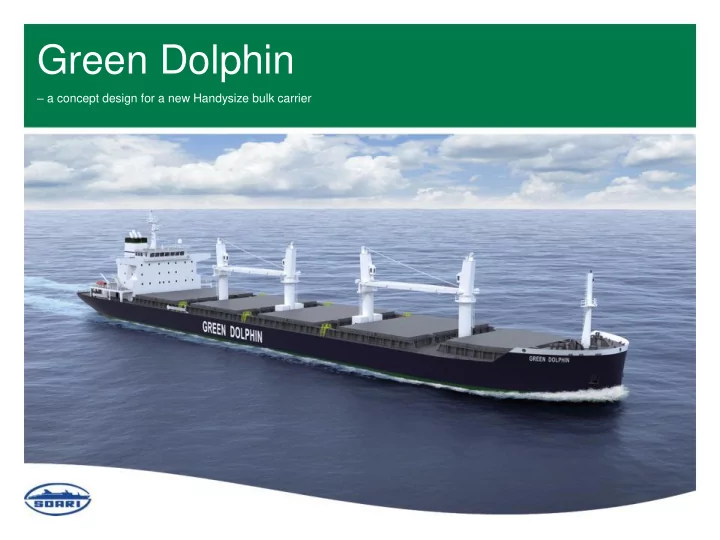
Green Dolphin a concept design for a new Handysize bulk carrier A - - PowerPoint PPT Presentation
Green Dolphin a concept design for a new Handysize bulk carrier A joint development project Project phases Phase 1: SDARI, DNV and Wrtsil have worked closely together Phase 2: SDARI will independently prepare basic design
A joint development project
- Project phases
– Phase 1: SDARI, DNV and Wärtsilä have worked closely together – Phase 2: SDARI will independently prepare basic design – DNV will later carry out class approval in principle.
- Challenging market situation
– Low freight rates – High fuel prices – New environmental standards
- The project concentrates on existing technologies currently available for
commercial use
5 June 2012 By SDARI, DNV and Wärtsilä
Developed in cooperation with ship owners and shipyards
- Objective
– Meet ship owner and shipyard needs as well as environmental regulations
- Input
– Market and logistics study – Input also received from ship owners and shipyards
- Focus areas
– Fuel efficiency – Operational flexibility
Input from ship owners
– Robust and reliable – Environment-friendly and prepared for future regulations
Concept overview
Main particulars
- Double hull bulk carrier designed to IACS Common Structural Rules
- Five flush cargo holds with high cubic and deadweight capacity
- Wide hatches with foldable double-skin hatch covers
- Four electric deck cranes with variable frequency drive
- Designed to carry a wide range of cargoes
5 June 2012 By SDARI, DNV and Wärtsilä
Length over all 180 m Draught, scantling 10.5 m Length between perpendiculars 177 m Draught, design 9.5 m Breadth 32 m Deadweight, scantling 38,800 mt Depth 15 m Deadweight, design 33,400 mt Cubic capacity (grain) 50,500 m3 Service speed at design draught 14.0 kn
FUEL AND ENERGY EFFICIENT OPERATIONAL FLEXIBILITY ROBUST AND RELIABLE ENVIRONMENT-FRIENDLY AND PREPARED FOR FUTURE REGULATIONS
Fuel efficiency
Hull optimisation and propulsion – a SDARI and DNV combined effort
- Hull form optimisation by use of Computational Fluid Dynamics
- Large propeller, low rpm
- Wake equalising duct, rudder transition bulb and rudder fins
- Main engine with economical performance over the whole operating range
Low fuel consumption achieved at a range of service conditions
- Daily main engine fuel consumption at 14 kn at 9.5 m draught: 17.7 t
- Daily fuel consumption at 10 kn slow-steaming: 6.4 t
- Energy Efficiency Design Index (EEDI) 25% below the IMO reference line for bulk carriers
5 June 2012 By SDARI, DNV and Wärtsilä
Wake distribution Wave pattern Propeller, rudder and propulsion-efficiency devices
Operational flexibility
Focus on cargo handling and maintenance friendliness
- Suitable to carry a wide range of cargoes, including deck cargoes
- High tank top load capacity for steel coil loading
- Electric variable frequency drive deck cranes
- Wide hatch openings
- Double-skin flush cargo holds without hopper or top side tanks in cargo holds 2, 3 and 4
- Cargo hold recess for compressed air, power and wash water supply
- Tanks for clean and dirty cargo hold wash water
- Separated dirty and clean ballast water tanks
5 June 2012 By SDARI, DNV and Wärtsilä
Midship section, steel coil loading
Robust and reliable
Safety and structural integrity at the center of the design
- Double hull construction
- IACS Common Structural Rules for Bulk Carriers
- Continuous hatch coamings
- Heavy ballast condition achieved without using cargo hold
- All fuel oil tanks located in the engine room
- A60 fire insulation of engine room bulkhead
- Cargo hold CO2 fire fighting system
- Safe access for crew and stevedores
- Piracy protection with citadel
5 June 2012 By SDARI, DNV and Wärtsilä
Clearly marked ladders and handrails
Environment-friendly
5 June 2012 By SDARI, DNV and Wärtsilä
Specific attention paid to performance and emission reduction
- Wärtsilä 5 cylinders two-stroke low-speed RT-flex50, IMO Tier II compliant
- Low fuel consumption level through the complete load range
- Compliant with existing NOX or SOX regulations
- Dual-fuel version available, utilizing low-pressure gas injection
- Ballast water treatment system
- Integrated bilge water treatment system
- Water-lubricated stern tube bearings
- Class notations CLEAN and RECYCLABLE
Existing and new environmental regulations
Illustration
Prepared for future regulations
5 June 2012 By SDARI, DNV and Wärtsilä
Illustration
Different versions to comply with upcoming local and global regulations
- Base case design runs on heavy fuel oil
Options exist to owners’ preference
- Scrubber system
- Selective Catalyst Reduction (SCR)
- Dual-fuel operation with LNG
SCR and scrubber installation LNG tank installation
- Fuel efficiency
- Operational flexibility
- Robust and reliable
- Environment-friendly and
prepared for future regulations