Motion Control of Differential Wheeled Robots with Joint Limit - - PowerPoint PPT Presentation

motion control of differential wheeled robots with joint
SMART_READER_LITE
LIVE PREVIEW

Motion Control of Differential Wheeled Robots with Joint Limit - - PowerPoint PPT Presentation

Motion Control of Differential Wheeled Robots with Joint Limit Constraints Speaker : Prof. Mohamed Abderrahim J. Gonzalez-Gomez, J. G. Victores, A. Valero-Gomez, M. Abderrahim Robotics Lab Carlos III University of Madrid, Spain 2011 IEEE


slide-1
SLIDE 1

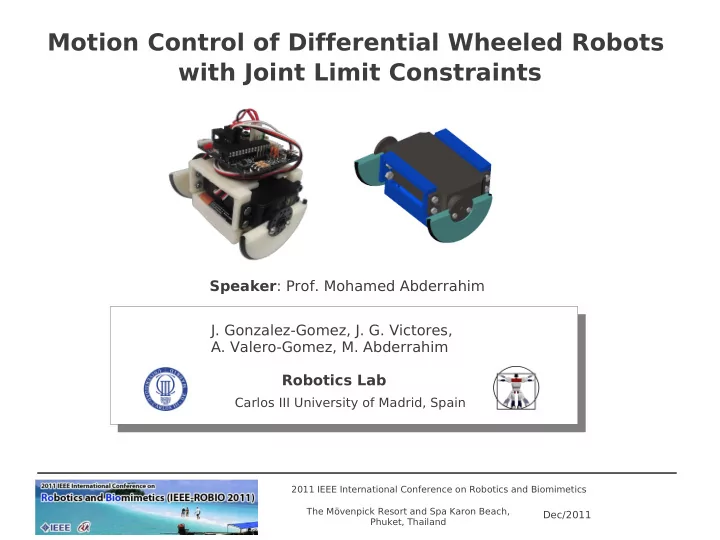
Motion Control of Differential Wheeled Robots with Joint Limit Constraints

  • J. Gonzalez-Gomez, J. G. Victores,
  • A. Valero-Gomez, M. Abderrahim

Robotics Lab

Carlos III University of Madrid, Spain

2011 IEEE International Conference on Robotics and Biomimetics

Dec/2011

The Mövenpick Resort and Spa Karon Beach, Phuket, Thailand

Speaker: Prof. Mohamed Abderrahim

slide-2
SLIDE 2

Outline

  • 1. Introduction
  • 2. Swing principle
  • 3. Kinematics
  • 4. Experiments
  • 5. Conclusions and future work

2011 IEEE International Conference on Robotics and Biomimetics

Motion Control of Differential Wheeled Robots with Joint Limit Constraints

slide-3
SLIDE 3

Rolling principle

  • Rolling behaviour is inherent to wheels
  • Wheels are assumed to rotate indefinitely in any direction
  • All kind of known wheels rely on it:

Standard wheel Castor wheel Swedish wheel Whegs Rotatory legs

slide-4
SLIDE 4

Limited wheels

Wheels that cannot turn freely due to constraints

Limit 1 Limit 2

Limited by shape

  • Ex. Broken wheel

Limited by the environment

  • Ex. A Robot in a narrow path

Robot Robot

  • Rot. angle
slide-5
SLIDE 5

Locomotion with limited wheels

  • Imagine a robot with a broken wheel...
  • Is it possible to achieve locomotion with

limited wheels?

  • The rolling principle cannot be applied
  • Another locomotion principle is necessary...
  • Improving the fault-tolerance of robots in critical missions
  • Recovering the robot if wheels break
  • Study and Develop new “locomotion gaits” with wheels

The problem: Applications:

slide-6
SLIDE 6

Our contribution: the swing principle

  • Differential robots with limited wheels can travel any

distance in some directions if applying the swing principle

  • Swing principle: Oscillating the wheels within the angle limits

φ1=Asin( 2π T t+ϕ0)+O φ2=Asin( 2π T t+Δϕ+ϕ0)−O

Oscillations: Parameters: Amplitude (A), Offset (O) Period (T), Phase difference ( )

Δ ϕ

slide-7
SLIDE 7

Kinematics

  • {Yi, Xi}: Global frame
  • {XR,YR}: Robot frame
  • (x,y, ): Robot position and orientation
  • r: Wheel's radius
  • l: Distance from the wheels to the com

θ

  • Forward kinematics:

˙ x=πr A T (C (0)+C(Δ ϕ))cos θ ˙ y=π r A T (C(0)+C (Δ ϕ))sinθ θ= r 2l (A S(0)−AS (Δ ϕ)+2O) C( x)=cos( 2π n T +ϕ0+x) S( x)=sin( 2π n T +ϕ0+x)

slide-8
SLIDE 8

Locomotion gait and trajectory

  • The robot moves sideways
  • Step: distance travelled per cycle
  • When the step is maximum
  • The step is proportional to the amplitude (A)
  • The period determines the mean speed along the x axis

Δ ϕ=90

slide-9
SLIDE 9

Trajectory orientation

  • The robot can also move in different directions
  • The trajectory orientation depends on the offset (O)
  • Limitations:
  • The robot cannot move in all

the directions

  • Increasing O implies decreasing

the Amplitud (A)

  • When A=0, there is no

locomotion

slide-10
SLIDE 10

Experiments (I)

  • A robot prototype with limited

wheels has been designed and built

  • Wheels limited by shape
  • Servos with mechanical limits
  • IR led on the top for tracking the

trajectory

slide-11
SLIDE 11

Experiments (II)

  • Real trajectory performed by the robot

Video

slide-12
SLIDE 12

Conclusions

  • Swing principle: A new locomotion principle for robots with

limited wheels has been proposed

  • It is based on wheels' oscillatory movement
  • Despite the limited wheels, the robots can travel any distance in

some directions

Future work

  • Test the swing principle with bio-inspired oscillators, such as CPGs

(Central Pattern Generators)

  • Application to tracked robots
  • Application to climbing slopes
  • Application to wheelchairs
slide-13
SLIDE 13

Motion Control of Differential Wheeled Robots with Joint Limit Constraints

  • J. Gonzalez-Gomez, J. G. Victores,
  • A. Valero-Gomez, M. Abderrahim

Robotics Lab

Carlos III University of Madrid, Spain

2011 IEEE International Conference on Robotics and Biomimetics

Dec/2011

The Mövenpick Resort and Spa Karon Beach, Phuket, Thailand

Speaker: Prof. Mohamed Abderrahim