SLIDE 1
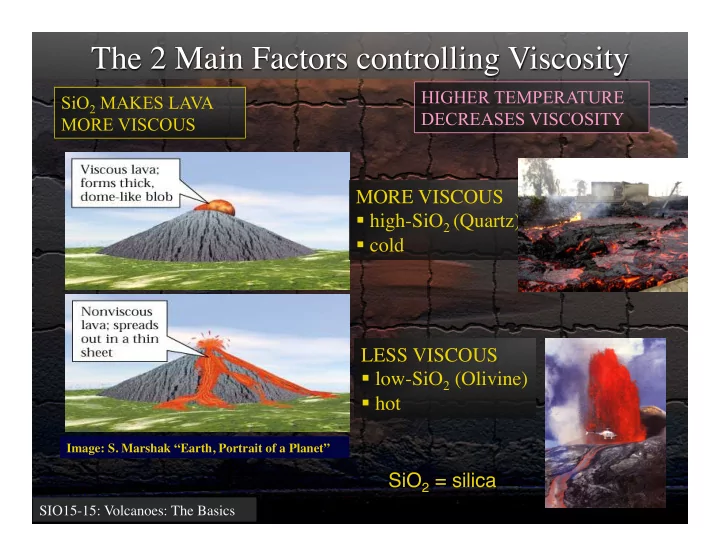
MORE VISCOUS high-SiO 2 (Quartz) cold LESS VISCOUS low-SiO 2 - - PowerPoint PPT Presentation
HIGHER TEMPERATURE SiO 2 MAKES LAVA DECREASES VISCOSITY MORE VISCOUS MORE VISCOUS high-SiO 2 (Quartz) cold LESS VISCOUS low-SiO 2 (Olivine) hot Image: S. Marshak Earth, Portrait of a Planet SiO 2 = silica SIO15-15:
SLIDE 2
SLIDE 3
SIO15-15: Volcanoes: The Basics
OCEANIC CRUST
- thin
- dense, dark rock
Image: S. Marshak “Earth, Portrait of a Planet”
CONTINENTAL CRUST
- thick
- less dense, light rock
SLIDE 4
SIO15-15: Volcanoes: The Basics
silicic (or felsic or rhyolitic) 65-70% intermediate (or andesitic) 55-65% mafic 40- 55%; rich in Mg, Fe
Volcanic/Plutonic Rock Rhyolite/Granite Andesite/Diorite Basalt/Gabbro
S i O
2
40% 70% density 2.5 g/cm3 3.4 g/cm3
dark color light color
SLIDE 5
SIO15-15: Volcanoes: The Basics
Granite: plutonic (coarse grained) silicic (light-colored) Basalt: volcanic (fine-grained) mafic (dark-colored)
SLIDE 6
SIO15-15: Volcanoes: The Basics
- rock consists of many minerals
- melting T of SiO2-rich minerals
(e.g. Quartz) 650oC
- melting T of SiO2-poor minerals
(e.g. Olivine) 1100oC Melting T depends on composition: Granite 650ºC, Gabbro 1100ºC
SLIDE 7
SIO15-15: Volcanoes: The Basics
- molten rock
+ dissolved grains + dissolved volatiles up to 15% (50% H2O, 20% CO2, SO2, H2S, others)
SLIDE 8
SIO15-15: Volcanoes: The Basics
LAVA
- surface
- volcanic
- extrusive
Image: S. Marshak “Earth, Portrait of a Planet”
MAGMA
- underground
- plutonic
- intrusive
- ven T:
260oC/500oF melting T or freezing point: 650 - 1100oC Quartz: 650ºC Olivine: 1100ºC yoF = xoC*9/5+32 1200 - 2000oF
SLIDE 9
SIO15-15: Volcanoes: The Basics
- melting solid rock: Quartz earliest to melt
- solidifying hot melt: Quartz latest to crystallize
- > lava has more SIO2 than mantle rock left behind