Molecular response to toxic diatom-derived aldehydes in the sea - - PowerPoint PPT Presentation

molecular response to toxic diatom derived aldehydes in
SMART_READER_LITE
LIVE PREVIEW

Molecular response to toxic diatom-derived aldehydes in the sea - - PowerPoint PPT Presentation

Molecular response to toxic diatom-derived aldehydes in the sea urchin Paracentrotus lividus Stefano Varrella e-mail: stefano.varrella@szn.it Stazione Zoologica Anton Dohrn, Naples, Italy Model organism: Paracentrotus lividus Relevant on

slide-1
SLIDE 1

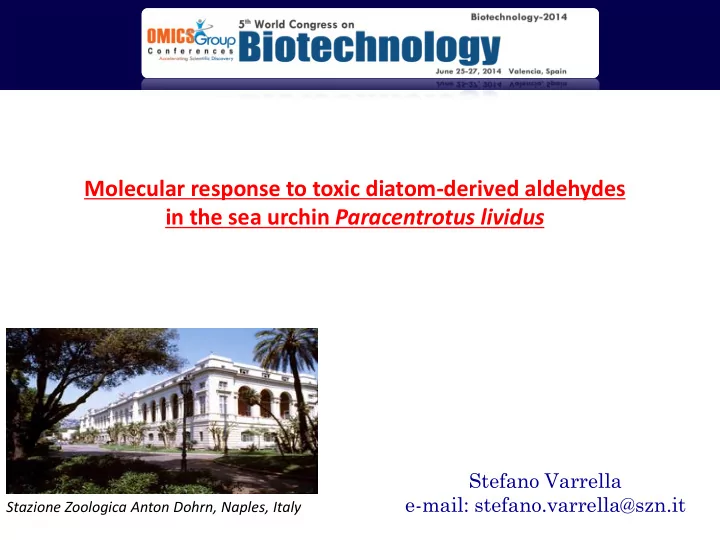
Molecular response to toxic diatom-derived aldehydes in the sea urchin Paracentrotus lividus

Stefano Varrella e-mail: stefano.varrella@szn.it

Stazione Zoologica Anton Dohrn, Naples, Italy

slide-2
SLIDE 2
  • Relevant on structure of benthic marine community
  • Mediterranean sea and Atlantic ocean
  • Extraction and manteinance of gametes are easy
  • Trasparent embryos
  • Embryos grow rapidly (pluteus stage at 48hpf)
  • Long reproductive period

 physical and chemical xenobiotics  low pH  X-rays  UVs

CLASSIFICATION Domain: Eukaryota Kingdom: Animalia Phylum: Echinodermata Class: Echinoidea Order: Echinoida Family: Echinidae Species: Paracentrotus lividus

 antifoulings/pesticides  heavy metals  endocrine disrupters compounds  oxylipins derived from diatoms

  • Good model for ecotoxicological studies on response
  • f marine invertebrate to environmental pollutants:

Model organism: Paracentrotus lividus

slide-3
SLIDE 3
  • There are more than 200 genera of living diatoms, and

approximately 100,000 species.

  • Diatoms live in the oceans and in freshwater.
  • Most live in open water, although some live as surface films at

the water-sediment interface (benthic), or even under damp atmospheric conditions.

  • They are very important in oceans, where they are estimated to

contribute up to 45% of the total oceanic primary production.

Diatoms

http://deepbluehome.blogspot.it/search?q=diatom

slide-4
SLIDE 4

Beneficial role in supporting planctonic food web. Diatoms are good food for the primary consumers of plankton.

Marine food web

slide-5
SLIDE 5
  • Oocyte viability
  • Sperm motility inhibition
  • Fertilization success
  • Cleavage inhibition
  • Hatching reduction
  • Larval toxicity

(Ianora and Miralto 2010)

Polychaetes Echinoderms Crustaceans

(Miralto et al. 1999)

Diatoms species produce secondary metabolities with cytotoxic activity

slide-6
SLIDE 6

Hydroperoxide lyase

(Ianora and Miralto 2010)

OXYLIPINS

Oxidative metabolism of fatty acids in diatoms

slide-7
SLIDE 7

The effects of decadienal on sea urchin embryos

(Romano et al., 2010) (Romano et al., 2011) (Marrone et al., 2012) (Romano et al., 2003)

Decadienal

Control 1.32 µM 2.63 µM 3.95 µM 5.26 µM

Increasing concentrations of decadienal

Control 1.32 µM 2.63 µM 3.95 µM

Decadienal induces teratogenesis and apoptosis First molecular studies

slide-8
SLIDE 8

….. The other PUAs?

Octadie diena nal Heptadie ienal

  • Abundant compounds among PUAs
  • No molecular evidences
slide-9
SLIDE 9

Stress responses of sea urchin after exposure to heptadienal and octadienal

 Do PUAs affect the embryogenesis?  When do PUAs act on embryo development?

Morphologic Molecular

 Do PUAs have molecular targets?  Could these targets be considered as possible biomarkers for environmental stress response?

slide-10
SLIDE 10

Sea urchin eggs Incubation for 10 min with aldehydes Fertilization Morphological

  • bservations

at 48 hpf

Experimental procedures

Decadienal Octadienal Heptadienal Control embryos at 48 hpf

http://www.alnmag.com/news/2012/02/sperm-pathways-sea-urchins

slide-11
SLIDE 11

Do PUAs affect the embryogenesis?

Control (embryos in sea water without aldehydes)

PUAs treatments induced TERATOGENESIS

(Varrella et al., 2014)

Dose-dependent increase of abnormal plutei

slide-12
SLIDE 12

Sea urchin eggs Incubation for 10 min with aldehydes Fertilization Morphological

  • bservations at

72, 96 hpf until one-week

Experimental procedures

Decadienal Octadienal Heptadienal Control embryos at one week hpf

http://www.alnmag.com/news/2012/02/sperm-pathways-sea-urchins

slide-13
SLIDE 13

Do PUAs affect the embryogenesis?

Developmental times (hpf) Abnormal embryos (%)

Decadienal Heptadienal Octadienal

Embryos number (%)

72, 96 hpf One week

Normal

Controllo 40’ df

Delayed

Control Decadienal

Abnormal

Heptadienal Octadienal

slide-14
SLIDE 14

Sea urchin eggs Incubation for 10 min with aldehydes Fertilization Morphological

  • bservations

at 48 hpf

Experimental procedures

10 min pf 40 min pf 2 hpf 3 hpf 5 hpf 8 hpf

PUAs additions

2 blastomeres 8 blastomeres 32 blastomeres Early blastula Late blastula

Control embryos at 48 hpf

http://www.alnmag.com/news/2012/02/sperm-pathways-sea-urchins

slide-15
SLIDE 15

When do PUAs act on embryo development? Concentrations (µM) Abnormal Plutei (%)

Heptadienal Decadienal Octadienal

10 min bf 10 min pf 40 min pf 2 hpf 3 hpf 5 hpf 8 hpf

(Varrella et al., 2014)

Aldehydes additions at different developmental times

slide-16
SLIDE 16

10 minutes before fertilization 10 minutes after

PUAs

PUAs action time

slide-17
SLIDE 17

Sea urchin eggs Incubation for 10 min with aldehydes Fertilization

Determination of teratogenic and dose-dependent concentrations of aldehydes

Analysis of 31 by Real Time q-PCR

Experimental procedures

Decadienal Octadienal Heptadienal

http://www.alnmag.com/news/2012/02/sperm-pathways-sea-urchins

slide-18
SLIDE 18

Do PUAs have molecular targets?

Hsp70 Hsp60 Hsp56 MT MTase GS cytb p38 MAPK 14-3-3ε hat sox9 BP10 Blimp Alix Wnt5 Wnt6 Wnt8 SM30 BMP5-7 SM50 Nec uni p16 p19 MT MT4 MT5 MT6 MT7 MT8 MDR1 CAT

Stress Skeletogenesis Development and differentiation Detoxification

Genes analyzed by Real-Time qPCR (Marrone et al., 2012; Varrella et al., 2014)

slide-19
SLIDE 19

The key stages of P. lividus embryogenesis 9 hpf 5 hpf 24 hpf 48 hpf

Early blastula Swimming blastula Prism Pluteus

slide-20
SLIDE 20

Effects of decadienal on gene expressions at different developmental stages

SM50 MT4 Hsp70 Hsp60 hat MT6 SM30 uni MT6 SM50 Wnt6 SM30 SM50 MT4 MT8

Stress Skeletogenesis Development/Differentiation Detoxification Up-regulated genes Down-regulated genes

(Modified from Varrella et al., 2014)

slide-21
SLIDE 21

Effects of heptadienal on gene expressions at different developmental stages

Stress Skeletogenesis Development/Differentiation Detoxification Up-regulated genes Down-regulated genes

(Modified from Varrella et al., 2014)

Wnt6 SM50 MT4 Hsp70 hat p38 MAPK MTase sox9 SM50 Hsp56 p38 MAPK Alix hat Wnt5 Wnt6 Wnt8 p19 p16 uni SM50 SM30 SM50 MT4 MT8

slide-22
SLIDE 22

Effects of octadienal on gene expressions at different developmental stages

Stress Skeletogenesis Development/Differentiation Detoxification Up-regulated genes Down-regulated genes

(Modified from Varrella et al., 2014)

Wnt6 SM50 SM30 BMP5-7 p19 p16 MT4 Hsp70 MTase hat SM30 SM50 SM30 SM50 MTase SM50 SM30 SM50 MT6 MT7 CAT

slide-23
SLIDE 23

Stress Skeletogenesis Development/Differentiation Detoxification Up-regulated genes Down-regulated genes

(Modified from Varrella et al., 2014) Decadienal Heptadienal Octadienal

Hsp70 Hsp60 SM50 SM30 uni hat Wnt6 MT4 MT6 MT8 Hsp70 MTase hsp56 p38 MAPK SM50 uni p19 Wnt5 Wnt6 Wnt8 hat sox9 Alix MT4 MT6 MT8 Hsp70 MTase SM50 SM30 BMP5-7 p16 p19 hat Wnt6 CAT MT4 MT6 MT8

Summary

slide-24
SLIDE 24

 Do PUAs affect the sea urchin embryogenesis?  When do PUAs act on embryo development? The aldehydes induced teratogenesis on sea urchin embryos in a dose-dependent manner. The aldehydes could compromise the normal embryonic development affecting embryos before and/or soon after the fertilization The teratogenic effect after a week of PUAs exposure appeared to be stronger for decadienal and heptadienal.

Morphological conclusions

slide-25
SLIDE 25

 Do PUAs have molecular targets? And could these targets be considered as possible biomarkers for environmental stress response?

The aldehydes have different molecular targets, affecting the expression levels of different genes at different times of embryonic development.

Stress response Biomarkers

Molecular conclusions

slide-26
SLIDE 26

....more in general

  • Effects of many other Oxylipins (HEPEs)
  • Functional networks of the PUAs target genes
  • Oxyditave stress effects induced by Oxylipins

Ecological relevance considering the importance of diatoms blooms in nutrient-rich acquatic environments….. .....molecular evidence for the toxic effects of the diatom-derived PUAs .....novel tools for understing the cellular mechanisms of the response to aldehydes exposure to the benthic organisms.

Future perspectives