Diatom/Dinoflagellate Index N.Wasmund, J.Kownacka, J.Gbel, A.Jaanus, - - PowerPoint PPT Presentation

diatom dinoflagellate index
SMART_READER_LITE
LIVE PREVIEW

Diatom/Dinoflagellate Index N.Wasmund, J.Kownacka, J.Gbel, A.Jaanus, - - PowerPoint PPT Presentation

Diatom/Dinoflagellate Index N.Wasmund, J.Kownacka, J.Gbel, A.Jaanus, M.Johansen, I.Jurgensone, S.Lehtinen Idea originated from a regime shift in Baltic Proper at the end of the 1980s: Diatoms decreased suddenly in the spring bloom and were


slide-1
SLIDE 1

Diatom/Dinoflagellate Index

N.Wasmund, J.Kownacka, J.Göbel, A.Jaanus, M.Johansen, I.Jurgensone, S.Lehtinen

1

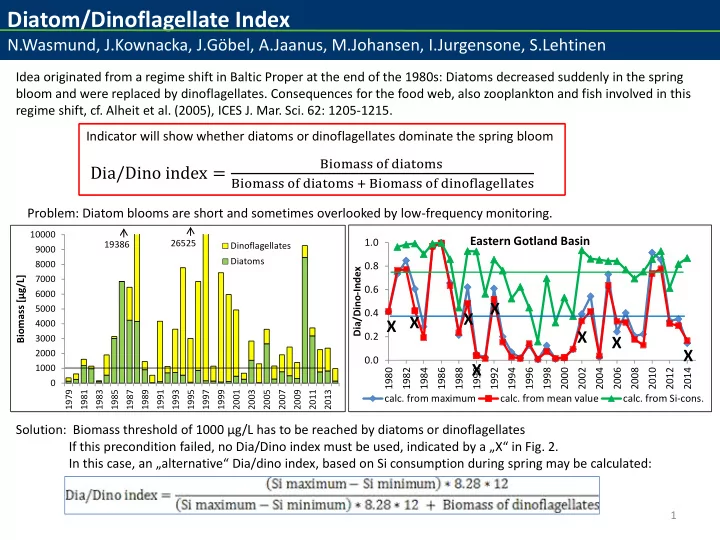
Idea originated from a regime shift in Baltic Proper at the end of the 1980s: Diatoms decreased suddenly in the spring bloom and were replaced by dinoflagellates. Consequences for the food web, also zooplankton and fish involved in this regime shift, cf. Alheit et al. (2005), ICES J. Mar. Sci. 62: 1205-1215. Indicator will show whether diatoms or dinoflagellates dominate the spring bloom

Dia/Dino index =

Biomass of diatoms Biomass of diatoms + Biomass of dinoflagellates

Problem: Diatom blooms are short and sometimes overlooked by low-frequency monitoring. Solution: Biomass threshold of 1000 µg/L has to be reached by diatoms or dinoflagellates If this precondition failed, no Dia/Dino index must be used, indicated by a „X“ in Fig. 2. In this case, an „alternative“ Dia/dino index, based on Si consumption during spring may be calculated:

1000 2000 3000 4000 5000 6000 7000 8000 9000 10000 1979 1981 1983 1985 1987 1989 1991 1993 1995 1997 1999 2001 2003 2005 2007 2009 2011 2013

Biomass [µg/L]

Dinoflagellates Diatoms 19386 26525

0.0 0.2 0.4 0.6 0.8 1.0 1980 1982 1984 1986 1988 1990 1992 1994 1996 1998 2000 2002 2004 2006 2008 2010 2012 2014 Dia/Dino-Index

Eastern Gotland Basin

  • calc. from maximum
  • calc. from mean value
  • calc. from Si-cons.

X X X X X X X X

slide-2
SLIDE 2

Diatom/Dinoflagellate Index

N.Wasmund, J.Kownacka, J.Göbel, A.Jaanus, M.Johansen, I.Jurgensone, S.Lehtinen

2

Alternative Dia/Dino index reflects diatom maximum → is higher than the standard Dia/Dino index → Regression between regular (biomass-based) and alternative (Si-based) Dia/Dino indices used for derivation of Si- based GES Sea area GES (standard Dia/Dino) GES (alternat. Dia/Dino) Kiel Bight 0,75 0,94 Mecklenburg Bight 0,75 0,93 Arkona Basin (0,7) (0,90) Bornholm Basin 0,6 (0,77) Eastern Gotland Basin 0,5 0,8

Year Date of diatom maximum Date of dinoflagellate maximum Dia-Dino index Original data source 1905 12.4.1905 12.4.1905 0.99 Lohmann (1908) 1906 11.4.1906 11.4.1906 0.87 Lohmann (1908) 1912 3.4.1912 3.4.1912 0.97 Busch (1916-1920) 1913 7.3.1913 13.2.1913 0.95 Busch (1916-1920) 1950 19.3.1950 30.3.1950 0.94 Gillbricht (1951)

Suggested GES values are based on historical values from the early 20th century. Example from Kiel Bay: Mean value = 0.94

If deviation of 20 % (=0.19) is allowed:

→ GES = 0,75 Historical literature from other Baltic areas suggest high Dia/Dino indices as GES, too.

slide-3
SLIDE 3

Diatom/Dinoflagellate Index

N.Wasmund, J.Kownacka, J.Göbel, A.Jaanus, M.Johansen, I.Jurgensone, S.Lehtinen

3

What does the Dia/Dino Index indicate?

High Dia/Dino index = Diatom dominance → strong sedimentation Consequences for food web (D4): Consequences for Eutrophication (D5):

  • high food availability for benthos

Removal of biomass (nutrients) from the pelagial. Biomass (nutrients) buried in the sediment

  • low food kept for pelagic food web

Mitigation of eutrophication (Low Dia/Dino index has the opposite effect) The Dia/Dino index indicates the pathway The Dia/Dino index may indicate eutrophication

  • f the winter nutrients and the food.

if N and P input lead to Si-limitation Summary:

  • Diatoms are typical in spring blooms according to historical data → High Dia/Dino index is GES
  • The Dia/Dino index is applicable where diatoms and dinoflagellates naturally occur, that is almost the

whole Baltic excluding fresh-water influenced coastal areas (lagoons, large river plumes)

  • Data are gathered from existing monitoring programs and are available from data banks.
  • The Dia/Dino index is robust, independent of sampling technique and calculation is easy and traceable.
  • If biomass data are too sparse or don‘t reflect the diatom bloom in some years, an alternative

Dia/Dino index may be calculated based on Si data, with specific GES borders.

  • Typical disadvantage (as for many biol. indicators): diatom/dinoflagellate ratio cannot be manipulated

→ it is primarily a descriptive trend indicator for D4 and secondly for D5