
MOL2NET, 2017, 3, doi:10.3390/mol2net-03-xxxx 1
MDPI
MOL2NET, International Conference Series on Multidisciplinary Sciences http://sciforum.net/conference/mol2net-03 Obtaining microorganisms with cellulolytic activity in different regions of Ecuador Carmen A. Salvador Pinos (pochasalvador@yahoo.com) a, Maira Rojas Carrillo
(maira.rojas@udla.edu.ec)b, Leyanis Mesa Garriga (leyanis.mesa@gmail.com)c, Pablo Londoño
(palondono@uce.edu.ec)a, Jonathan Villavicencio Montoya (jfvm_1993@hotmail.com)c, Erenio
González Suárez (erenio@uclv.edu.cu)c
a Universidad Central del Ecuador b Universidad de las Américas c Universidad Central Marta Abreu de las Villas
Abstract. It is estimated that in developing countries 60%
- f waste is from lignocellulosic material that can
be used in recycling processes. The purpose of this research is to find enzymatic cocktails from bacteria native to Ecuador that allow degradation
- f the lignocellulosic material, by searching
native microorganisms collected in Los Andes, Amazonia and Antartida, which can be introduced in a process of bagasse enzymatic hydrolysis on an industrial scale. For this, qualitative and quantitative tests were carried
- ut to measure the endoglucanase, exoglucanase
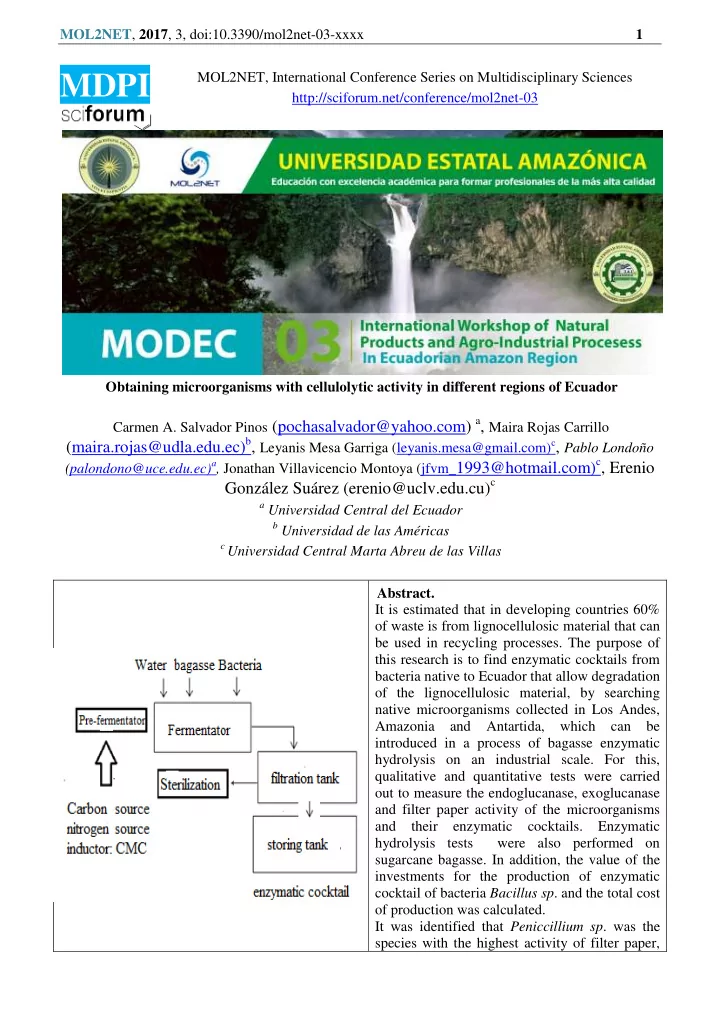
and filter paper activity of the microorganisms and their enzymatic cocktails. Enzymatic hydrolysis tests were also performed on sugarcane bagasse. In addition, the value of the investments for the production of enzymatic cocktail of bacteria Bacillus sp. and the total cost
- f production was calculated.
It was identified that Peniccillium sp. was the species with the highest activity of filter paper,