
MOL2NET, 2017, 3, doi:10.3390/mol2net-03-xxxx 1
MDPI
MOL2NET, International Conference Series on Multidisciplinary Sciences http://sciforum.net/conference/mol2net-03
Twitter Data Mining and Predictive Modeling in R
Eliana Espinosa (E-mail: eespinosa@stu.edu) a, Reinaldo Sanchez-Arias (E-mail: rsanchez-arias@stu.edu) a
a School of Science, St. Thomas University, Miami Gardens, FL, USA.
Graphical Abstract Keywords: social media, sentiment analysis, Twitter data mining. Abstract. The
- pen source statistical programming
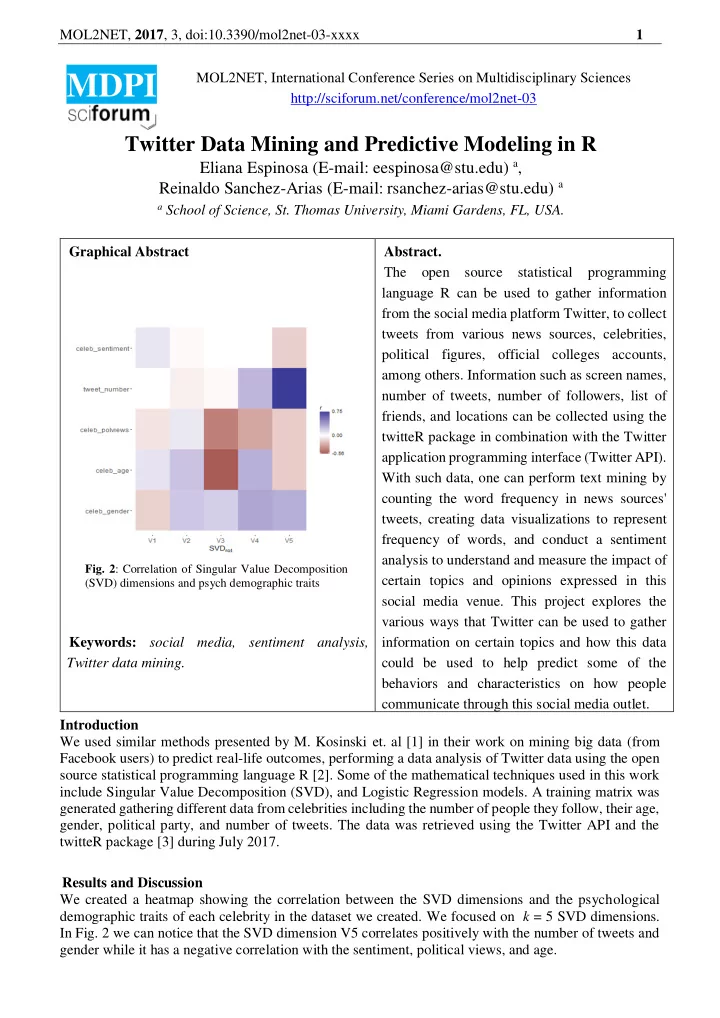
language R can be used to gather information from the social media platform Twitter, to collect tweets from various news sources, celebrities, political figures, official colleges accounts, among others. Information such as screen names, number of tweets, number of followers, list of friends, and locations can be collected using the twitteR package in combination with the Twitter application programming interface (Twitter API). With such data, one can perform text mining by counting the word frequency in news sources' tweets, creating data visualizations to represent frequency of words, and conduct a sentiment analysis to understand and measure the impact of certain topics and opinions expressed in this social media venue. This project explores the various ways that Twitter can be used to gather information on certain topics and how this data could be used to help predict some of the behaviors and characteristics on how people communicate through this social media outlet. Introduction We used similar methods presented by M. Kosinski et. al [1] in their work on mining big data (from Facebook users) to predict real-life outcomes, performing a data analysis of Twitter data using the open source statistical programming language R [2]. Some of the mathematical techniques used in this work include Singular Value Decomposition (SVD), and Logistic Regression models. A training matrix was generated gathering different data from celebrities including the number of people they follow, their age, gender, political party, and number of tweets. The data was retrieved using the Twitter API and the twitteR package [3] during July 2017. Results and Discussion We created a heatmap showing the correlation between the SVD dimensions and the psychological demographic traits of each celebrity in the dataset we created. We focused on k = 5 SVD dimensions. In Fig. 2 we can notice that the SVD dimension V5 correlates positively with the number of tweets and gender while it has a negative correlation with the sentiment, political views, and age.
- Fig. 2: Correlation of Singular Value Decomposition
(SVD) dimensions and psych demographic traits