
MOL2NET, 2017, 3, doi:10.3390/mol2net-03-xxxx 1
MDPI
MOL2NET, International Conference Series on Multidisciplinary Sciences http://sciforum.net/conference/mol2net-03
Analysis of the Gentrification Process in the City of Miami using Publicly Available Data
Sabrina Romero (E-mail: sabrina.romero002@mymdc.net) a, Reinaldo Sanchez-Arias (E-mail: rsanchez-arias@stu.edu) b
a Miami Dade College, InterAmerican Campus, Miami FL, USA b School of Science, St. Thomas University, Miami Gardens, FL, USA.
Graphical Abstract Keywords: gentrification, data mining, sentiment analysis. Abstract. Gentrification is a process involving the movement of a high-income group to working- class neighborhoods nearby amenities, and that usually results in the displacement of the original
- inhabitants. Changes like alteration of local
services, increasing prices, and unaffordable housing are derived from the process, and the negative repercussions it might have in our community, grant great significance to its
- forecasting. Our goal for this project was to offer
a comprehensive analysis of the main indicators
- f the gentrification process in Miami. The data
that was collected and analyzed, along with the different patterns found for the indicators considered in this study, will help in the development of a forecasting model for gentrification of the neighborhoods in the City of Miami. Introduction Using data publicly available for the City of Miami, an analysis of the gentrification process was performed in a subset of neighborhoods in the city, taking into account several indicators that could be used as predictors in a gentrification forecasting model. By finding significant patterns of the main indicators of gentrification in the different communities, local governments could intervene in an effort to balance development and tradition. Movement of a high-income group to a working-class neighborhood might also be encouraged by government policies in the form of tax incentives, local economic developments (public transportation, malls, stadiums, amenities), programs to rehabilitate public housing, among others. Results and Discussion In order to analyze the impact of gentrification in the City of Miami, three of the main indicators were chosen: local tax rates [1], records of building permits [1], and housing prices [2]. The datasets conveying such information were filtered and analyzed using R [3], an open source statistical
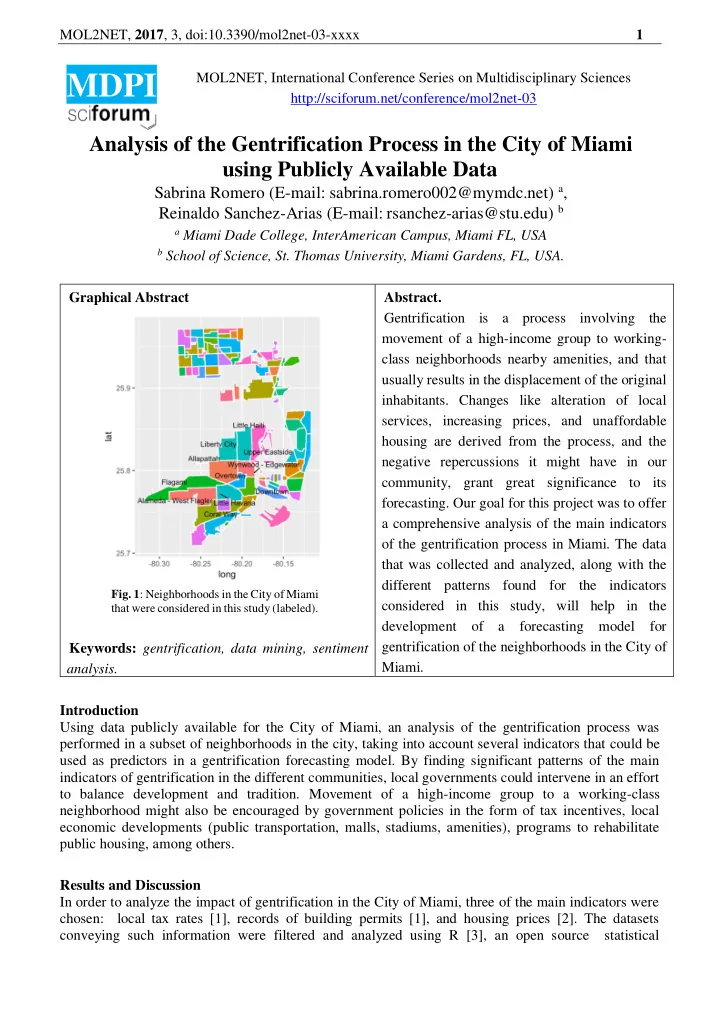
- Fig. 1: Neighborhoods in the City of Miami
that were considered in this study (labeled).