Module 10 Facilitation and Presentation Skills Module Ten: - - PDF document

module 10 facilitation and presentation skills
SMART_READER_LITE
LIVE PREVIEW

Module 10 Facilitation and Presentation Skills Module Ten: - - PDF document

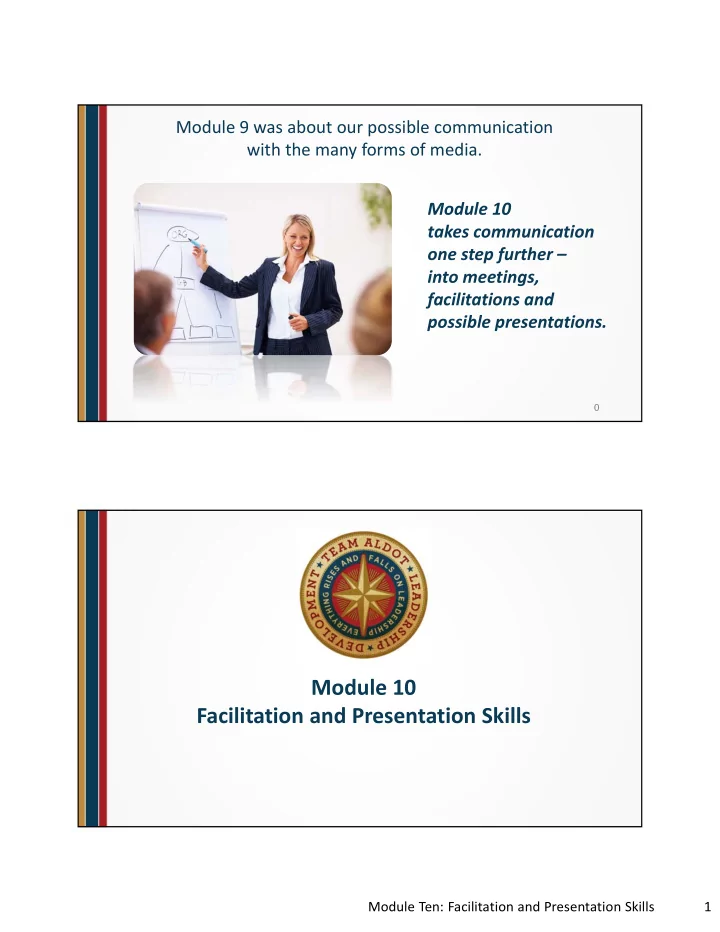
Module 9 was about our possible communication with the many forms of media. Module 10 takes communication one step further into meetings, facilitations and possible presentations. 0 Module 10 Facilitation and Presentation Skills


slide-1
SLIDE 1

Module Ten: Facilitation and Presentation Skills 1

Module 9 was about our possible communication with the many forms of media. Module 10 takes communication

  • ne step further –

into meetings, facilitations and possible presentations.

Module 10 Facilitation and Presentation Skills

slide-2
SLIDE 2

Module Ten: Facilitation and Presentation Skills 2

Objectives

  • Recognize the power and potential for influence through verbal

and nonverbal communication.

  • Learn techniques to enhance the effectiveness of meetings.
  • Demonstrate keys to effective formal or informal presentations.

2

Effective Communication

…happens when the intended audience receives the intended message from a speaker who is present

  • r can otherwise be seen and heard.

3

slide-3
SLIDE 3

Module Ten: Facilitation and Presentation Skills 3

LEADERSHIP MOMENT Ronnie Baldwin, Retired ALDOT Chief Engineer Video Title: Effective Physical Communication

4

Ronnie Baldwin Chief Engineer, Retired Effective Physical Communication

Believability of Our Communication

  • Verbal (spoken words) = 7%
  • Vocalics (e.g., tone, pitch, volume, speed of voice) = 38%
  • Nonverbal (facial expressions, gestures, posture, eye contact) = 55%

5

slide-4
SLIDE 4

Module Ten: Facilitation and Presentation Skills 4

Conducting Effective Meetings

6 7

If you had to identify, in one word, the reason why the human race has not achieved, and never will achieve, its full potential, that word would be ‘meetings. Dave Barry

How can you make your meetings more effective?

7

slide-5
SLIDE 5

Module Ten: Facilitation and Presentation Skills 5

Conducting Effective Meetings

1. Determine the purpose of the meeting. 2. Plan and conduct the meeting in accordance with the purpose. 3. Follow through and follow up.

8

Planning the Meeting In Advance Why is the meeting being held?

The need, purpose, and objectives of the meeting should be clear before the meeting is scheduled, even if it is with just one other person.

9

slide-6
SLIDE 6

Module Ten: Facilitation and Presentation Skills 6

  • Meetings to Inform
  • Meetings to Discuss
  • Meetings to Decide
  • Meetings to Solve
  • Meetings to Invent
  • Meetings to Sell
  • Meetings to Meet

Planning the Meeting In Advance

  • What?

What type of meeting is necessary?

10

Planning the Meeting In Advance

How will the meeting be conducted?

  • Where will the meeting be held? This location may be physical or virtual.
  • When will the meeting be held? Is it urgent? Should it be tied to other

events?

  • How will the meeting be implemented? What is the appropriate format?
  • Am I prepared?
  • Do I know how to meet the meeting goals?
  • Can I hold a respectful and effective meeting?

11

slide-7
SLIDE 7

Module Ten: Facilitation and Presentation Skills 7

Tips for Effective Meetings

During the meeting, it is important to:

  • Take notes and record minutes.
  • Stay on point.
  • Always have an agenda, whether the meeting is formal or not. Have an agenda

printed for everyone even if the meeting is more general and flexible in nature.

  • Use a “parking lot” if necessary (flip chart or white board to record important, but off‐

topic comments/questions for follow‐up later). Many meetings get off task because “tangents” are allowed.

12

Tips for Effective Meetings

During the meeting, it is important to:

  • Be respectful by keeping the meeting orderly (not allowing interruption
  • f others, protecting opposing viewpoints, and seeking input from

everyone—including the quieter attendees).

  • Record and restate action items and assignments at the end of the

meeting.

13

slide-8
SLIDE 8

Module Ten: Facilitation and Presentation Skills 8

Tips for Effective Meetings

During the meeting, it is important to:

  • Be clear about what should happen next.

This should be in alignment with the purpose for the meeting.

  • End on time. Set an expectation that your

meetings end when you say they will end.

14

Tips for Effective Meetings

After the meeting, it is important to:

  • Follow up.
  • Make sure the effort and time invested in the meeting are not wasted.
  • Share the minutes and notes and remind attendees of their action

items.

  • Restate the purpose and objectives of the meeting and mention

whether they were accomplished.

15

slide-9
SLIDE 9

Module Ten: Facilitation and Presentation Skills 9

Management's job is to convey leadership's message in a compelling and inspiring way. Not just in meetings, but also by example. Jeffrey Gitomer

16 17

Conducting Effective Informal or Formal Presentations

17

slide-10
SLIDE 10

Module Ten: Facilitation and Presentation Skills 10

18

We must remember that the purpose and goal of the presentation determine how the information should be delivered.

19

The true questions every presenter should start with are: What does the audience need to know? AND What is the best way to communicate that message to ensure audience understanding?

slide-11
SLIDE 11

Module Ten: Facilitation and Presentation Skills 11

Presentations Are More Than PowerPoint

  • Conversation?
  • Lecture?
  • White Board?
  • Static visuals?
  • Graphics?
  • Charts?
  • Dynamic visuals?
  • Video?
  • PowerPoint?
  • Keynote?
  • Prezi?

20

Presentations Are More Than PowerPoint

  • Set clear, realistic goals.
  • Anticipate resistance.
  • Find some common ground.
  • Be honest.
  • Stay calm.

21

slide-12
SLIDE 12

Module Ten: Facilitation and Presentation Skills 12

20 Habits of Truly Brilliant Presenters

Maurice DeCastro, Author Founder of Mindful Presenter for GoToMeeting Resource Center

22

Habit 1: Acknowledge and reframe.

Anxiety

  • Mental reaction
  • Physical reaction
  • Give it a name—feeling

23

slide-13
SLIDE 13

Module Ten: Facilitation and Presentation Skills 13

Habit 2: Focus on the audience.

My audience needs to:

  • Hear what I’m saying
  • Understand what I’m saying
  • Feel a certain way
  • Act in a certain direction

24

Habit 3: Don’t try to be perfect.

A goal of perfection

  • Is unreasonable
  • Creates more anxiety
  • Makes it more difficult to connect with the

audience

25

slide-14
SLIDE 14

Module Ten: Facilitation and Presentation Skills 14

Habit 4: Stick to the point.

  • What do they need to know?
  • Less is always more.
  • 10‐20‐30 RULE

26

Habit 5: See the opportunity.

  • Opportunity for them
  • Opportunity for you

27

slide-15
SLIDE 15

Module Ten: Facilitation and Presentation Skills 15

Habit 6: Anchor yourself.

  • Know your purpose.
  • Be assured of your preparation.
  • Remain grounded.

28

Habit 7: Practice

“Practice your presentation until you’re sick of it. Then practice it more.” ‐‐Guy Kawasaki

29

slide-16
SLIDE 16

Module Ten: Facilitation and Presentation Skills 16

Habit 8: Tell stories.

People do not need a list of facts. Even if you have facts listed on the handout or PowerPoint, tell stories. Provide examples, situations, and happenings that illustrate your point. That is what people will remember.

30

Habit 9: Use colorful, creative, and compelling images.

Images move through a different part of the brain than words, and they cause a faster and stronger reaction than words. So, use great images that cause reactions. Create a compelling graph, a simple image, a strong single message, and people will remember long after you have presented.

31

slide-17
SLIDE 17

Module Ten: Facilitation and Presentation Skills 17

Habit 10: Involve the audience.

Audiences today need to be engaged. They need to be kept involved,

  • r they will not be engaged during and after the presentation.

They also will not remember what was said.

Name some examples.

32

Habit 11: Use videos and props.

Again, videos and props use a different part of the brain to process. It is important to increase the probability that people will remember your points.

Name some examples.

33

slide-18
SLIDE 18

Module Ten: Facilitation and Presentation Skills 18

Habit 12: Use your voice.

  • Tone
  • Pitch
  • Volume
  • Rate/speed
  • Pauses

34

Habit 13: Stay in the present.

  • Always make eye contact with audience members.
  • Do not stare at the ceiling or walls or out the windows.
  • Do not keep checking your watch or phone.
  • Walk about, including getting closer to the audience.
  • Do not read your notes.

35

slide-19
SLIDE 19

Module Ten: Facilitation and Presentation Skills 19

Habit 14: Know how to make friends.

  • See your audience as potential friends.
  • Find common interests.
  • Tell great stories.
  • Smile and empathize.
  • Listen.
  • Add value.

36

Habit 15: Know your stuff.

  • Knowing your content makes your credibility real.
  • Be prepared so you do not read notes or PowerPoint.
  • Knowledgeable presenters are respected.
  • People will be drawn to your stories and experience, not

your opinion.

37

slide-20
SLIDE 20

Module Ten: Facilitation and Presentation Skills 20

Habit 16: Be consistent.

  • Present the same way you have conversations with friends.
  • Do not become “another person” when presenting.
  • Know your entire presentation.
  • Use time wisely. Do not rush at the end or end early because

you spoke too fast.

38

Habit 17: Be generous.

Think about your audience. Again, it’s not about you. It’s about them.

39

slide-21
SLIDE 21

Module Ten: Facilitation and Presentation Skills 21

Habit 18: Help them see the contrast.

  • Problem/solution
  • Need/fulfillment
  • Old/new
  • Ineffective/effective

40

Habit 19: Give them a good reason.

  • Making the case for your idea or decision is your

responsibility.

  • Don’t blame the audience for a lack of action or buy‐in.
  • Why would someone want to see it your way?

41

slide-22
SLIDE 22

Module Ten: Facilitation and Presentation Skills 22

Habit 20: Give them hope.

The great presenters know how to put themselves in their audience’s shoes and think carefully about everything they may hope for. Then, they demonstrate their understanding by providing that hope in the context of their presentation.

42

Handling a Tough Crowd

  • Set clear, realistic goals.
  • Anticipate resistance.
  • Find some common ground.
  • Be honest.
  • Stay calm.

43

slide-23
SLIDE 23

Module Ten: Facilitation and Presentation Skills 23

44

Group Facilitation

Group Facilitation

  • A facilitator is not the seat of all knowledge. A facilitator is a

guide to help people move through a process together.

  • Group facilitation does not focus just on what gets achieved. It

also focuses on how people participate in the process of learning or planning.

  • A facilitator does not take sides.

45

slide-24
SLIDE 24

Module Ten: Facilitation and Presentation Skills 24

Tips To Gain Input And Participation

  • Make sure everyone feels comfortable participating.
  • Develop a structure that allows for everyone’s ideas to be heard.
  • Make people feel good about their contributions.
  • Make sure the group feels the ideas and/or decisions are theirs.
  • Support everyone’s ideas. Do not criticize them for what they say.

46

Successful Facilitation

  • Be prepared.
  • Know what is needed as far as purpose and goals.
  • Know the participants in the room and consider

their expectations or lack of expectations.

  • Set and keep a structure as the seminar or

meeting is conducted.

  • Provide clear directives.

47

slide-25
SLIDE 25

Module Ten: Facilitation and Presentation Skills 25

Active Listening

  • Facilitators must keep up with the flow of conversations and

ideas.

  • Facilitators should make encouraging comments about input as

people contribute.

  • Appropriate structure should be maintained throughout the

time allotted.

48 49

Final Thought

Speech is power: speech is to persuade, to convert, to compel. It is to bring another out of his bad sense into your good sense. Ralph Waldo Emerson