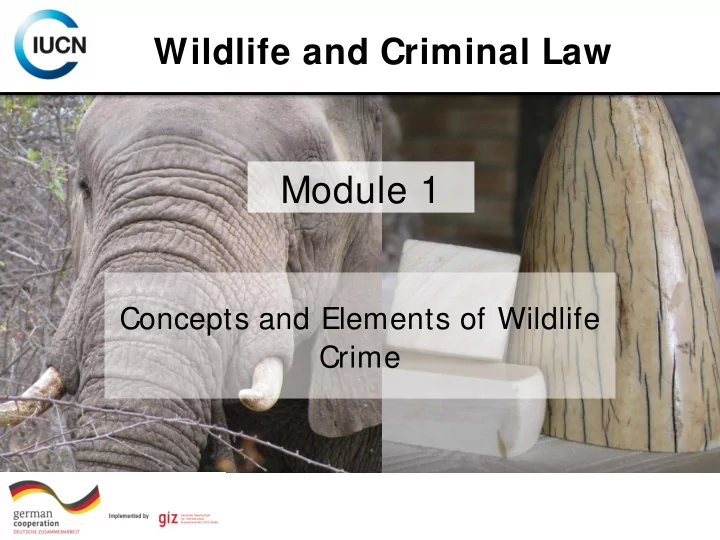
SLIDE 1
Wildlife and Criminal Law
Concepts and Elements of Wildlife Crime
Module 1
SLIDE 2
Overview of this module
Introduction International and Regional Dimension Elements of Criminal Liability Relationship with Other Crimes Wildlife Offences
SLIDE 3
I NTRODUCTI ON
Defining wildlife crime Compliance approaches Importance Motivation … and implications
SLIDE 4
Defining wildlife crime What is wildlife crime?
Conduct Criminalised Wildlife
exploitation possession trade import and export
SLIDE 5
Compliance approaches Compliance
adherence to legal requirement Voluntary compliance State incentives
Enforcement
Administrative Civil Criminal response to non-compliance
SLIDE 6
I mportance of addressing wildlife crime
Practical reasons Moral and ethical reasons Protection of human rights
Scientific and ecological Economical and medical Aesthetic and recreational
Rule of law
Why is wildlife crime important?
SLIDE 7
I mportance of addressing wildlife crime Purpose of prosecution?
Punishment Prevention Deterrence Incarceration Taking away the means
SLIDE 8 “Wildlife crime is in essence a crime of greed”
Motivation for committing wildlife crimes and implications for criminal enforcement
Practical consequences
crime syndicates
- multinational
- deliberate and
intentional acts Practical Solutions
- Specialised investigation
and prosecution
cooperation
SLIDE 9
Overview of this module
Introduction International and Regional Law Elements of Criminal Liability Relationship with Other Crimes Wildlife Offences
SLIDE 10
THE I NTERNATI ONAL AND REGI ONAL DI MENSI ON
Relevance International vs. National MEAs Regional agreements Crime-related agreements International cooperation
SLIDE 11
Relevance of international law
“Environmental crime often involves harm of a global nature, for the manifestations of environmental crime can be realized far beyond the crime site in both space and time. The crimes themselves may be done at an international level. Thus, international co-operation and consistent enforcement everywhere are necessary to combat environmental crime” Advocacy Memorandum: Arguments for Prosecutors of Environmental Crime, Interpol
SLIDE 12
Role of I nternational Law
International Law and National Law self-implementing
automatically enforceable in national courts
non-self-implementing
requires implementing legislation
Obligations on countries harmonize offences and penalties measures for international cooperation
SLIDE 13 Convention on Biological Diversity (CBD) Convention on the Protection
- f World Cultural and Natural
Heritage (World Heritage Convention) Convention on the International Trade of Endangered Species of Wild Fauna and Flora (CITES) Convention on the Conservation of Migratory Species of Wild Animals (Bonn Convention or CMS)
Wildlife related International Agreements
Multilateral Environmental Agreements
SLIDE 14
Appendix I Appendix II Appendix III
no commercial trade limited commercial trade export + import permit export permit + certificate of origin African Elephant Hippopotamus Civet
Convention on the I nternational Trade of Endangered Species
SLIDE 15
“95.-(1) Any trade in violation of CITES provisions is prohibited under this Act and all specimens illegally traded shall be confiscated.” Tanzania, Wildlife Conservation Act 2009
Implementing Legislation
Convention on the I nternational Trade of Endangered Species
SLIDE 16 Regional Environmental Agreements
Regional agreements African Convention on the Conservation
- f Nature and Natural Resources
Bern Convention on the Conservation of European Wildlife Noumea Convention
SLIDE 17
Agreements on Aspects of Crime
Global agreements on aspects of crime UN Convention against Transnational Organized Crime (UNTOC) UN Convention Against Corruption (UNCC) Regional agreements on aspects of crime Co-operation agreements
SLIDE 18
I nternational assistance in combatting wildlife crime
Informal methods person-to-person not admissible in court Formal methods agency-to-agency mutual assistance treaty INTERPOL
SLIDE 19
ICCWC
CITES, INTERPOL, UNODC, World Bank, World Customs Organisation
ASEAN-WEN Lusaka Agreement SAWEN CAWEN
Regional and international initiatives and networks
SLIDE 20
Overview of this module
Introduction International and Regional Law Elements of Criminal Liability Relationship with Other Crimes Wildlife Offences
SLIDE 21
ASPECTS AND ELEMENTS OF CRI MI NAL LI ABI LI TY
What is criminal law? Criminal liability Liability of corporations
SLIDE 22
provides … elements of criminal offences extension/limitation of liability general defences burden of proof penalties
Criminal law
criminal procedure jurisdiction evidence witnesses
SLIDE 23
single statute set of laws case law found in… delegated legislation/regulations
Criminal law
SLIDE 24
wrongful conduct
voluntary act or omission legally recognized crime unlawful (not justified)
culpable mental state (mens rea)
intention negligence/recklessness strict liability
Criminal liability
SLIDE 25
proving mens rea
subjective infer from factual circumstances
knowledge of law
ignorantia juris non excusat
Criminal liability
expected to know?
SLIDE 26 Offences motivated by financial gains Corporations
fines Change corporate behaviour and culture
Liability of corporations Why prosecute corporations?
SLIDE 27
“Any person who is or was a director of a firm at the time of the commission by that firm of an offence ... shall himself or herself be guilty of the said offence and liable on conviction to the penalty specified in the relevant law... if the offence in question resulted from the failure of the director to take all reasonable steps that were necessary under the circumstances to prevent the commission of the offence: Provided that proof of the said offence by the firm shall constitute prima facie evidence that the director is guilty under this subsection”. [emphasis added] South African National Environmental Management Act of 1998
Liability of employers and directors
SLIDE 28
Overview of this module
Introduction International and Regional Law Elements of Criminal Liability Relationship with Other Crimes Wildlife Offences
SLIDE 29
WI LDLI FE OFFENCES
Introduction Illegal exploitation Protected areas Illegal possession Illegal trade Illegal export/import Inchoate offences
SLIDE 30 I ntroduction domestic wildlife law covers:
designation of government departments licensing systems for hunting, trade, possession, etc. trade in wildlife or wildlife products importing/exporting of wildlife products
protected areas species-specific provisions
SLIDE 31
Offences related to illegal exploitation of wildlife typical offences
hunting, killing, catching, gathering without permit hunting, killing, catching, gathering of protected species hunting, killing, catching, gathering in a protected area illegal methods of hunting, killing, catching, gathering hunting, killing, catching, gathering out of season
SLIDE 32
No person shall hunt any wild animal specified in Schedule I,II, III and IV except as provided under section 11 and section 12… “hunting”, with its grammatical variations and cognate expressions, includes, (a) capturing, killing, poisoning, snaring, and trapping of any wild animal and every attempt to do so … (c) injuring or destroying or taking any part of the body of such animal, or in the case of wild birds and reptiles, damaging the eggs of such birds and reptiles, or disturbing the eggs or nests of such birds or reptiles. Section 9 of the Indian Wildlife Protection Act, 1972
Offences related to illegal exploitation of wildlife protected species
SLIDE 33
(1) A person may not carry out a restricted activity involving a specimen of a listed threatened or protected species without a permit issued in terms of this Act "restricted activity", in relation to a specimen of a listed threatened or protected species, means- (i) hunting, catching, capturing or killing any living specimen of a listed threatened or protected species by any means, method or device whatsoever, including searching, pursuing, driving, lying in wait, luring, alluring, discharging a missile or injuring with intent to hunt, catch, capture or kill any such specimen; (ii) gathering, collecting or plucking any specimen of a listed threatened or protected species; (iii) picking parts of, or cutting, chopping off, uprooting, damaging or destroying, any specimen of a listed threatened or protected species "listed threatened or protected species" means a species listed as such by the Minister in the Government Gazette; South African National Environmental Management: Biodiversity Act 10 of 2004
protected species Offences related to illegal exploitation of wildlife
SLIDE 34
- Art. 65. The use of the following means and methods shall be prohibited at
hunting:
- 1. fire arms …
- 2. traps, loops, nets, glues and pits (ditches), if they are applied for non selective
hunting;
- 3. poisonous or anaesthetic substances, as well as baits with such substances;
- 4. (amend. SG 79/02) electric sound reproducing devices and artificial sources of
light, as well as facilities for lighting the target;
- 5. mirrors and other blinding subjects;
- 6. electric appliances, able to kill or stun;
- 7. live animals, used as bait;
- 8. explosives, gas or smoke;
- 9. appliances for night shooting …
- 10. motor vehicles;
- 11. aviation means;
Bulgaria, Law for hunting and protection of the Game, 2000 (amended 2002)
hunting methods Offences related to illegal exploitation of wildlife
SLIDE 35
typical offences
Hunting within a protected area Possession of firearms/prohibited gear within a protected area Entry into a protected area
Offences relating to protected areas
Disturbance of habitat within a protected area
SLIDE 36 Subject to subsection(2), no person shall, in any wildlife area (a) hunt or fish, (b) be in possession of any firearm, slingshot, bow and arrow, shot other than non-toxic shot or any instrument that can be used for the purpose of hunting … hunt means to chase, pursue, worry, follow after or on the trail of, stalk
- r lie in wait for the purpose of taking animals, and includes molesting,
trapping, attempting to trap or shooting at animals, whether or not the animal is then or subsequently captured, killed or injured… Section 3 of the Canadian Wildlife Area Regulations (C.R.C., c. 1609)
Offences relating to protected areas
SLIDE 37 Offences relating to the illegal possession
- f wildlife and wildlife products
typical offences
keeping, possession and control illegal processing illegal transport
SLIDE 38 Any person who keeps or is found in possession of a wildlife trophy ...or manufactures any item from a trophy without a permit issued under this Act....commits an offence... where "trophy" means "any wild species alive or dead and any bone, claw, egg, feather, hoof, skin, tooth, tusk or other durable portion whatsoever of that animal whether processed, added to or changed by the work of man or not, which is recognizable as such" section 95 of the Kenyan Wildlife Conservation and Management Act 47 of 2013
Offences relating to the illegal possession
- f wildlife and wildlife products
possession
SLIDE 39 No person shall transport game or game meat unless he is the holder of a permit, written authority, or written permission granted and issued in terms of this Ordinance.... Any person who contravenes or fails to comply with any provision of this Ordinance...shall be guilty of an offence where "game" means "specially protected game, protected game, huntable game, huntable game birds and exotic game" section 48(1)(a), read with section 86 of the Namibian Nature Conservation Ordinance, 1975
Offences relating to the illegal possession
- f wildlife and wildlife products
transport
SLIDE 40
physical possession (“corpus”) intention to possess (“animus”) POSSESSION
Proving possession
SLIDE 41 Offences relating to illegal trade
- f wildlife and wildlife products
typical offences
selling
supplying buying bartering trading
SLIDE 42 Any person who sells, buys, transfers, transports, accepts ....any trophy in contravention of any of the provisions of this Part....commits an
where "trophy" means "any wild species alive or dead and any bone, claw, egg, feather, hoof, skin, tooth, tusk or other durable portion whatsoever of that animal whether processed, added to or changed by the work of man or not, which is recognizable as such" section 80(1) & (4), 81(1) and 84(1) of the Tanzanian Wildlife Conservation Act 2009
Offences relating to illegal trade
- f wildlife and wildlife products
SLIDE 43
Offences relating to illegal export and import of wildlife or wildlife products typical offences
import/export without permit or certificate import/export of protected species import/export of illegally sourced product abuse of or failure to comply with licensing system
SLIDE 44
Subject to subsection (2) no person shall, except with a permit issued by the authorised officer and subject to such conditions including the payment of such fees as may be prescribed- (c) export from Mauritius or import into Mauritius any prescribed species of wildlife or any product thereof, (d) assist in, or facilitate, the export from Mauritius or import into Mauritius of any prescribed species of wildlife or any product thereof unless he has ascertained that a permit has been issued by the authorised officer in respect of such export or import. Section 17(1) of the Wildlife and National Parks Act 1993 of Mauritius
Offences relating to illegal export and import of wildlife or wildlife products
SLIDE 45
It is unlawful for any person . . . (2) to import, export, transport, sell, receive, acquire, or purchase in interstate or foreign commerce– (A)any fish or wildlife taken, possessed, transported, or sold in violation of any law or regulation of any State or in violation of any foreign law. US Lacey Act
“Lacey Act” Provision
SLIDE 46
I nchoate and ancillary offences
Attempt Conspiracy Incitement
inchoate offences
Organizer/leader of criminal activity may not be the one holding the gun…
why prosecute inchoate offences?
Aiding and abetting Procuring
SLIDE 47
Overview of this module
Introduction International and Regional Law Elements of Criminal Liability Relationship with Other Crimes Wildlife Offences
SLIDE 48
Relationship with other crimes
Introduction Commercial crime Organized crime
SLIDE 49 I ntroduction
Wildlife
Protected areas Firearms and ammunition Customs and excise Narcotics Health Commercial and
SLIDE 50
Relationship with commercial crimes relevant commercial offences
Forgery Corruption Fraud Tax evasion Money laundering
SLIDE 51
relevant organized crime offences
participation in an organized criminal group (“racketeering”) active part knowing contribution transnational
Relationship with organized crimes
SLIDE 52
why charge under organized crime offence?
criminalize person not holding gun emphasis on criminal enterprise, not specific incident responsibility on all members of syndicate
Relationship with organized crimes
SLIDE 53
Overview of this module
Introduction International and Regional Law Elements of Criminal Liability Relationship with Other Crimes Wildlife Offences
SLIDE 54
CONCLUSI ON
Why a criminal law approach? What makes criminal law effective?
SLIDE 55 Why criminal law?
Effective investigation/ prosecution
Criminal sanctions Deterrent value
Liability for damages
Loss of proceeds Removing the incentive to commit such crimes
Powers of enforcement
investigators
Successful prosecutions Break up
syndicates
SLIDE 56
What makes criminal law effective?
strong legislation
provides powers to enforce/investigate creates offences covering all transgressions provides for adequate penalties
effective detection, enforcement, investigation prosecutors have awareness, knowledge, expertise appropriate and public sentences
SLIDE 57
Wildlife and Criminal Law
Thank You!