Modem Surasak Sanguanpong nguan@ku.ac.th - - PDF document

modem
SMART_READER_LITE
LIVE PREVIEW

Modem Surasak Sanguanpong nguan@ku.ac.th - - PDF document

1/14 Modem Surasak Sanguanpong nguan@ku.ac.th http://www.cpe.ku.ac.th/~nguan Last updated: 26 November 2004 Applied Network Research Group Department of Computer Engineering, Kasetsart University 2/14 Modem


slide-1
SLIDE 1

Applied Network Research Group Department of Computer Engineering, Kasetsart University 1/14

Modem

Surasak Sanguanpong nguan@ku.ac.th http://www.cpe.ku.ac.th/~nguan

Last updated: 26 November 2004 Applied Network Research Group Department of Computer Engineering, Kasetsart University 2/14

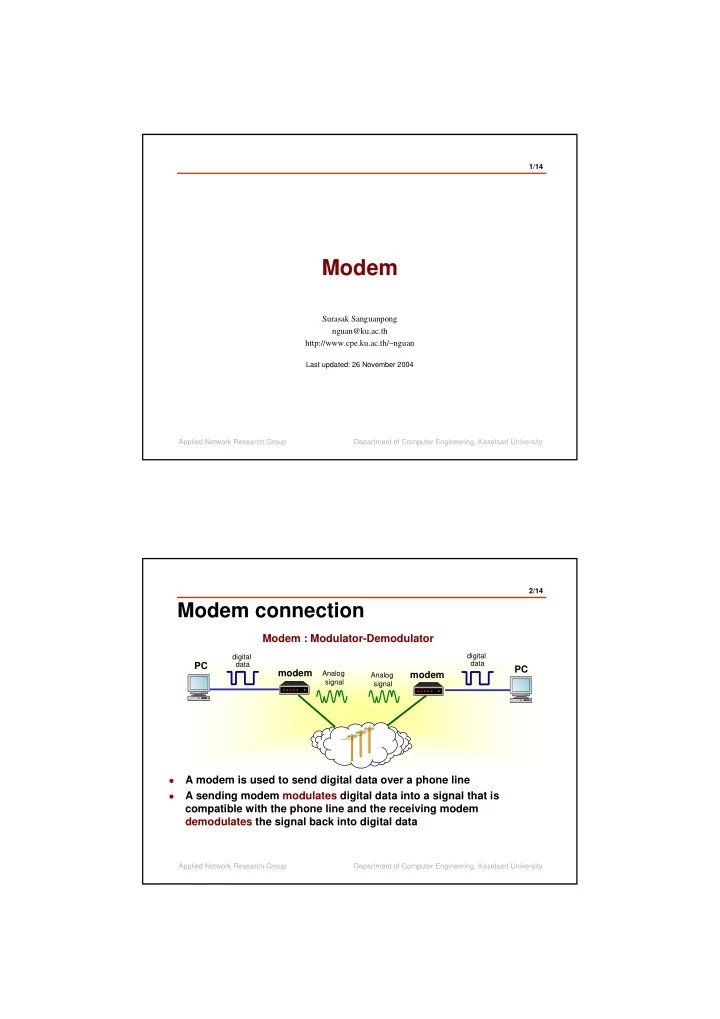
Modem connection

PC PC modem modem

  • A modem is used to send digital data over a phone line
  • A sending modem modulates digital data into a signal that is

compatible with the phone line and the receiving modem demodulates the signal back into digital data Modem : Modulator-Demodulator

digital data Analog signal Analog signal digital data

slide-2
SLIDE 2

Applied Network Research Group Department of Computer Engineering, Kasetsart University 3/14

The Original of Modem

Mainframe Dumb Terminal modem modem

  • Modems came into existence in the 1960s as a way to allow terminals

to connect to computers over the phone lines

  • A dumb terminal at an off-site office "dial up" to the mainframe using

300 bps modem

Applied Network Research Group Department of Computer Engineering, Kasetsart University 4/14

300 bps Full Duplex Modem

1070 1270 2025 2225

Hz PSTN bandwidth

  • Use Frequency Shift Keying (FSK)
  • The originate and answer modems use

different tones, they can both use the line simultaneously (Full-duplex

  • peration)

D T E D T E Modulator Space=1070 Mark=1270 Demodulator Space=2025 Mark=2225 Demodulator Space=1070 Mark=1270 Modulator Space=2025 Mark=2225

1 1

Originate modem (sender) Answer modem (receiver)

slide-3
SLIDE 3

Applied Network Research Group Department of Computer Engineering, Kasetsart University 5/14

FSK FSK PSK PSK

Modulation Techniques

ASK ASK Modulation ASK+PSK ASK+PSK TCM TCM

Low speed modem higher speed modem Very high speed modem Not used for modem

Applied Network Research Group Department of Computer Engineering, Kasetsart University 6/14

Modem Operating Mode

Half Duplex Half Duplex Dial up Dial up Synchronous Synchronous

Half duplex over two wires

Leased line Leased line Full Duplex Full Duplex

V.S.

  • Full duplex over four wires
  • Full duplex over two wires with two channel
  • f different frequency

Temporary connection between two sites Each call to the same site might use

different routes with different line quality wires

Private permanent connection between two sites Constant line quality and the route is fixed Offer higher speed with lower error rates

Asynchronous Asynchronous

V.S. V.S.

A block of bits is transmitted in a steady stream synchronization is maintain by a clock signal data are transmitted one character at a time synchronization is maintained within each

character with start and stop codes

slide-4
SLIDE 4

Applied Network Research Group Department of Computer Engineering, Kasetsart University 7/14

Bandwidth for Telephone line

300 600 3000 3400 Hz 2400 Hz for data 3100 Hz for voice

  • Why 33.6 Kbps?

Applied Network Research Group Department of Computer Engineering, Kasetsart University 8/14

How modem achieves more speed?

bit rate = 2xbaud rate

+90ฐ=01 0ฐ=00 +270ฐ=11 +180ฐ=10

bit rate = 3xbaud rate

4-PSK 8-QAM

1 amplitude, 4 phases : 2 bits encoding in one signal change 2 amplitudes, 4 phases : 3 bits encoding in one signal change 001 011 010 111 100 101 000 110

Answer : Signals encode multiple bits, the bit rate is a multiple of the baud rate.

slide-5
SLIDE 5

Applied Network Research Group Department of Computer Engineering, Kasetsart University 9/14

Modem Standards

Bell and ITU-T compatibility chart

Bell Bell ITU-T ITU-T

103/113 212A 202 201B/C 208 209A V.21 V.22 V.23 V.26 V.27 V.29 300 600 1200 1200 1600 2400 300 1200 1200 2400 4800 9600 FSK 4-PSK FSK 4-PSK 8-PSK 16-QAM

Baud rate Bit rate Modulation Duplex Mode

Full Full Half Full Full/Half Full/Half Sync/Async Sync/Async Sync/Async Sync Sync Sync

Applied Network Research Group Department of Computer Engineering, Kasetsart University 10/14

More ITU-T Modem Standards

V.22 bis V.26bis V.26ter V.27bis V.27ter V.32 V.32bis V.33 V.34 600 1200 1200 1600 1600 2400 2400 2400 2400 2400 2400 2400 4800 4800 9600 14400 14400 28800 16-QAM 4-PSK 4-PSK 8-PSK 8-PSK TCM TCM TCM TCM

Baud rate Bit rate Modulation Duplex Mode

Full Half Full/Half Full Half Full Full Full Full Sync/Async Sync Sync/Async Sync Sync Sync Sync Sync Sync/Async

slide-6
SLIDE 6

Applied Network Research Group Department of Computer Engineering, Kasetsart University 11/14

Interface V.S. Operating rate

modem PC interface speed

  • perating rate

115.2 Kbps 33.6 Kbps

  • With 4:1 compression a V.34 Modem can

receive data at 115.2 Kbps from PC

  • The 33.6 Kbps limit of the telephone line is not

exceeded

Applied Network Research Group Department of Computer Engineering, Kasetsart University 12/14

Fallback

modem modem

12,200 bps

Down speed

9,600 bps

modem modem modem modem

4,800 bps

slide-7
SLIDE 7

Applied Network Research Group Department of Computer Engineering, Kasetsart University 13/14

56 Kbps Modems

V.34

CO CO

Analog Digital

Home ISP

Conventional V.34 Modem V.90 Modem Central Office Digital

CO CO

Analog V.34 V.90

CO CO

Analog Digital

Home ISP

Digital

CO CO

V.90 Digital Central Office Analog Digital Analog

Analog Digital

56 Kbps 33.6 Kbps

Analog Digital Analog

33.6 Kbps

Analog Digital

33.6 Kbps

Applied Network Research Group Department of Computer Engineering, Kasetsart University 14/14

Asymmetrical Stream

33.6 Kbps

V.90 acts as V.34

A/D A/D

Analog Digital Home ISP

From home, you transmit To home, you receive

56 Kbps

V.90 acts as V.90

D/A D/A

Analog Digital Home

Central Office

Digital Digital ISP

Quantization noise limits the data rate to No quantization noise (No PCM)