Models of care to better meet patient needs Gaps, needs and - - PowerPoint PPT Presentation

models of care to better meet patient needs gaps needs
SMART_READER_LITE
LIVE PREVIEW

Models of care to better meet patient needs Gaps, needs and - - PowerPoint PPT Presentation

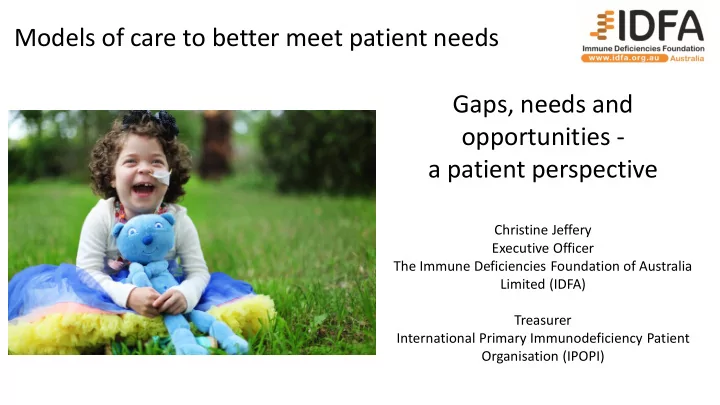
Models of care to better meet patient needs Gaps, needs and opportunities - a patient perspective Christine Jeffery Executive Officer The Immune Deficiencies Foundation of Australia Limited (IDFA) Treasurer International Primary


slide-1
SLIDE 1

Models of care to better meet patient needs Gaps, needs and

  • pportunities -

a patient perspective

Christine Jeffery Executive Officer The Immune Deficiencies Foundation of Australia Limited (IDFA) Treasurer International Primary Immunodeficiency Patient Organisation (IPOPI)

slide-2
SLIDE 2

Primary Immune Deficiency Diseases (PIDs) are caused by defects in the genes that control the immune system, so people with PIDs are born missing some or all of the parts of the immune system. The World Health Organisation (WHO) recognises more than 240 PIDs. There is no cure for the majority of PIDs. PIDs can be mild, severe and fatal. Many people with PIDs also have other comorbidities. What is a primary immune deficiency? The “bubble boy” disease..

David Vetter, the “bubble boy”, had Severe Combined Immune Deficiency (SCID). This is fatal without a Haematopoietic Stem Cell Transplantation (HSCT).

slide-3
SLIDE 3

 Is the peak patient organisation for people affected by PIDs in Australia.

Is the 4th largest patient organisation for PIDs in the world. IDFA brings the PID community together by providing free education, resources, practical advice, emotional support, conferences, events and links members via social media. Advocates for members to ensure accurate diagnosis and optimal treatment to provide a better quality of life. IDFA does not receive funding from the Federal or State governments. IDFA Background

slide-4
SLIDE 4

European model of care: PID principals of care This includes:

  • 1. The role of specialised centres.
  • 2. The importance of national and international registries.
  • 3. The need for international collaboration and research.
  • 4. The role of patient organisations.
  • 5. Management and treatment options for PIDs.
  • 6. Managing PID diagnosis and care in all countries.

Frontiers in immunology Primary immune deficiencies principles of care Helen Chapel 1*, Johan Prevot 2, Hubert Bobby Gaspar 3,Teresa Español 4, Francisco

  • A. Bonilla5, Leire Solis2, Josina Drabwell 2 andThe Editorial Board for Working Party on Principles of Care at IPOPI † 1 University of Oxford, Oxford, UK 2

International Patient Organisation for Primary Immunodeficiencies (IPOPI), Downderry, UK 3 University College London Institute of Child Health, London, UK 4 Hospital General Vall d’Hebron, Barcelona, Spain 5 Boston Children’s Hospital, Harvard Medical School, Boston, MA, USA 15 December 2014 Information supplied from 30 countries

slide-5
SLIDE 5

United Kingdom model of care: PID Patient centred chronic care management The emphasis is on:

  • 1. The patient as an “expert” on their disease.
  • 2. Healthcare teams manage the disease and comorbidities.
  • 3. Self administered home therapy.
  • 4. Disease management falls within the framework of other chronic disease

management programs.

  • 5. “Primary practice” where nurse case managers or immunology centres

assist the patient through education, support, and facilitate access to community resources.

NCBI Resources Primary immunodeficiency disease: a model for case management of chronic diseases. Burton J1, Murphy E, Riley P. Author information

1National Health Service, Oxford, England. janet.burton@orh.nhs.uk

slide-6
SLIDE 6

Australian model of care (Clinical professionals): Evidence based model of care Australasian Society of Clinical Immunology and Allergy (ASCIA) For a patient with a PID, the diagnosis, treatment and management is by an immunologist. Most PIDs cannot be cured. Some require urgent Haematopoietic Stem Cell Transplantation (HSCT) or the outcome is fatal. PIDs need to be managed. IDFA is affiliated with ASCIA.

slide-7
SLIDE 7
  • 6. PID Community
  • 5. Patient Outcomes
  • 4. Organisational (IDFA) commitment
  • 3. Patient/Carer Individual commitment
  • 2. Patient Advocacy
  • 1. Patient Needs

Australian model of care (patient organisation): patient centred model of care

IDFA’s model of care is directed at the national PID community. It has 6 focus areas and refers to 3 cohorts of patients. The patient centred model of care changes to reflect the needs of each cohort (child, adolescent and adult).

  • 1. Child
  • 2. Adolescent
  • 3. Adult
slide-8
SLIDE 8

Example of IDFA’s model of care: Choice of Immunoglobulin replacement therapy for adults The majority of PIDs require immunoglobulin (Ig) replacement therapy. Currently the treatment methods are: Intravenous Immunoglobulin therapy (IVIg) in hospital Subcutaneous immunoglobulin therapy (SCIg) – available globally for 20 years (is a new method of treatment in Australia) The National Blood Authority (NBA) approved SCIg as an Ig replacement therapy in March 2013 Other methods of treatment include: Haematopoietic Stem Cell Transplantation (HSCT) Prophylactic antibiotics Immunosuppressants Gamma interferon Steroids

slide-9
SLIDE 9
  • 1. Patient need - Immunoglobulin treatment methods
  • 1. IVIg in

hospital

  • 2. IVIg at home

– only a few patients in Australia

IDFA endorses patient choice of treatment in consultation with their Immunologist. Question: If you had the choice to have your treatment at home …….... would you?

Images with permission from Noelene Davies, Transfusion Nurse, ARCBS presented at IDFA 2013 National Conference.

  • 3. SCIg at home 1-3

times a week. SCIg assists in maintaining trough levels, therefore improving patient health and reducing infections and hospitalisation.

slide-10
SLIDE 10
  • 2. Patient Advocacy – Immunoglobulin treatment options - SCIg

Advocacy/ Opportunities Treatment options: Patient choice for hospital based or home based therapy Gap/need: Hospital must have an immunologist, Ig Clinical practice consultant or Ig Centre to train patients/carers

Patient choice - access to SCIg and IVIg treatments at home

 South Australia is the only State with a full time immunology advanced clinical practice consultant (innovative approach for Australia) who trains and monitors patients in the use of SCIg and home IVIg. Patients, once trained pick up their Ig and administer it at home  This consultant also trains other nurses e.g. Melbourne has a nurse 2.5 days per week to train and monitor patients at the Royal Children’s Hospital, Royal Melbourne, Alfred and Monash Medical Centre and a few patients in Tasmania  At the Children’s Hospital Westmead NSW, the Immunologist trains parents

slide-11
SLIDE 11
  • 3. Patient Commitment –treatments

Regardless of the treatment, the patient or parent if child under 18, must commit to the treatment regime as treatment is lifelong. IDFA has patients between the ages of 0-79.

slide-12
SLIDE 12

PID patient Joins IDFA No membership fees Receives an IDFA resource pack

  • free

Joins IDFA closed Facebook group – discussions about economic issues – Centrelink, health funds IDFA advocating for SCIg (subcutaneous Immunoglobulin treatment) IDFA advocating for home treatment vs hospital (costs are high for hospital – parking fees, lunch) IDFA advocating for newborn screening for SCID (severe combined immune deficiency) Member attends National Conference – pays $100 deposit - IDFA pays all costs for conference (approximately $750 person)

4. . Organis isational l com

  • mmitment

Economic Inclusion process for members

Membership is free

ee

Patient Resource pack is free (worth $75 dollars)

Weekend National conference is free!

IDFA cover all costs for a weekend conference includes 2 nights accommodation, participant costs, meals & conference dinner Members pay a $100 pp booking fee IDFA pays the rest ($750 pp)

How much will it cost for membership and resources? This year, due to lack of funding, there was no national conference & we have produced only a few resources

I Don’t Feel Alone!

slide-13
SLIDE 13

PID patient Joins IDFA Contacted by IDFA staff Receives an IDFA resource pack Becomes part

  • f the PID

community Joins IDFA closed Facebook group & participates in teleconferences Introduced to a buddy or mentor if needed Attends social

  • utings

Attends National Conference

4.

  • 4. Organis

isational l com

  • mmitment

We will act for our members and their families

Social Inclusion process for members

 Our members are currently participating in 2 clinical trials.

Feeling alone?

I Don’t Feel Alone!

slide-14
SLIDE 14
  • 4. Organisational commitment –Global information

Patients are interested in national and global research and events. IDFA is associated with:  IDF (US)  IDFNZ  IPOPI - Executive Officer is Treasurer of IPOPI.

slide-15
SLIDE 15
  • 5. Patient Outcomes

Immunoglobulin (IVIg or SCIg), hospital or home based, should be the considered choice of the patient.

Resources

slide-16
SLIDE 16
  • 6. Patient Community

buddies mentors social get-togethers national conference families inspiring young adults

IDFA = I Don’t Feel Alone!

slide-17
SLIDE 17
  • 6. Rare Disease Community
  • 5. Patient Outcomes
  • 4. Organisational commitment
  • 3. Patient/Carer Individual commitment
  • 2. Patient Advocacy
  • 1. Patient Needs

Australian IDFA patient centred model of care

IDFA’s model of care could represent any rare disease patient organisation model of care. The following patient needs within the PID community and suggestions for narrowing the gaps could refer to any rare disease patient organisation.

slide-18
SLIDE 18
  • 1. Patient needs

Patient Gaps/needs Narrowing the gap - opportunities A correct diagnosis & management by Clinician (validation of symptoms) IDFA continues to raise awareness in the medical community about PIDs. Early diagnosis and treatment improves quality of life. Access to optimal treatment options As a “developed” nation, Australia needs to reduce “red tape” for treatment

  • ptions.

Education and resources to understand their disease If Immunologists and transfusion units gave patients IDFA contact details, they could access resources and other PID patients to help their journey. Loneliness, isolation, emotional support, communication with other PID patients Patient organisations can provide emotional support through the PID buddies and mentors system, but there needs to be access for patients to

  • ther allied health services (psychological, physio, pumps, consumables)

that are free. GP/ Medical/ Hospital education about condition (frequent hospitalisation) PID patients are susceptible to infections (need isolation). PID patients need a means of identification about their disease e.g. an ID card, number code

  • r mobile app. - patient protective isolation, especially for emergency

doctors. Quality of life QOL is improved by access to diagnosis, optimal medical treatment and care, information, practical advice, coping skills, emotional support, participating in events and being part of the PID community.
slide-19
SLIDE 19
  • 2. Patient Advocacy

Gaps/needs Narrowing the gap - opportunities

Patient needs “time” to challenge the system for government benefits and services, also a clear process to access to the health system Financial / Government / Centrelink Support / chronic care plans / pensions / carers allowance / medicare / allied health services 1. There is general confusion about how the health system functions 2. Patient uncertainty in completing forms and rejection 3. Govt support is needed for access to care 4. Govt support is needed to identify and process assessments for PID/RD patients in a way that is easily accessible for patients, e.g. an identified number/code /template could be made so patients don’t have the demoralising process of pension rejection several times 5. IDFA/RD has links on their websites for patients to access the health system Patients need an allied care health package with the above information National plan for RD could streamline this process by code or app. If this process is streamlined, patients who have had the trauma of new diagnosis, will not suffer further trauma financially or emotionally. Patients need advocacy and support from a patient organisation Advocacy projects cannot proceed without human resources or funds Govt support is needed financially for patient organisations.

slide-20
SLIDE 20
  • 2. Patient Advocacy

Gaps/needs Narrowing the gap - opportunities

Patients & families need information and support Support is based on human resources and funding. Annual financial support of IDFA would ensure IDFA could produce resources and hold conferences. Patients want a choice of treatment methods In regard to Ig – patient choice for IVIg or SCIg. Treatment process should be easy not complicated. Need more Ig nursing practitioners to train patients for SCIg. Patients want less complicated access to hospital services When being admitted to emergency, the doctors on call have not heard of PID. A patient ID card or mobile app with disease information would be handy. Lack of awareness in the medical and general community IDFA promotes rare diseases through media platform. Seek grants for World PI Week to produce a newspaper insert/ news event. Communication between rare disease organisations Encouraging sharing of information and models of care between rare disease groups. IDFA patients not only have a rare disease, they also have severe comorbidities and complex chronic health issues PIDs work within a framework of chronic disease management. Rare Disease Health Centres/Clinics.

slide-21
SLIDE 21
  • 2. Patient Advocacy

Gaps/needs Narrowing the gap - opportunities

Transition from child to adult care Many agree that the transition from child to adult hospitals and services represents a major gap in patient care. Whatever the system is, it is failing our adolescent patients. This area needs addressing as it is resulting in teen non compliance with treatment resulting in hospitalisation and

  • ccasionally death. Plans must be put in place for teens with PID entering the adult
  • world. Perhaps an app with appointments, treatment dates etc or transition conferences,

where any young adult from any rare disease organisation can attend.

slide-22
SLIDE 22
  • 3. Patient individual commitment

Gaps/needs Narrowing the gap - opportunities

Patients need to commit to their treatment

  • regime. This is a life long process. As patients

are hospitalised regularly, many want home based treatment options to reduce hospital admissions More hospitals to implement SCIg. More Ig nursing practioners to train patients for home treatments. The implementation of SCIg is too slow. Currently, for patients on SCIg, the patient needs to pick up monthly treatment, so no saving is made in regard to travel costs for members. Treatments should be accessible from the patient’s local hospital and a 3 monthly supply provided. Patients need economic and social inclusion Join patient organisation, which provides resources, education, mentors, buddies, social support and conferences.

slide-23
SLIDE 23
  • 4. Organisational commitment

Gaps/needs Narrowing the gap - opportunities

Patients, carers and families need economic and social inclusion Closed Facebook pages – (adults and YAMS), mentors and buddies newsletters, teleconferences, National conferences– commitment to member services is dependant on human resources and funding. Patients need information and education about their disease and treatment options. They are also interested in global issues and access to clinical trials nationally and internationally Provide resources to assist with PIDs, treatments, research IDFA posts all clinical trials, white papers, journals etc on website, sign up for international information. Patients need a Support officer who is available for chats, teleconferences and suggestions for practical coping skills. Due to IDFA growth, there is more pressure on our PT Support

  • Officer. “Talks” and teleconferences are getting further behind as

more staff needed - Without funding, there is no member services. Patients need current PID information IDFA is associated with ASCIA and attends annual conference. President of ASCIA is IDFA Board MAC Chair. IDFA has a close relationship with Aust PID Clinicians and nurses. Patients are interested in global research and events IDFA is associated with IDF (US), IDFNZ & IPOPI. Executive Officer is Treasurer of IPOPI.

slide-24
SLIDE 24
  • 5. Patient outcomes

Gaps/needs Narrowing the gap - opportunities

Patients have high levels of stress which puts relationships at risk Resource kits discussed with new patients can ease the stress of newly diagnosed patients and their families. Patients need to accept their disease Empowering patients leads to positive emotions = improved quality of life IDFA staff and mentors assist new patients as soon as they

  • join. The IDFA closed Facebook group are very kind and

empathetic towards new members, they feel they are not alone. Education and resources The provision of an IDFA member resource pack provides education and resources for new members. Access to clinical trials Clinical trials are posted in the website and on Facebook. Genetic sequencing assists future decisions Genetic testing is sought through the Immunologist. All patients want to understand their condition and identify with others Joining the patient organisation makes them part of a community they identify with. Patient organisations are

  • nly able to assist if they have adequate human and

financial resources.

slide-25
SLIDE 25
  • 6. Community

Gaps/needs Narrowing the gap - opportunities

Patients need to feel supported Joining the patient organisation makes them part of a community they identify with. Patient organisations are only able to assist with human and financial resources. No funding = no services Patients need to feel part of a PID community where they do not feel so isolated and alone Foster and engage a PID community where members do not feel so isolated and alone. IDFA member mantra is promoted I Don’t Feel Alone. Patient organisations foster a sense of

  • community. They provide advocacy

and organisational commitment which plays a crucial role in patient care, economic and social inclusion, compliance and quality of life. If patient organisations received annual government funding, this could relieve some of the burden of care placed on the health system by patients. In Sweden, at tax time, 1% of taxable income (church tax) must be donated to a church or charity of their choice PID patients need improved quality of life Lines of communication between the evidence based model of care and the patient centred model of care are necessary for advocacy and to improve patient quality of life. Currently ASCIA and IDFA commit to national advocacy campaigns where ASCIA provides evidence based support and IDFA provides patient based support.

slide-26
SLIDE 26

Recommendation: A community focussed model of care where the patient is supported by the evidence based and the patient centred models of care, and includes communication between the evidence based model of care and the patient centred model of care to improve quality of life.

Specialist medical team(s)

Disease focussed specialist Hospital treatments Co- morbidity specialists

Patient support group

Patient needs – resources education Global communication Patient advocacy Patient individual commitment Organisational commitment Patient

  • utcomes

Patient

Medical team(s) Hospital /medical identification Support: Emotional, financial, community Patient support group Transition process Streamlined access to Govt assistance Access to

  • ptimal

treatment Correct diagnosis

ASCIA Evidence based model of care IDFA Patient centred model of care Community focussed model of care improves patients quality of life

slide-27
SLIDE 27

Contact

Executive Officer: Christine Jeffery Mobile: 0409 945 114 Email: christine.jeffery@idfa.org.au

A: PO Box 969 Penrith NSW 2751 P: 1800 100 198 W: www.idfa.org.au ACN: 117 585 976 ABN: 99 117 585 976 To become a member, complete the membership form online: http://www.idfa.org.au/idfa-membership-patients-families-healthcare-professionals/