Models for Thermal Transport Properties of Oil Shale Carl D. Palmer, - - PowerPoint PPT Presentation

models for thermal transport properties of oil shale
SMART_READER_LITE
LIVE PREVIEW

Models for Thermal Transport Properties of Oil Shale Carl D. Palmer, - - PowerPoint PPT Presentation

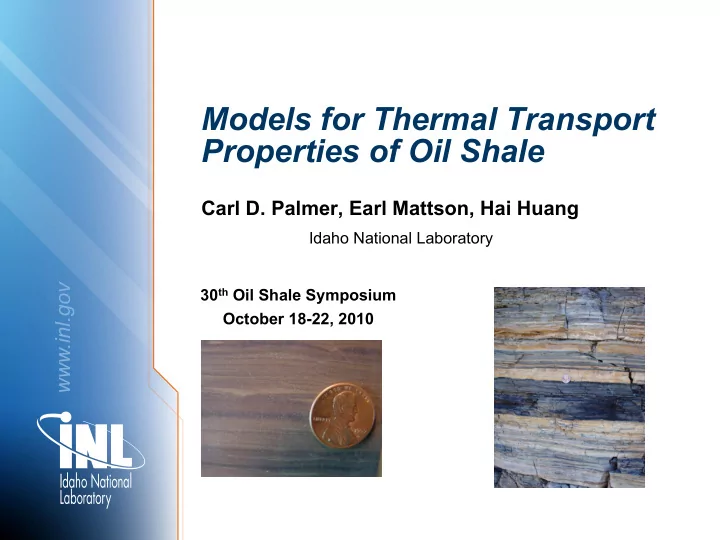
Models for Thermal Transport Properties of Oil Shale Carl D. Palmer, Earl Mattson, Hai Huang Idaho National Laboratory www.inl.gov 30 th Oil Shale Symposium October 18-22, 2010 Objective: To develop models of the thermal transport properties


slide-1
SLIDE 1

www.inl.gov

Models for Thermal Transport Properties of Oil Shale

Carl D. Palmer, Earl Mattson, Hai Huang

30th Oil Shale Symposium October 18-22, 2010 Idaho National Laboratory
slide-2
SLIDE 2

Objective:

To develop models of the thermal transport properties of

  • il shale as a function of temperature and grade.

Approach:

  • Combine heat capacity data of oil shale components

(minerals, kerogen, coke)

  • Develop theoretical and empirical approaches for

estimating thermal conductivity values as a function of temperature and grade

  • Compare the thermal conductivity of oil shale with

models of binary mixtures

slide-3
SLIDE 3

Heat Capacity of Oil Shale

  • Applied law of additivity of heat capacities:
  • Heat capacity is a weighted sum of the heat capacities of the

minerals and organic fractions in the formation. Cp(oil shale) = f(minerals) Cp(minerals) + f(kerogen) Cp(kerogen) + f(char)Cp(Char)

  • f(kerogen) and f(char) are changing during retorting. This

change can simulated with first-order reaction of kerogen and a proportionate increase in char.

slide-4
SLIDE 4

Heat Capacity of Oil Shale

slide-5
SLIDE 5

For insulators above the Debye temperature:

( )

3 4 2 2

2 2 1

/

e

D

x T B B total x

k k T x dx v h e

θ

π λ τ λ τ π ⎛ ⎞ ⎛ ⎞ = ⎜ ⎟ ⎜ ⎟ ⎝ ⎠ ⎝ ⎠ −

For Umklapp (U) processes:

2

1

/

D

B T U

A Te

θ

ω τ

=

Therefore:

( )

5 1 3 2

1

( ) /

e

D

B x T x D

x T dx e

θ

λ ξ λ ξ θ

+

= −

Thermal Conductivity -- Theory

slide-6
SLIDE 6

1 2 2

1 1 1 2 1 2

( )

( ) (( ) / ) ( / )

B x x

e B x B x e x x

+

≈ + + + + − ≈ − ≈ +

Simplify by using the approximations: Substitute the approximations:

( )

3 2 3 2 2

1 1 1 1 4

/

( ( ) (( ) ) ) /

D T

D

x B x B x T dx x x

θ

λ ξ λ ξ θ + + + + + + = + + + +

Integrate and Simplify:

1 8 16

D D

T a bT θ ξ θ ξ λ θ = = = = + + + +

Thermal Conductivity -- Theory

slide-7
SLIDE 7

Horizontal Thermal Conductivity of Oil Shale

r2 = 0.939

850 750 650 550 450 350 Temperature (K) 100 80 60 40 20 Grade (gal/ton) 0.5 1 1.5 2 2.5 3 3.5

1

h

a bT cG λ = + + + +

Data from: Wang et al. (1979), Pratt and O-Brien (1975), Tihen et al. (1968), Nottenburg et al. (1978), Sladek (1970), Dindi et al. (1989), Wang et al. (1979b), Clauser and Huenges (1995)

slide-8
SLIDE 8

Ratio of Coefficients:

2

D

a b θ =

We can there estimate an effective Debye temperature for

  • il shale:

Oil shale 110K Calcite 261K Deines (2004) Crude Oil 98K Singh et al. (2006)

Thermal Conductivity -- Theory

slide-9
SLIDE 9

Vertical Thermal Conductivity of Oil Shale

r2 = 0.911

Data from: Wang et al. (1979), Pratt and O-Brien (1975), Tihen et al. (1968), Nottenburg et al. (1978), Sladek (1970), Dindi et al. (1989), Wang et al. (1979b), Clauser and Huenges (1995) 850 750650550450350 Temperature (K) 100 80 60 40 20 Grade (gal/ton) 0.5 1 1.5 2 2.5 3 3.5

1

v

a bT cG λ = + + + +

slide-10
SLIDE 10

200 300 400 500 600 700 T(K) 10 20 30 40 50 60 70 80 G (gal/ton) 0.95 1 1.05 1.1 1.15 1.2 1.25 1.3 Anisotropy

Anisotropy of Thermal Conductivity of Oil Shale

slide-11
SLIDE 11

Density (g/cm3)

1.5 1.7 1.9 2.1 2.3 2.5 2.7

Fischer Assay (gpt)

20 40 60 80

¡

min

291.118 291.118

sh

a FA a ρ = − ρ r2 = 0.9496 r

min= 2.676 ±0.039 g/cm3

a = 0.350 ±0.020 cm3/g

¡

min ker

a α = ρ − ρ − ρ

Data from Pratt and O’Brien (1975)

Fischer Assay versus Density

slide-12
SLIDE 12

0 68 (Palmer & Mattson) Mass of carbon in oil . Mass of carbon in kerogen

M

α = ≈

,ker ker ,

Volume of Oil Volume of kerogen

C M C oil

  • il

f f ρ α α α α ρ = = = =

min ker

a α ρ ρ ρ ρ = −

Substitute and solve for ρker: 1

min ker ,ker , C M C oil

  • il

a f a f ρ ρ α ρ = ⎛ ⎞ ⎛ ⎞⎛ ⎞ ⎛ ⎞ + ⎜ ⎟ ⎜ ⎟⎜ ⎟ ⎜ ⎟ ⎜ ⎟ ⎜ ⎟⎝ ⎠ ⎝ ⎠ ⎝ ⎠ ⎝ ⎠

Conversion Factor and Kerogen Density

slide-13
SLIDE 13

0 941

,ker ,

.

C C oil

f f =

3

(based on 4667 measurements, USGS 2009)

0 900 0 012 g/cm . .

  • il

ρ = ± = ±

3 ker

0.882 g/cm α = 0.693 ρ =

Sample Maturity Specific Gravity End of Diagenesis 0.814 Onset of Oil Window 0.995

Vandenbrouke and Largeau (2007)

For Type II Kerogens:

Conversion Factor and Kerogen Density

slide-14
SLIDE 14

Fischer Assay (gpt)

20 40 60 80 100

Kerogen Volume Fraction

0.0 0.2 0.4 0.6 0.8 1.0

a = 0.5 0.6 0.7 0.8

( )

291 118

ker min

.

sh

V FAa V FA a ρ α = +

Kerogen Volume Fraction

slide-15
SLIDE 15

Parallel Model Series Model Maxwell-Eucken 1 Flow parallel to layers Flow across to layers Low conductivity dispersed in continuous high conductivity material

1 1 2 2 avg

v v λ λ λ λ λ = + = +

1 1 2 2

1 / /

avg

v v λ λ λ λ λ = +

1 1 1 2 2 1 2 1 1 2 1 2

3 2 3 2

avg

v v v v λ λ λ λ λ λ λ λ λ λ λ λ λ λ λ + + = + +

Maxwell-Eucken 2 High conductivity dispersed in continuous low conductivity material

2 2 2 1 1 2 1 2 2 1 2 1

3 2 3 2

avg

v v v v λ λ λ λ λ λ λ λ λ λ λ λ λ λ λ + + = + +

Equivalent Media Theory Random distribution of components

1 2 1 2 1 2

2 2

avg avg avg avg

v v λ λ λ λ λ λ λ λ λ λ λ λ − − − − + = + = + + + +

Composition/Structure Models

slide-16
SLIDE 16

Volume Fraction of Kerogen

0.0 0.2 0.4 0.6 0.8 1.0

l

avg/l minerals 0.0 0.2 0.4 0.6 0.8 1.0

Parallel Maxwell-Eucken 1 Maxwell-Eucken 2 Series Effective Media Theory

Composition/Structure Models

slide-17
SLIDE 17

Volume Fraction of Kerogen

0.0 0.2 0.4 0.6 0.8 1.0

l

avg/l minerals 0.0 0.2 0.4 0.6 0.8 1.0

298 K

Fitted Surface Parallel to bedding Volume Fraction of Kerogen

0.0 0.2 0.4 0.6 0.8 1.0

l

avg/l minerals 0.0 0.2 0.4 0.6 0.8 1.0

298 K

Fitted Surface Perpendicular to bedding

Parallel to Bedding Perpendicular to Bedding

Comparison of Fitted and Theoretical Models

slide-18
SLIDE 18

Summary

For oil shale, we have

  • Developed a simple model for estimating heat capacity,
  • Demonstrated a theoretical basis for the temperature

dependence of thermal conductivity,

  • Developed a simple equation for estimating thermal

conductivity and thermal anisotropy as a function of temperature and grade,

  • Demonstrated that that the thermal conductivity does not follow

simple layered models of minerals and kerogen.