
SLIDE 1
Modelling the spectral evolution of Supernovae
- The JEKYLL code
Mattias Ergon
In collaboration with Claes Fransson, Anders Jerkstrand, Markus Kromer and Cecilia Kozma
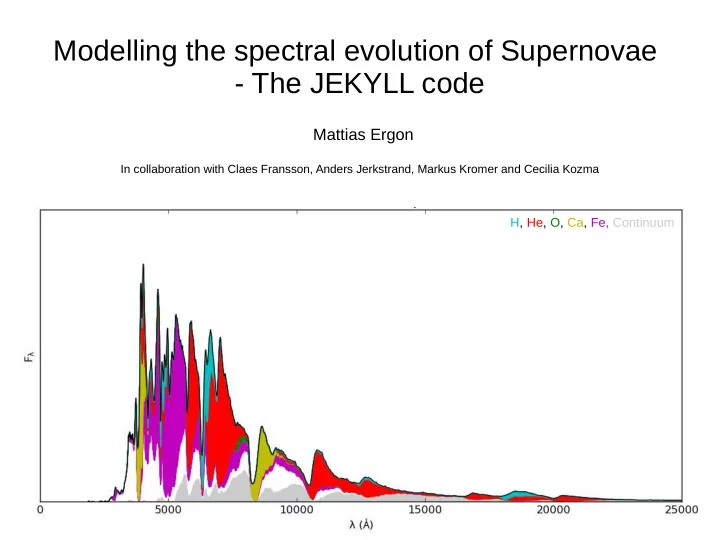
H, He, O, Ca, Fe, Continuum
Modelling the spectral evolution of Supernovae - The JEKYLL code - - PowerPoint PPT Presentation
Modelling the spectral evolution of Supernovae - The JEKYLL code Mattias Ergon In collaboration with Claes Fransson, Anders Jerkstrand, Markus Kromer and Cecilia Kozma H, He, O, Ca, Fe, Continuum The JEKYLL code What: Realistic* simulations of
Mattias Ergon
In collaboration with Claes Fransson, Anders Jerkstrand, Markus Kromer and Cecilia Kozma
H, He, O, Ca, Fe, Continuum
The JEKYLL code
What: Realistic* simulations of the spectral evolution and lightcurves of SNe in the photospheric and nebular phase. How: Full NLTE-solution for the matter and the radiation field, following (and extending) the MC method outlined by Leon Lucy (2002, 2003, 2005). Key ingredients: Non-thermal electrons and macroscopic mixing. * Restrictions: Homologous expansion. Spherical symmetry. Steady-state for the matter.
Electron temperature Thermal equilibrium Radiation field (MC) Radiative transfer Ion level populations Statistical equilibrium Matter Lambda iteration Non-thermal electrons Spencer-Fano equation Homologous expansion
Method outline
Time iteration
Other similar codes
SUMO (Jerkstrand et al. 2011)
Geometry: 1-D NLTE: Full Non-thermal ionization/excitation: Yes Time-dependence: No Macroscopic mixing: Yes Phase: Nebular
ARTIS (Kromer et al. 2009)
Geometry: 3-D NLTE: Ionization Non-thermal ionization/excitation: No Time-dependence: Radiation field Macroscopic mixing: Yes Phase : Photospheric
CMFGEN (Hillier 1998)
Geometry: 1-D NLTE: Full Non-thermal ionization/excitation: Yes Time-dependence: Full Macroscopic mixing: No Phase: All
JEKYLL (Ergon et al. In prep.)
Geometry: 1-D NLTE: Full Non-thermal ionization/excitation: Yes Time-dependence: Radiation field Macroscopic mixing: Yes Phase: All
SEDONA (Kasen et al. 2006)
Geometry: 3-D NLTE: No Non-thermal ionization/excitation: No Time-dependence: Radiation field Macroscopic mixing: Yes Phase : Photospheric
Comparisons
SUMO ARTIS CMFGEN
In progress. T.B.D.
Nebular spectra model 13G Early lightcurves for model 12C
C/O He H 56Ni
Application to a Type IIb model
MEj=1.7 M⊙ MNi=0.075M⊙
Evolved through the early phase with JEKYLL in Ergon et al. (In prep.) Preferred model for SN 2011dh from Jerkstrand et al. (2015), where it was evolved through the nebular phase with SUMO.
EK=6.8×10
50 erg
MIn=12M⊙
Type IIb model: Spectral evolution
Model: Before 150 days H, He, O, Ca, Fe, Continuum
Comparison to SN 2011dh: Spectral evolution
Model and SN 2011dh – Before 150 days
Comparison to SN 2011dh: Lightcurves
Model (circles) and SN 2011dh (crosses): Before 150 days
Effect of NLTE: Bolometric lightcurve
Model 12C : 3-100 days Model: Before 100 days
Non-thermal ionization/excitation - Off Model 12C : 3-100 days Model: Before 100 days
Effect of NLTE: Bolometric lightcurve
NLTE excitation - Off Non-thermal ionization/excitation - Off Model 12C : 3-100 days Model: Before 100 days
Effect of NLTE: Bolometric lightcurve
Effect of NLTE: Spectral evolution
Non-thermal ionization/excitation - On/Off
LTE + Opacity floor (HYDE) Model 12C : 3-100 days Model: Before 100 days
Effect of NLTE: Bolometric lightcurve
LTE + Opacity floor (HYDE) Model 12C : 3-100 days Arnett (1982) + Popov (1991) Model: Before 100 days
Effect of NLTE: Bolometric lightcurve
HYDE opacity floor : 0.024, 0.05, 0.1, 0.15, 0.2 cm gram Model 12C : 3-100 days Model 12C : 3-100 days Model: Before 100 days
Effect of NLTE: Bolometric lightcurve
2
Microscopic Mixing
Effect of mixing: Bolometric lightcurve
Macroscopic Mixing Model: Before 100 days
Effect of mixing: Spectral evolution
Macroscopic mixing - On/Off