Regional Meetings Report American Sportfishing Association SAFMC - - PowerPoint PPT Presentation

regional meetings report
SMART_READER_LITE
LIVE PREVIEW

Regional Meetings Report American Sportfishing Association SAFMC - - PowerPoint PPT Presentation

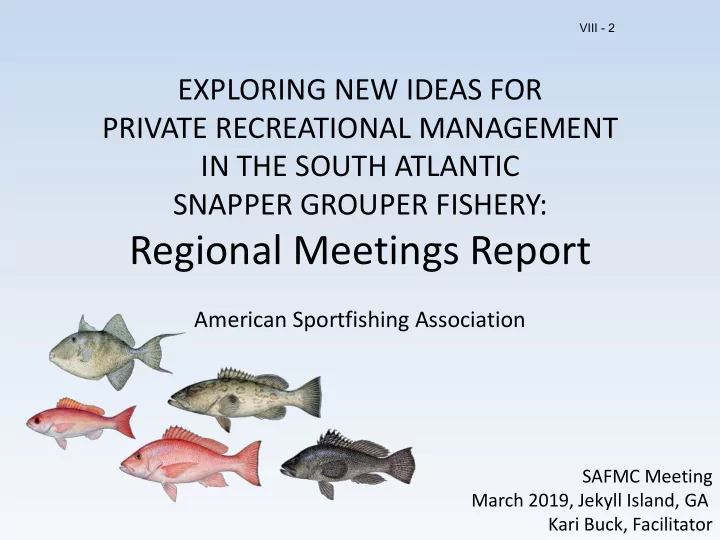
VIII - 2 EXPLORING NEW IDEAS FOR PRIVATE RECREATIONAL MANAGEMENT IN THE SOUTH ATLANTIC SNAPPER GROUPER FISHERY: Regional Meetings Report American Sportfishing Association SAFMC Meeting March 2019, Jekyll Island, GA Kari Buck, Facilitator


slide-1
SLIDE 1

SAFMC Meeting March 2019, Jekyll Island, GA Kari Buck, Facilitator

EXPLORING NEW IDEAS FOR PRIVATE RECREATIONAL MANAGEMENT IN THE SOUTH ATLANTIC SNAPPER GROUPER FISHERY:

Regional Meetings Report

American Sportfishing Association

VIII - 2

slide-2
SLIDE 2

Presentation Outline

  • Background
  • Council Workshop
  • Regional Meetings
  • Meeting Summaries
  • Angler Preferences & Seasonality
  • Harvest Rate Management
  • Harvest Tags Application
  • Recreational Stamp & Reporting
  • Barotrauma Reduction
  • Recommendations
slide-3
SLIDE 3

Project Overview

  • American Sportfishing Association, Yamaha Marine Group

and Coastal Conservation Association

  • Council Workshop (September 2018)
  • Discussion and feedback on approaches for regional

meetings

  • Regional Meetings (Fall/Winter 2018/2019)
  • Recreational representative feedback
  • Recommendations (March 2019)
  • Recommended actions for Council consideration
slide-4
SLIDE 4

Sept 2018 Council Workshop

  • Council discussed approaches for input at regional meetings
  • Outcome
  • Harvest rate management
  • Harvest tags for certain deepwater species
  • Seasonal management
  • Regional differences
  • Electronic recreational reporting
  • Recreational registration or stamp
  • Release mortality reduction
slide-5
SLIDE 5

Regional Meetings

PURPOSE

  • Information about each area’s

needs and characteristics

  • Angler input on the potential

approaches November 2018 – January 2019

  • Ladson, SC
  • Brunswick, GA
  • St. Augustine, FL
  • West Palm Beach, FL
  • Greenville, NC
slide-6
SLIDE 6

Angler Preferences and Regional Variation

  • What makes a good fishing trip?
  • Catch a lot of fish, keep enough to make the trip worthwhile
  • ‘Enough’ fish = one trophy fish to keep and some to take home
  • Sufficient opportunity to go fishing when it best suits the angler
  • Important species: Red snapper, gag grouper, vermilion snapper,

black sea bass and gray triggerfish

  • A variety of harvestable fish allows anglers to keep “enough” fish by

switching target species Restrictions on red snapper affect trip satisfaction due to discards and having to avoid red snapper to catch other species

slide-7
SLIDE 7

Angler Preferences and Regional Variation

  • Seasonality
  • Snapper grouper trips occur all year
  • Variation in season peak across

region due to weather and access to popular species

  • Economic Benefits to Local Businesses
  • Red snapper seasons illustrate

economic benefit of popular species

  • Boat manufacturers and gear/tackle

businesses have reduced inventory

  • Regional Variation
  • Each area is different based on

distance to fishing grounds, weather, and number of fishable days

slide-8
SLIDE 8

Harvest Rate Management Overview

  • Uses exploitation rate targets to reach a desired rate of

removal and stock biomass level

  • Approach focuses on how Council monitors and responds to

changes, and adjusts management to reach established targets

  • Allows response to changes in recreational effort and fish

populations using most recent information

  • Provides more stability and predictability
  • Example: ASMFC Striped Bass
slide-9
SLIDE 9

Harvest Rate Management Summary

  • Anglers were supportive of the outcomes of this approach

(i.e., more predictability and management flexibility)

  • Overall, meeting participants felt that science and

management aligned with fishery conditions

  • Except red snapper
  • While HRM may not be a

priority approach for most species, it could be a useful tool to explore for future applications to important species

slide-10
SLIDE 10

Harvest Tags Overview

  • Tags issued for each fish to be harvested, examples in

game management

  • Likely more appropriate for species with low ACLs or

naturally low abundance

  • Can be used to improve data collection or control effort
  • Challenges:
  • Fairness in how to distribute tags
  • Potential to restrict access for active participants

Potential for a pilot program to allow for selective distribution and # tags higher than the ACL

slide-11
SLIDE 11

Harvest Tags Summary

  • Discussion focused on tags for certain deepwater species
  • Anglers were supportive of harvest tags in limited applications
  • Other comments:

– Most anglers do not target deepwater species, therefore, potential participants in a tag program would be self-limiting – Tags should be available to all anglers – Some kind of effort by the angler should be required to limit tag recipients to only interested anglers – Reporting should be required for each tag received, successful or not – Current management measures like bag/vessel limits would need to be reviewed and possibly modified

  • Tags and reporting would likely not be a burden to anglers who target

these species

  • Some anglers commented on the potential for red snapper tags as a way

to extend the season length, while others did not support this due to the additional burden on anglers and concerns about how to allocate

slide-12
SLIDE 12

Recreational Registration/Stamp Overview

  • Registration or stamp through states for anglers targeting snapper

grouper species

  • Open access (no limit)
  • Better understand the number of anglers in the fishery
  • Could be used for voluntary or selective reporting requirements
slide-13
SLIDE 13

Recreational Reporting Overview

  • Could be used to supplement MRIP data
  • SAFMC is considering reporting for recreational

anglers

  • Existing platform

(MyFishCount app)

slide-14
SLIDE 14

Registration and Reporting Summary

  • Anglers were supportive of registration or a stamp to define the “universe”

targeting snapper grouper species.

  • Anglers were supportive of recreational reporting.
  • Recreational registration/stamp should be a simple process, but also

require some kind of effort to improve accuracy

  • Registration through a state recreational license would be the most

straight-forward way to implement

  • Anglers will be more likely to report if they understand how the data will

be used and if they do not feel that the data will result in more restrictions

  • Anglers may be more likely to comply with reporting for popular species
  • Complicated and lengthy reporting may be too much of a burden for

most anglers and could result in inaccurate data

  • Acceptance of reporting will take time as anglers become familiar with the

process and the benefits of additional data

slide-15
SLIDE 15

Release Mortality Reduction Overview

SAFMC is considering mandatory descending devices, venting tools, and circle hooks for recreational anglers

slide-16
SLIDE 16

Release Mortality Reduction Summary

  • Anglers were supportive of methods and tools to reduce

barotrauma

  • Many anglers do not use venting tools or descending devices, but

the number is increasing as anglers become more aware

  • Venting tools may not be used correctly by some anglers, even

though these tools are easier and quicker to use than a descending device

  • Manufactured descending devices may be too expensive for some

anglers, which may reduce compliance

  • A regulatory requirement may be beneficial to increase use of

venting tools or descending devices, but education and outreach will be key to improving acceptance and voluntary use

  • Using tools and methods to reduce barotrauma will take time to

become common practice for all anglers

slide-17
SLIDE 17

Final Recommendations

  • The Council should consider regional regulations for appropriate

species

  • The Council should continue to explore harvest rate management for

high value snapper grouper species, especially for red snapper

  • The Council could consider an Exempted Fishing Permit for a pilot

program to test harvest tags for certain deepwater species (i.e.,those with low annual catch limits or low abundance)

  • The Council should work with state partners to establish a

registration for anglers targeting snapper grouper species, with consistency across all states

  • The Council should continue development of Snapper Grouper

Amendment 46 to implement required or selective reporting for recreational anglers and continue outreach on benefits of providing data

  • The Council should continue development of Snapper Grouper

Amendment 29 to require use of descending devices or venting tools, along with other best fishing practices, to reduce release mortality
slide-18
SLIDE 18

Thank you to the hosts of our meeting locations and to the participants. Questions?