Mission I-SOC: An optical clock on the ISS Coordinator: S. Schiller - - PowerPoint PPT Presentation

mission i soc an optical clock on the iss
SMART_READER_LITE
LIVE PREVIEW

Mission I-SOC: An optical clock on the ISS Coordinator: S. Schiller - - PowerPoint PPT Presentation

Mission I-SOC: An optical clock on the ISS Coordinator: S. Schiller (Univ. Dsseldorf) U. Sterr Ch. Lisdat R. Le Targat J. Lodewyck Y. Singh K. Bongs N. Poli G.M. Tino F. Levi I. Prochazka Prelude When ACES was proposed in 1997


slide-1
SLIDE 1

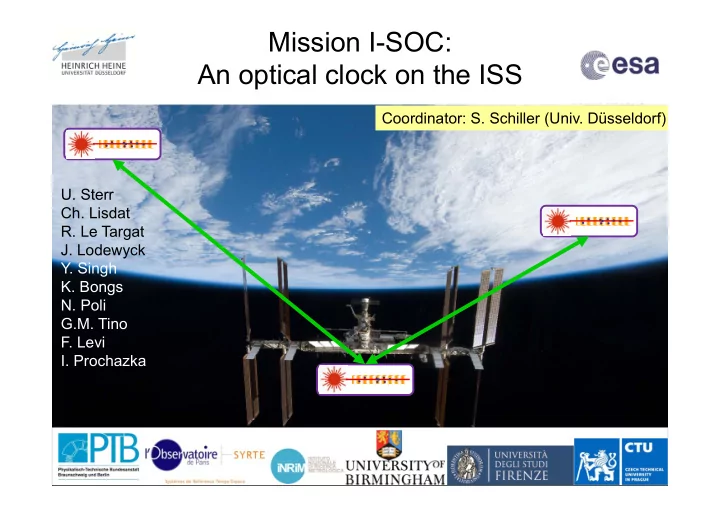
Mission I-SOC: An optical clock on the ISS

Coordinator: S. Schiller (Univ. Düsseldorf)

  • U. Sterr
  • Ch. Lisdat
  • R. Le Targat
  • J. Lodewyck
  • Y. Singh
  • K. Bongs
  • N. Poli

G.M. Tino

  • F. Levi
  • I. Prochazka
slide-2
SLIDE 2

Prelude

When ACES was proposed in 1997 …

Review: Poli et al. Nuovo Cimento (2013) Ludlow et al. RMP (2015)

… Optical clocks were appearing in a few labs – primarily single-ion clocks … transportable clocks of high accuracy were a dream … the frequency comb did not exist … long-distance clock comparisons at 10-19 level were a dream … robust lasers for visible wavelengths and high power were just appearing

slide-3
SLIDE 3

Going optical

  • For ACES, optical ground clocks, combs and links now are a key mission

component

  • However, the impressive progress of ground clock performance calls for a

post-ACES means of comparing them

  • Improvements in ground and space technology (revolutionary & evolutionary)

allow improvement by 10 – 100 in science output compared to ACES

  • … leveraging on ACES heritage, we expect a cost smaller than that of ACES
  • Systematic errors understanding must improve correspondingly -> optimistic

perspective (talk by P. Wolf)

  • It is important to develop the I-SOC clock and to implement I-SOC within a

reasonable time following ACES, in order to maintain its know-how and heritage (technology, clock operations, MWL operations, data analysis, …)

  • S. Schiller, ACES Workshop Zürich, 29.-30. 6. 2017
slide-4
SLIDE 4

From ACES to I-SOC

Space lattice clock (SLOC) Upgraded ELT (ELT+) Upgraded MWL (MWL) Optical cavity + laser („clock laser“, OSRC) Laser bench

  • Same location, similar system concept, but optical
  • As in ACES, OSRC is the local oscillator;

is steered to the atoms on the long time scale

  • In contrast to ACES, SLOC contains no own oscillator
  • Frequency comb is phase-locked to clock laser
  • FDP contains a USO for backup
  • No frequency-comb based optical link (cost, mass & power)

Space frequency comb (SFC)

429 THz 10 GHz 100 MHz

slide-5
SLIDE 5

ACES and I-SOC

  • ACES actual/estimated performance vs. I-SOC requirements

* from I-SOC ESR document

  • I-SOC clock signal shall be phase-coherent → requirement to comb and SLOC
  • ELT+ supports reaching 1×10-18 ground clock comparisons (or ground-space)
  • I-SOC performance can be tested fully on the ground (trapped atoms)

ACES I-SOC * Improvem.

Clock instability 1x10-13/1/2 8 x 10-16/1/2 (up to 2×10⁶ s) x 100 Clock inaccuracy 1x10-16 1x10-17 x 10 MWL / MWL+ 1.5 ps ×(/10 000 s)1/2 0.03 ps ** x 150 @ 1 day ELT / ELT+ 8 ps @ 106 s 1 ps @ 106 s x 8 Phase coherence yes yes, minimum 12 h

** ground-to-space

slide-6
SLIDE 6

Consequences of I-SOC performance

  • Higher stability of ELT+ and MWL

both allow clock comparisons at 10-18 level AND within quiet ISS orbit intervals AND more quiet intervals to make use of

  • Higher stability of MWL and transportable high-performance optical clocks:

allow doing geodetic surveys at 1 cm level (pairs of optical clocks compared in common-view), hundreds of field points

  • Higher stability of space clock:

allows measuring its systematic effects in-situ more precisely

slide-7
SLIDE 7

Ground stations

  • Heritage from ACES
  • (I) MWL ground stations: stationary & transportable
  • (II) Ground stations with ELT+

For intercontinental clock comparisons: At least two SLR stations with ELT+, each with optical clock linked to it possibilities: Wettzell + future optical link to PTB Graz + transportable optical clock Yarragadee + link to UWA NICT (Tokio) + optical clocks Matera? US? For systematic tests: MWL and ELT+ at same SLR station with common linked ground clock Contributions welcome!

slide-8
SLIDE 8

Mission I-SOC (Space Optical Clock on ISS)

  • Scientific goals: (*)

measure Earth‘s gravitational time dilation at 2 x 10⁻⁷ level measure Sun‘s time dilation at 1 x 10⁻⁶ level measure Moon‘s time dilation at 2 x 10⁻⁴ level enable world-wide relativistic geodesy enable world-wide atomic time distribution enable world-wide clock comparisons search for dark matter topological defects

  • Natural follow-on of ACES mission
  • Mission of ESA in SciSpacE program; potential launch in 2022+

Optical lattice clock (SLOC) inaccuracy: <1 x 10-17; instability: <1 x 10-15/1/2 mass < 100 kg, power consumption < 250 W, volume < 0.5 m3 MWL: current ESA study (SYRTE, DLR, Timetech) ELT+: Ivan Prochazka‘s talk SFC:

  • M. Lezius‘ talk

Data analysis:

  • P. Wolf‘s talk
slide-9
SLIDE 9

SOC breadboard demonstrator development (2010-15)

Reference cavity Clock laser breadboard Atomic unit

slide-10
SLIDE 10

CLEO/Europe-EQEC 2017, Munich 29/06/17 10

Laser cooling and trapping Sr

I I

z x y z x y

T=3mK 3×10⁶ atoms

T<2μK 1×10⁶ atoms

103 atoms T=1.3 μK = 6.5 s

Blue MOT (461 nm) Red MOT (689 nm) Optical lattice (813 nm)

I I

  • S. Schiller, ACES Workshop Zürich, 29.-30. 6. 2017
slide-11
SLIDE 11

CLEO/Europe-EQEC 2017, Munich 29/06/17 11

Modular laser system

461 nm 461 nm distribution 813 nm lattice 698 nm clock laser Reference cavity 461, 689, 813 nm stabilization unit Repumper 679 nm Repumper 707 nm 689 nm cooling 689 nm stirring

  • S. Schiller, ACES Workshop Zürich, 29.-30. 6. 2017
slide-12
SLIDE 12

CLEO/Europe-EQEC 2017, Munich 29/06/17 12

Modular laser system

461 nm 461 nm distribution 813 nm lattice 698 nm clock laser Reference cavity 461, 689, 813 nm stabilization unit Repumper 679 nm Repumper 707 nm 689 nm cooling 689 nm stirring

  • Relies on robust, mostly COTS, laser technology
  • Units are exchangeable with improved ones

Bongs, K. et al., “Development of a strontium optical lattice clock for the SOC mission on the ISS”, C. R. Phys. 16, 553 (2015)

  • S. Schiller, ACES Workshop Zürich, 29.-30. 6. 2017
slide-13
SLIDE 13

CLEO/Europe-EQEC 2017, Munich 29/06/17 13

SOC: compact atomics package

  • S. Schiller, ACES Workshop Zürich, 29.-30. 6. 2017
slide-14
SLIDE 14

CLEO/Europe-EQEC 2017, Munich 29/06/17 14

Low power (20 W) atomic oven1

  • 1M. Schioppo et al., Rev. Sci. Instrum. 83, 103101 (2012)

SOC: compact atomics package

  • S. Schiller, ACES Workshop Zürich, 29.-30. 6. 2017
slide-15
SLIDE 15

CLEO/Europe-EQEC 2017, Munich 29/06/17 15

Permanent-magnets Zeeman slower2 Low power (20 W) atomic oven1

  • 1M. Schioppo et al., Rev. Sci. Instrum. 83, 103101 (2012)
  • 2I. R. Hill et al., J. Phys. B 47, 075006 (2014)

SOC: compact atomics package

  • S. Schiller, ACES Workshop Zürich, 29.-30. 6. 2017
slide-16
SLIDE 16

CLEO/Europe-EQEC 2017, Munich 29/06/17 16

Permanent-magnets Zeeman slower2 Low power (20 W) atomic oven1

Vacuum chamber

  • 1M. Schioppo et al., Rev. Sci. Instrum. 83, 103101 (2012)
  • 2I. R. Hill et al., J. Phys. B 47, 075006 (2014)

SOC: compact atomics package

  • S. Schiller, ACES Workshop Zürich, 29.-30. 6. 2017
slide-17
SLIDE 17

CLEO/Europe-EQEC 2017, Munich 29/06/17 17

Permanent-magnets Zeeman slower2 Low power (20 W) atomic oven1

Vacuum chamber

  • 1M. Schioppo et al., Rev. Sci. Instrum. 83, 103101 (2012)
  • 2I. R. Hill et al., J. Phys. B 47, 075006 (2014)

Small coils (5 W, no water cooling)

SOC: compact atomics package

  • S. Schiller, ACES Workshop Zürich, 29.-30. 6. 2017
slide-18
SLIDE 18

CLEO/Europe-EQEC 2017, Munich 29/06/17 18

Permanent-magnets Zeeman slower2 Low power (20 W) atomic oven1

Vacuum chamber

  • 1M. Schioppo et al., Rev. Sci. Instrum. 83, 103101 (2012)
  • 2I. R. Hill et al., J. Phys. B 47, 075006 (2014)

Small coils (5 W, no water cooling)

TECs (5W) + Heat pipes Temperature stabilization system (goal ∆T<100 mK)

SOC: compact atomics package

  • S. Schiller, ACES Workshop Zürich, 29.-30. 6. 2017
slide-19
SLIDE 19

CLEO/Europe-EQEC 2017, Munich 29/06/17 19

Birmingham Eurotunnel Braunschweig (PTB)

Atomic package transport (June 2015)

  • S. Schiller, ACES Workshop Zürich, 29.-30. 6. 2017
slide-20
SLIDE 20

CLEO/Europe-EQEC 2017, Munich 29/06/17 20

Clock laser integration

  • S. Schiller, ACES Workshop Zürich, 29.-30. 6. 2017

Świerad et al., Sci. Rep. 6, 33973 (2016)

slide-21
SLIDE 21

CLEO/Europe-EQEC 2017, Munich 29/06/17 21

Clock laser integration

FWHM = 32 Hz

  • 200
  • 100

100 200 0.00 0.05 0.10 0.15 0.20 0.25 0.30 Detuning (Hz) Excitation probability

  • S. Schiller, ACES Workshop Zürich, 29.-30. 6. 2017

Świerad et al., Sci. Rep. 6, 33973 (2016)

slide-22
SLIDE 22

Characterization of the SOC breadboard demonstrator

Stefano Origlia, Mysore Srinivas Pramod, Stephan Schiller (Universität Düsseldorf) Yeshpal Singh, Sruthi Viswam, Kai Bongs (University of Birmingham) Sebastian Häfner, Sofia Herbers, Sören Dörscher, Ali Al-Masoudi, Roman Schwarz, Uwe Sterr, and Christian Lisdat (PTB Braunschweig)

H2020

slide-23
SLIDE 23

Physics package Reference cavity Control electronics Clock laser electronics

  • S. Origlia

Pramod M.S.

I-SOC clock breadboard demonstrator: current set-up

Laser modules S.Origlia et al., Proc. SPIE 9900, 990003 (2016);http://arxiv.org/abs/1603.06062

470 kg 1.1 kW, 2000 liter

slide-24
SLIDE 24

CLEO/Europe-EQEC 2017, Munich 29/06/17 24

Isotopic aboundance: 83% Laser cooling easier Shorter cycle time (2 interrogations) Insensitive to vector and tensor light shift Need for magnetically induced spectroscopy: 1) Large magnetic field 2) Large clock laser beam intensity S-wave collisions

88Sr (boson) vs. 87Sr (fermion)

Isotopic aboundance: 7% Nuclear spin (I = 9/2): laser cooling more complicated (1 more laser) 1st order Zeeman shift (4 interrogations) Sensitive to vector and tensor light shift Hyperfine interaction allows 1S0-3P0 transition Only p-wave collisions

88Sr 87Sr

May have advantages in terms of simplicity and for transportability Better for accuracy

Isotope shift: fundamental physics test (e.g. atomic Higgs force1)

  • 1C. Delaunay et al., arXiv:1601.05087
  • S. Schiller, ACES Workshop Zürich, 29.-30. 6. 2017
slide-25
SLIDE 25

CLEO/Europe-EQEC 2017, Munich 29/06/17 26

With stationary cavity1,2 (PTB)

Clock transition line in 88Sr (698 nm)

  • 1D. G. Matei et al., J. Phys. Conf. Ser., 723, 012031 (2016)
  • 2D. G. Matei et al., arXiv:1702.04669
  • 3Ch. Lisdat et al., PRL 103, 090801 (2009)

Control of collisional broadening3: use << 1 atom per lattice site Long interrogation time: 4 s (Fourier-limited linewidth)

4 a.u. 8 a.u. 16 a.u. 24 a.u. 36 a.u.

  • 20
  • 10

10 20 0.0 0.2 0.4 0.6 0.8 Frequency detuning (Hz) Excitation probability

Collisional broadening (lineshape vs. number of atoms)

  • 1.5
  • 1.0
  • 0.5

0.0 0.5 1.0 1.5 0.0 0.1 0.2 0.3 0.4 0.5 0.6 Detuning (Hz) Excitation probability FWHM = 220 mHz

FWHM = 220 mHz

  • S. Schiller, ACES Workshop Zürich, 29.-30. 6. 2017
slide-26
SLIDE 26

CLEO/Europe-EQEC 2017, Munich 29/06/17 28

Combined instability of the two clocks: 4.2 × 10⁻¹⁶/√ Lowest instability: 3×10-18 at = 2×10⁴ s

Clock instability

  • 1S. Falke et al., New J.
  • Phys. 16, 073023 (2014)
  • 2A. Al-Masoudi et al.,
  • Phys. Rev. A 92,

063814 (2015)

3 × 10-18 SOC clock locked continuously to atoms for 74 hours

I-SOC goal specification: 8 × 10-16/√

Instability determined by comparison with 87Sr clock at PTB1,2

  • Tot. averaging time:

102 000 s

  • S. Schiller, ACES Workshop Zürich, 29.-30. 6. 2017
slide-27
SLIDE 27

CLEO/Europe-EQEC 2017, Munich 29/06/17 31

Preliminary uncertainty budget

ν(88Sr) – ν(87Sr) = 62 188 134.035(65) Hz Recently published values: ν(88Sr) – ν(87Sr) = 62 188 134.004(10) Hz1 ν(88Sr) – ν(87Sr) = 62 188 134.9(1.9) Hz2

  • 1T. Takano, et al., Appl. Phys. Express 10, 072801 (2017)
  • 2C. Radzewicz, et al., Phys. Scr. 91, 084003 (2016)

Effect Correction Uncertainty

BBR chamber 495.8 0.7 BBR oven Scalar lattice shift <10 Collisional shift 0.3 0.3 Probe light shift 130.7 <5 2nd-order Zeeman shift 168.9 <10 DC Stark shift <2 Total 795.4 <15

× 10-17

PRELIMINARY

Expect to improve soon to low 10-17 level × 10-17

  • S. Schiller, ACES Workshop Zürich, 29.-30. 6. 2017
slide-28
SLIDE 28

Summary - I

  • Transportable cold-atom lattice clock apparatus

(2 racks, 1.1 kW)

  • Successful transport from

Birmingham (UK) to Braunschweig (D)

  • Ultra-narrow clock

transition in 88Sr

  • bserved:

220 mHz width

  • 1.5- 1.0- 0.5 0.0 0.5 1.0 1.5

0.0 0.1 0.2 0.3 0.4 0.5 0.6 Detuning (Hz) Excitation probability

  • Ultra-low instability bosonic clock:

<3×10-16/√ and 3×10-18 at 2 × 10⁴ s

Total deviation, σTOT(τ) 10-18 10-17 10-16 100 101 102 103 104 105 Averaging time, τ (s)

  • Preliminary uncertainty: 1.5 ×10⁻¹⁶
  • System concept is suitable for space clock
  • Soon: low 10-17 – level inaccuracy; 87Sr
slide-29
SLIDE 29

Summary - II

  • I-SOC breadboard demonstrator is a testbed for new laser units
  • I-SOC breadboard will be developed further to become a transportable high-

performance clock during the ACES mission

  • I-SOC is technically feasible
  • I-SOC is a test bed for quantum sensors, future clocks and links: Europe has

the chance to remain at the forefront quantum technology in space and its applications

  • I-SOC is strategic
  • will generate new research opportunities for a world-wide

community of scientists across fields

  • will introduce a new technology step
  • future clocks will be based on its technology

(upgrade/downgrade of performance can be traded off with mass, power, volume)

  • is part of a long roadmap of quantum technology in space

(10 x improvements in accuracy, lifetime, distance ea. 10 years)

  • S. Schiller, ACES Workshop Zürich, 29.-30. 6. 2017
slide-30
SLIDE 30

I-SOC: way forward

1) ESA technology developments 2016-2018:

  • 462 nm, 689 nm lasers

[Fraunhofer UK, TopGaN,CNR,HHU]

  • CCU: laser frequency stabilization system

[NPL UK, PTB]

  • 813 nm lattice laser

[Fraunhofer UK, SYRTE]

  • Clock laser reference cavity (698 nm)

[Airbus F‘hafen, NPL, SpaceTech, PTB]

  • Two-way microwave link

[Timetech,DLR Oberpf.,SYRTE]

2) Experiment Science Document 2/2017 [Science team] 3) Phase-A study, scientific part 2017 [Science team] 4) Phase-A study, industrial part 2018 [space industry, Science team] 5) Phases B, C 2019+ [space industry, Science team] Mission 2022+

New approach by ESA: Science team is strongly involved in all phases of mission development

  • S. Schiller, ACES Workshop Zürich, 29.-30. 6. 2017