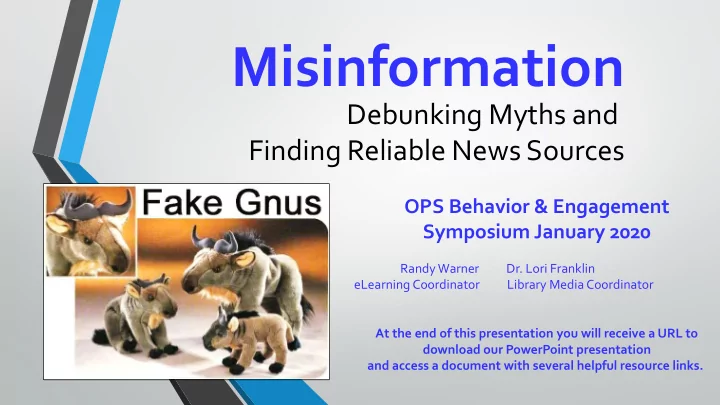
Misinformation Debunking Myths and Finding Reliable News Sources - - PowerPoint PPT Presentation

misinformation
SMART_READER_LITE
LIVE PREVIEW

Misinformation Debunking Myths and Finding Reliable News Sources - - PowerPoint PPT Presentation

Misinformation Debunking Myths and Finding Reliable News Sources OPS Behavior & Engagement Symposium January 2020 Randy Warner Dr. Lori Franklin eLearning Coordinator Library Media Coordinator At the end of this presentation you will


slide-1
SLIDE 1

Misinformation

Debunking Myths and Finding Reliable News Sources

OPS Behavior & Engagement Symposium January 2020

Randy Warner

  • Dr. Lori Franklin

eLearning Coordinator Library Media Coordinator At the end of this presentation you will receive a URL to download our PowerPoint presentation and access a document with several helpful resource links.

slide-2
SLIDE 2

MISINFORMATION

https://www.fredericknewspost.com/terms/special/cartoon/i-cannot-tell-a-lie/image_3712ebe0-f375-53fb-a4c2-3fa24e4dc383.html

slide-3
SLIDE 3

NBC Meet The Press; S 73; Ep 50; Dec 29, 2019

slide-4
SLIDE 4

Semantics Disinformation is false information spread deliberately to deceive. This is a subset of misinformation, which also may be unintentional.

  • Wikipedia

https://en.wikipedia.org/wiki/Disinformation

slide-5
SLIDE 5

The World Students Inhabit is Unclear

Stanford History Education Group: Civic Online Reasoning

https://www.youtube.com/watch?v=LHLBMTUvj60&feature=youtu.be

slide-6
SLIDE 6

Bill of Rights – 1st Amendment

  • Misinformation is protected (with limits) by the first amendment.
  • The first amendment protects you from government censorship, but

not censorship by other entities such as employers, social media, etc. Dec 15, 1791

slide-7
SLIDE 7

Limits on Freedom of Speech

  • Citizens cannot express their

freedoms at the same time they are infringing on the rights/ freedoms of other citizens.

  • Slander: Knowingly and

maliciously lying about someone.

  • Libel: Knowingly and

maliciously printing a lie about someone. (Hate speech is also protected.)

slide-8
SLIDE 8

NBC Meet The Press; S 73; Ep 50; Dec 29, 2019

slide-9
SLIDE 9

Limits on Freedom of Speech

60 Minutes Interview 12/1/2019 YouTube CEO Susan Wojcicki and the debate

  • ver Section 230

https://www.youtube.com/watch?v=rxdln3dXmTg

slide-10
SLIDE 10

I found it on the Internet

so it must be true.

slide-11
SLIDE 11

Maintaining a belief despite new information that firmly contradicts it. The human mind will go to great lengths to keep the peace. We don’t like being wrong and we don’t like the discomfort of relearning something.

https://science.howstuffworks.com/science-vs-myth/everyday-myths/why-people-believe-things-science-proved-untrue.htm

Why Do People Believe Things That Are Untrue?

Belief Perseverance

slide-12
SLIDE 12

The mental discomfort of facing inconsistency in

  • ne's thoughts, beliefs,

perceptions and/or behaviors.

Why Do People Believe Things That Are Untrue?

Cognitive Dissonance

https://science.howstuffworks.com/science-vs-myth/everyday-myths/why-people-believe-things-science-proved-untrue.htm

slide-13
SLIDE 13

We are more likely to believe (or seek or remember or even notice) the "facts" that support

  • ur current viewpoints, and less likely to believe

the ones that would require mental adjustment. The more deeply ingrained or self-defining or consequential the current viewpoint, the further the mind might go to ignore the new evidence that would disprove it. Attempts to debunk an irrational belief will tend instead to reinforce it, as the believer may have come to see his or her perseverance as heroic, as standing up to the "establishment“.

Why Do People Believe Things That Are Untrue?

Confirmation Bias

https://science.howstuffworks.com/science-vs-myth/everyday-myths/why-people-believe-things-science-proved-untrue.htm

slide-14
SLIDE 14

“Reinterpreting the evidence" involves analyzing any new facts in such a way as to support the original belief. When faced with overwhelming evidence individuals may determine "evidence" to be the product of a far-reaching medical, governmental, and corporate conspiracies.

Why Do People Believe Things That Are Untrue?

Denialism

https://science.howstuffworks.com/science-vs-myth/everyday-myths/why-people-believe-things-science-proved-untrue.htm

slide-15
SLIDE 15

Influence of the Internet: One can seek out "experts" who

support the irrational belief through pseudoscience, misinterpretations, misrepresentations, and logical fallacies. Those looking to maintain an irrational viewpoint need only perform a simple search to locate fellow believers, entire communities of them, and the "experts" who back it all up with appropriate jargon.

Why Do People Believe Things That Are Untrue?

https://science.howstuffworks.com/science-vs-myth/everyday-myths/why-people-believe-things-science-proved-untrue.htm

slide-16
SLIDE 16
slide-17
SLIDE 17
slide-18
SLIDE 18

Cognitive Ability: How well a person can regulate the contents of working

memory – their “mental workspace” for processing information.

  • ..some people are more prone to “mental clutter” than other people. In other

words, some people are less able to discard (or “inhibit”) information from their working memory that is no longer relevant to the task at hand - or… information that has been discredited.

  • …correlates highly with education. Through education, people may develop

meta-cognitive skills - strategies for monitoring and regulating one’s own thinking - that can be used to combat the effects of misinformation.

  • Research on cognitive aging indicates that, in adulthood, this ability declines

considerably with advancing age, suggesting that older adults may also be especially vulnerable to [misinformation].

Why Do People Believe Things That Are Untrue?

https://www.scientificamerican.com/article/cognitive-ability-and-vulnerability-to-fake-news/

slide-19
SLIDE 19

Research published in the journal PLOS ONE, 2009: Overall, there [is] greater brain activation that persist[s] for longer during states of disbelief. Greater brain activation requires more cognitive resources, of which there is a limited supply. What these findings show is that the mental process of believing is simply less work for the brain, and therefore often favored. The default state of the human brain is to accept what we are told, because doubt takes

  • effort. Belief, on the other hand, comes easily.
  • Bobby Azarian, neuroscientist affiliated with George Mason University

Neuroscience

https://www.rawstory.com/2019/12/a-neuroscientist-explains-why-christian-evangelicals-are-wired-to-believe- donald-trumps-gaslighting-lies/?fbclid=IwAR3H0aJzCtDIKUANx452Ju1H4EmFcg_1kMIGFA2dj57AwVFiaVPafWOlwrI

slide-20
SLIDE 20

Some people believe that OPINION can supersede FACT.

Everyone gets to have their own opinion. We all share the same

  • facts. There are no

ALTERNATIVE facts.

Fact vs Opinion

https://www.tes.com/lessons/YqoZ2S6BTTWk2A/facts-and-opinions

slide-21
SLIDE 21
slide-22
SLIDE 22

Overall, 86% of Americans say they have at least “a fair amount” of confidence in scientists to act in the public interest. This includes 35% who have “a great deal” of confidence, up from 21% in 2016. But a partisan divide persists. More Democrats (43%) than Republicans (27%) have “a great deal” of confidence in scientists – a difference of 16 percentage points.

Some People Do Not Trust Science (...nullifies fact-checking?)

https://www.pewresearch.org/science/2019/08/02/trust-and-mistrust-in- americans-views-of-scientific-experts/

8/2/2019

slide-23
SLIDE 23
slide-24
SLIDE 24

Some People Do Not Trust Journalists

NBC Meet The Press; S 73; Ep 50; Dec 29, 2019

slide-25
SLIDE 25

Fact Checking: Non-Partisan

https://www.huffpost.com/entry/donald-trump-daily-lies-presidency-washington- post_n_5da565cbe4b0058374e81392

12/16/2019 2016

slide-26
SLIDE 26
slide-27
SLIDE 27

Flat Earth

slide-28
SLIDE 28

https://ascienceenthusiast.com/49-years-ago-today-celebrating-over-400k-people-who-helped-nasa-fake-the-moon-landing/

50 50

slide-29
SLIDE 29

Message Hoaxes

Clues: No barcode; extended or no expiration; hyperlinked to third party (survey); free with no purchase; not on their social media, app, or website. Money will not be given away

  • Bill Gates
  • Mark Zuckerberg
  • Nigerian Prince
slide-30
SLIDE 30

Message Hoaxes

“Probably not true, but it can’t hurt anything so here goes…….” We are on constant information overload. We have an ethical obligation to share truth.

https://www.asm.org/Articles/2019/June/Altering-the-Academic-Ecosystem-Graduate-Education

Information Doubling Curve

slide-31
SLIDE 31

NBC Meet The Press; S 73; Ep 50; Dec 29, 2019

slide-32
SLIDE 32
slide-33
SLIDE 33
slide-34
SLIDE 34
slide-35
SLIDE 35

Top Sites for Fact Checking

slide-36
SLIDE 36

Top Sites for Fact Checking

  • 1. Snopes.com

http://snopes.com

  • 2. Google

http://google.com

  • 3. Politifact Truth-O-Meter

https://www.politifact.com/truth-o-meter/

  • 4. FactCheck.org

https://www.factcheck.org/

  • 5. That’s nonsense

http://www.thatsnonsense.com/

  • 6. About Urban legends

http://urbanlegends.about.com/

  • 7. Break the Chain

http://www.breakthechain.org/

  • 8. TruthOrFiction.com

http://www.truthorfiction.com/

  • 9. FullFact.org

https://fullfact.org/

10.Sophos

http://www.sophos.com/security/hoaxes/

11.Hoax-Slayer

https://www.hoax-slayer.net/

12.Symantec

http://www.symantec.com/business/security_resp

  • nse/threatexplorer/risks/hoaxes.jsp
slide-37
SLIDE 37

Snopes Ratings

https://www.snopes.com/fact-check-ratings/

slide-38
SLIDE 38

MEDIA ACCURACY

https://www.gettyimages.com/detail/photo/old-fashioned-pinocchio-news-boy-holding-fake-royalty-free-image/893110848

slide-39
SLIDE 39

Reliable News Sources

10/22/2019

https://www.politico.com/news/2019/11/22/jake-tapper-trump-gaslight-country-072888

“And so, if you have one set of hypotheses that has evidence to support it and another hypotheses which has no evidence to support it, reporting on those two hypotheses in and of itself, is a distortion of the facts.”

  • Michael McFaul, US Ambassador to Russia 2012-2014

NBC Meet The Press; S 73; Ep 50; Dec 29, 2019

slide-40
SLIDE 40

Reliable News Sources

https://www.huffpost.com/entry/thanksgiving-dinner-ecological-impact_l_5db07ef7e4b0d5b78944bc6e

11/05/2019

slide-41
SLIDE 41

Reliable News Sources

11/05/2019

slide-42
SLIDE 42

Reliable News Sources

https://www.politifact.com/punditfact/tv/fox/

21% Mostly True to True 79% Half True to False to Lies Avg 60% false The Fox News Effect In 2012, a Fairleigh Dickinson University survey reported that Fox News viewers were less informed about current events than people who didn't follow the news at all.

https://www.forbes.com/sites/quora/2016/07/ 21/a-rigorous-scientific-look-into-the-fox- news-effect/#5da4793712ab

slide-43
SLIDE 43

Reliable News Sources

4/2/2018

https://www.youtube.com/watch?v=xwA4k0E51Oo

Sinclair Broadcasting – Owner of multiple local news stations

slide-44
SLIDE 44

Reliable News Sources

  • Coverage bias
  • Gatekeeping bias
  • Statement bias
  • Advertising bias
  • Concision bias
  • Mainstream bias
  • Partisan bias
  • Sensationalism
  • Structural bias
  • False balance
  • Undue weight
  • Speculative content
  • False timeliness
  • Ventriloquism

https://en.wikipedia.org/wiki/Media_bias

Media Bias

slide-45
SLIDE 45

Fact-checking for educators and Future voters FactBar EDU, 2018 ISBN 978-952-69148-0-0

(Access the full report in our share folder.)

slide-46
SLIDE 46

Media Bias Chart –Vanessa Otero

slide-47
SLIDE 47

https://www.adfontesmedia.com/

slide-48
SLIDE 48

https://www.youtube.com/watch?time_continue=13&v=RL-CHyzgK1Q&feature=emb_logo

Political media's bias, in a single chart

slide-49
SLIDE 49
slide-50
SLIDE 50

NBC Meet The Press; S 73; Ep 50; Dec 29, 2019

Who’s Watching?

slide-51
SLIDE 51
  • Currency
  • Relevance
  • Authority
  • Accuracy
  • Purpose

The CRAAP Test

Evaluation tool for students to scrutinize a single source of information.

Developed by Sarah Blakeslee and her team of librarians at California State University

slide-52
SLIDE 52
slide-53
SLIDE 53

Where’s the starting place for helping students develop habits of resistance to misinformation, and habits of fact-checking? I wondered if you had any thoughts or advice that we can pass on to our educators?

slide-54
SLIDE 54

The LART Lateral Accuracy

and

Reliability Tool

A tool to laterally evaluate several news sources for similar information to support the validity of the news item.

slide-55
SLIDE 55
slide-56
SLIDE 56

Media Literacy Lessons at Your Fingertips!

  • Log into Nearpod

and check out the ”fake news” lessons for all age groups!

  • Presentations are

pre-packaged and modifiable.

https://nearpod.com/t/search?q=fake%20news&t=0

slide-57
SLIDE 57

Your Turn! Bust a Myth

slide-58
SLIDE 58

Your Turn! Bust a Myth

The first known use

  • f the acronym

“OMG” was written in a letter to Abraham Lincoln.

slide-59
SLIDE 59

The first known use

  • f the acronym

“OMG” was written in a letter to Winston Churchill.

slide-60
SLIDE 60

Your Turn! Bust a Myth

slide-61
SLIDE 61
slide-62
SLIDE 62

Your Turn! Bust a Myth

An invention was patented in 1965 that used centrifugal force to aid in childbirth.

slide-63
SLIDE 63

An invention was patented in 1965 that used centrifugal force to aid in childbirth.

https://www.snopes.com/fact-check/centrifugal-birthing-apparatus/

slide-64
SLIDE 64

Your Turn! Bust a Myth

slide-65
SLIDE 65
slide-66
SLIDE 66

Your Turn! Bust a Myth

slide-67
SLIDE 67

"I would like to order a pizza at [address]," she said. "You called 911 to order a pizza?" the dispatcher asked. "Uh, yeah. Apartment [number]," she replied. "This is the wrong number to call for a pizza," the dispatcher said. "No no no no no no no, you're not understanding," the caller said. "I'm getting you now," the dispatcher replies. The dispatcher then asks a series of yes-no

  • questions. Moments later, police arrived and

arrested the suspect. But there's no universal code language to let dispatchers know you're in trouble, said April Heinze, 911 operations director for the National Emergency Number Association (NENA).

slide-68
SLIDE 68

Your Turn! Bust a Myth

FACEBOOK: The 3 wolves in the front are either

  • ld or sick. They walk in front to lead the way to

set the pace. The 5 wolves behind them are the

  • strongest. They protect the front in case of an
  • attack. The middle group consists of newborns,

pregnant females, and young wolves. They are fully protected from front as well as from back. The 5 wolves, behind the middle group are also among the strongest, they protect the back

  • side. The last and the lone wolf in the back is

the leader. He ensures no one is left behind. He keeps the pack tight and cohesive. Also in case

  • f an ambush he remains active to run in any

direction to protect his pack.

slide-69
SLIDE 69

FACEBOOK: The 3 wolves in the front are either

  • ld or sick. They walk in front to lead the way to

set the pace. The 5 wolves behind them are the

  • strongest. They protect the front in case of an
  • attack. The middle group consists of newborns,

pregnant females, and young wolves. They are fully protected from front as well as from back. The 5 wolves, behind the middle group are also among the strongest, they protect the back

  • side. The last and the lone wolf in the back is

the leader. He ensures no one is left behind. He keeps the pack tight and cohesive. Also in case

  • f an ambush he remains active to run in any

direction to protect his pack.

slide-70
SLIDE 70
slide-71
SLIDE 71
slide-72
SLIDE 72
slide-73
SLIDE 73

Resources

At this link you can download a PDF of our presentation and a PDF with links to our videos and several Internet sites used for our research, with additional information helpful for learning more or classroom instruction:

http://tinyurl.com/JanSymposium

slide-74
SLIDE 74

1903 George Bernard Shaw published Man and Superman: A Comedy and a Philosophy. The book included a section titled “Maxims for Revolutionists”.

“A learned man is an idler who kills time with study. Beware of his false knowledge: it is more dangerous than ignorance.”